




















































Choosing wellington boots for a food processing facility should start with the production environment, not with a footwear catalogue.
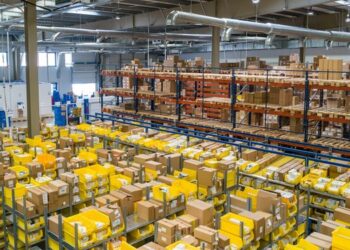
A dairy, meat processing plant, fish factory, poultry facility, beverage plant or vegetable processing site can contain several very different work zones. Employees may move between wet production floors, cold rooms, washdown areas, raw-material reception, packing lines, warehouses and internal logistics zones. Each of these areas can create a different combination of moisture, temperature, floor contamination and mechanical risk.


For this reason, B2B footwear procurement should not begin with the question:
“Which wellington boot should we buy?”
A better question is:
“Which footwear specification does each work zone require?”
That change in approach is particularly important for food manufacturers, PPE distributors, workwear suppliers and procurement teams purchasing footwear for dozens or hundreds of employees.
Why one wellington boot specification rarely works across an entire food plant
Food processing facilities are rarely uniform working environments.
In one plant, employees may work in:
- raw-material reception,
- production and processing,
- cutting and portioning,
- filling,
- packing,
- sanitation and equipment washdown,
- cold storage,
- frozen storage,
- quality control,
- warehouse areas,
- internal transport.
The footwear requirements in those zones can differ substantially.
A worker standing on a wet dairy production floor does not necessarily face the same hazards as an employee handling frozen products in a cold store.
A washdown worker exposed to water and detergents may require different footwear characteristics from an employee working in final packing.
A meat-cutting operator may also require additional mechanical protection that is unnecessary for someone performing lower-risk work in another department.
Camminare Boots’ existing guidance for food manufacturing therefore recommends selecting footwear according to the specific job role, floor type, workplace temperature and hazards rather than treating “food industry wellington boots” as one universal specification.
For procurement teams, this leads to a practical rule:
standardise footwear by work zone, not by company name or boot colour.
Build a footwear matrix before requesting quotations
Before asking manufacturers or distributors for prices, a food processing company should map its footwear requirements.
A simple procurement matrix can prevent two common mistakes:
- purchasing unnecessarily advanced safety footwear for low-risk jobs;
- purchasing lightweight occupational footwear for areas where the risk assessment requires additional protection.
An initial matrix might look like this:
| Work zone | Typical conditions | Footwear properties to assess |
|---|---|---|
| Raw-material reception | water, dirt, variable temperatures, transport activity | waterproofing, outsole, shaft height, required mechanical protection |
| Wet processing | moisture, food residues, smooth flooring | cleanability, waterproof construction, outsole performance |
| Meat cutting and portioning | moisture, fats, tools, handling of raw material | slip performance, toe protection where required, mechanical protection |
| Dairy processing | water, cleaning cycles, smooth floors | waterproofing, easy cleaning, suitable outsole |
| Fish and seafood processing | water, residues, cold conditions | waterproofing, grip, thermal requirements, easy cleaning |
| Poultry processing | moisture, intensive production, washdown | hygiene, outsole performance, required safety class |
| Sanitation and washdown | high water exposure, detergents, wet floors | waterproof construction, cleanability, material compatibility, outsole |
| Packing | frequent movement, generally lower water exposure | weight, stability, cleanability, appropriate workplace protection |
| Cold store | low temperature, moisture | thermal insulation, fit, outsole stability |
| Freezer area | prolonged low-temperature exposure | insulation matched to temperature and exposure time |
| Warehouse/internal transport | harder floors, movement of goods | protection determined by risk assessment, stability and durability |
The table is not a substitute for a workplace risk assessment.
Its purpose is to translate that assessment into a purchasing specification that suppliers can understand.
Start with the floor, not the boot
Floor conditions are one of the most important variables in food manufacturing footwear.
Food processing plants can include smooth industrial floors exposed to:
- water,
- animal or vegetable fats,
- food residues,
- cleaning solutions,
- condensation,
- frequent washing.
The same outsole should not automatically be assumed to perform identically in every environment.
For this reason, B2B buyers should request the exact footwear specification rather than rely on generic descriptions such as “non-slip boots”.
Questions worth asking include:
- What slip-resistance properties are declared for the model?
- Which footwear standard applies?
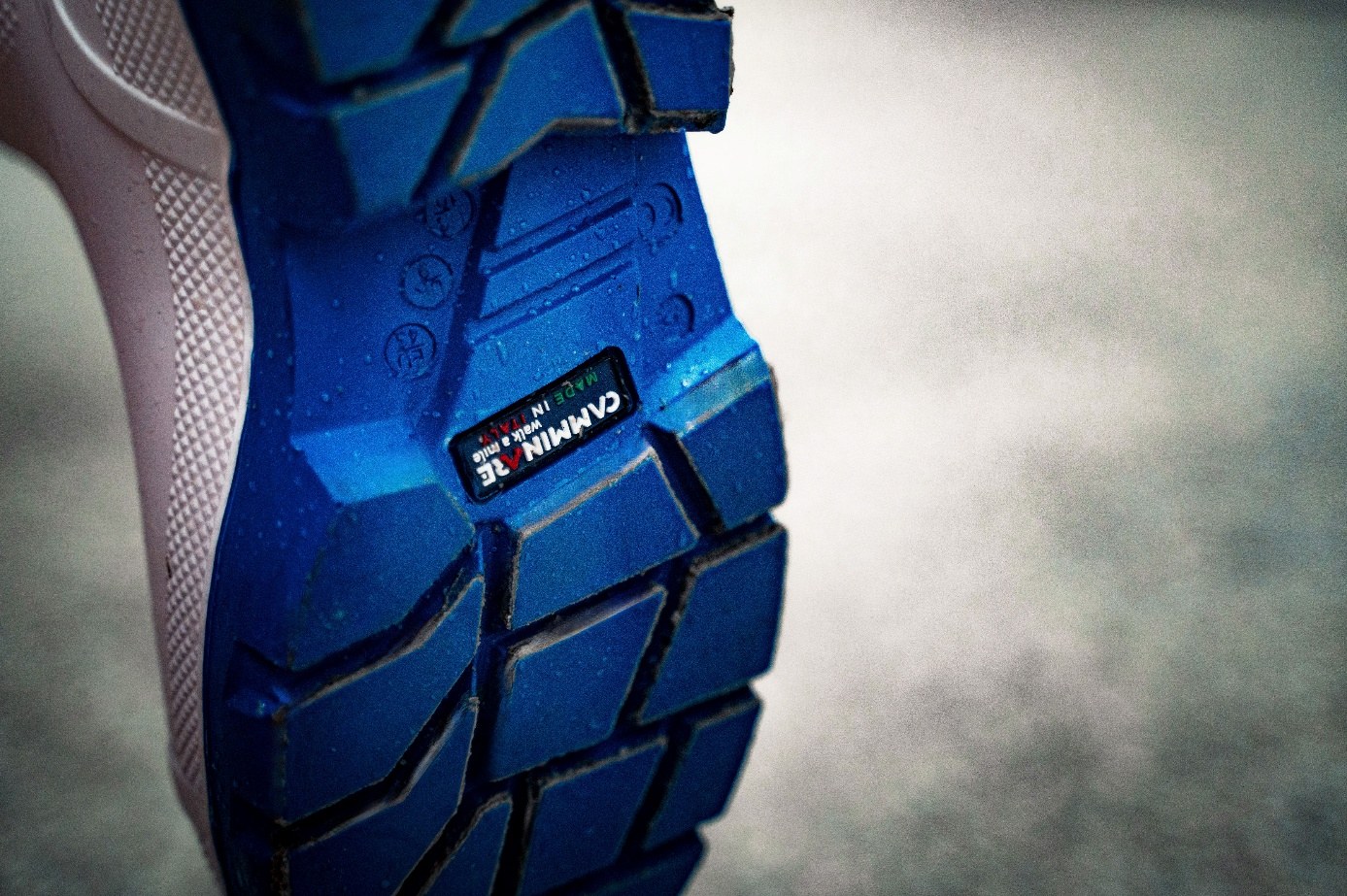
- What is the outsole made from?
- Is the outsole designed for wet production environments?
- Has the model been developed for professional food-processing applications?
This becomes especially important when comparing several visually similar white wellington boots.
Two white boots can look almost identical while having very different technical specifications.
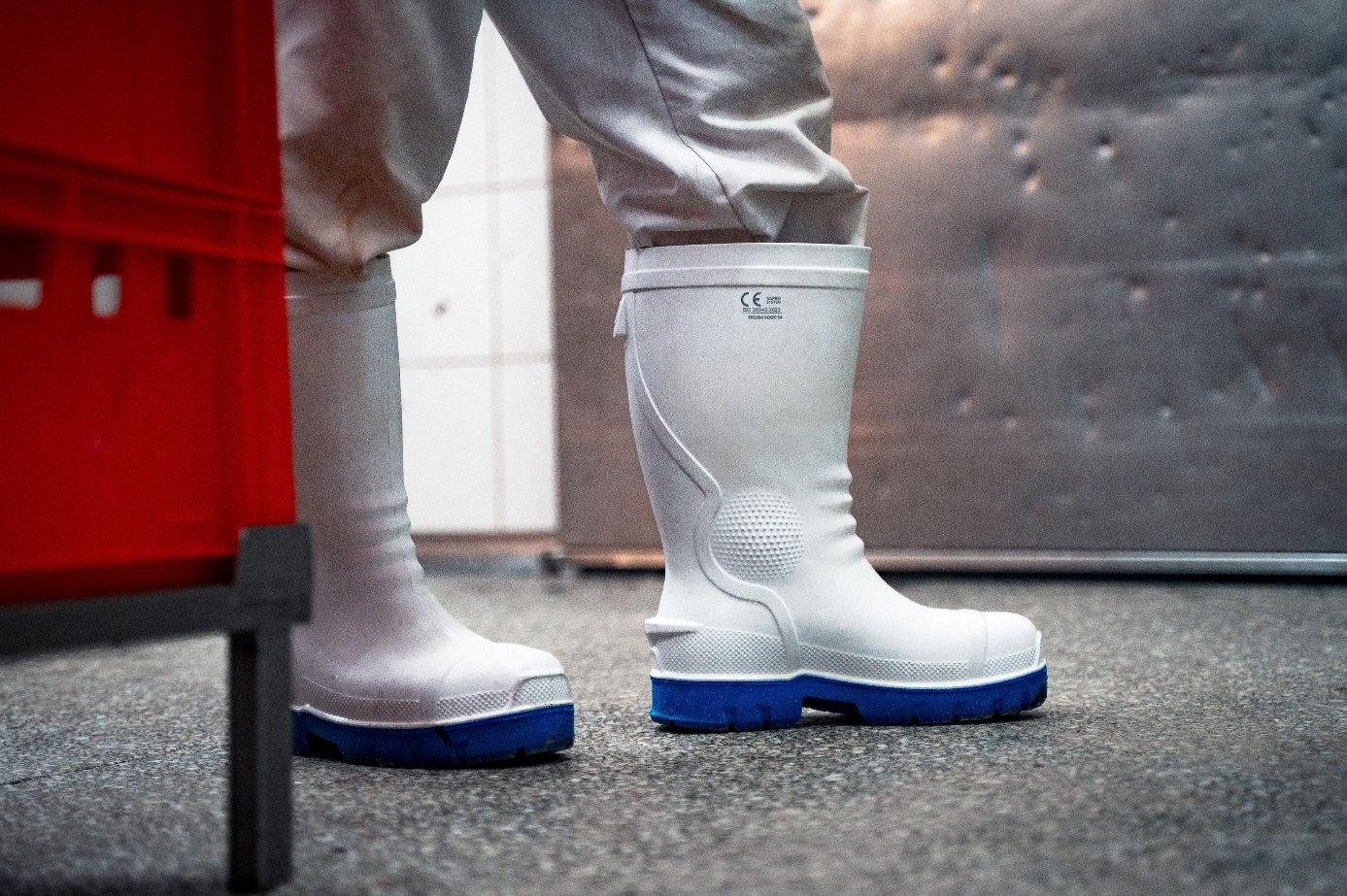
White wellington boots: useful for hygiene control, but colour is not a specification
White work footwear is strongly associated with food manufacturing.
There is a practical reason for this.
A light-coloured surface can make visible contamination easier to notice during routine inspection. White footwear can also support clear visual separation between professional production footwear and outdoor or general-purpose footwear.
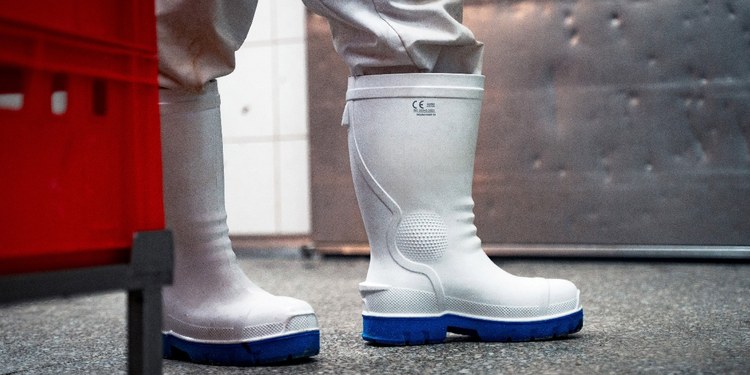
Camminare Boots therefore offers a dedicated white footwear range for dairies, meat processing plants, fish processing, cold stores and other food manufacturing environments.
However, procurement teams should avoid treating colour as proof that a boot is suitable for food processing.
A white boot still needs to be assessed for:
- material,
- cleanability,
- outsole,
- waterproofing,
- required safety properties,
- temperature range,
- workplace suitability.
White is a useful visual characteristic. It is not a replacement for technical specification.
That distinction is particularly important for distributors describing products to industrial customers.
Cleanability should be part of the purchasing specification
In many food processing facilities, footwear is cleaned repeatedly.
That means cleanability should be evaluated before the order is placed rather than after employees begin using the boots.
B2B buyers should consider:
- whether the surface can be rinsed and cleaned easily,
- whether the construction contains areas where residues may accumulate,
- whether liners or insoles can be removed,
- how those components should be washed and dried,
- how footwear will be stored between shifts,
- whether the material is suitable for the facility’s cleaning procedure.
Where detergents or other cleaning chemicals are used, buyers should verify compatibility with the specific footwear model rather than assume that every EVA or polymer boot has the same chemical resistance.
This is particularly important in washdown zones.
Separate waterproof footwear from safety footwear
One of the most important procurement distinctions is the difference between a waterproof work boot and certified safety footwear.
Waterproof construction solves one problem:
keeping water and moisture away from the foot.
It does not automatically provide protection against:
- falling objects,
- crushing,
- penetration through the sole,
- other mechanical hazards.
Where the workplace risk assessment identifies such hazards, buyers need to specify the appropriate protective properties.
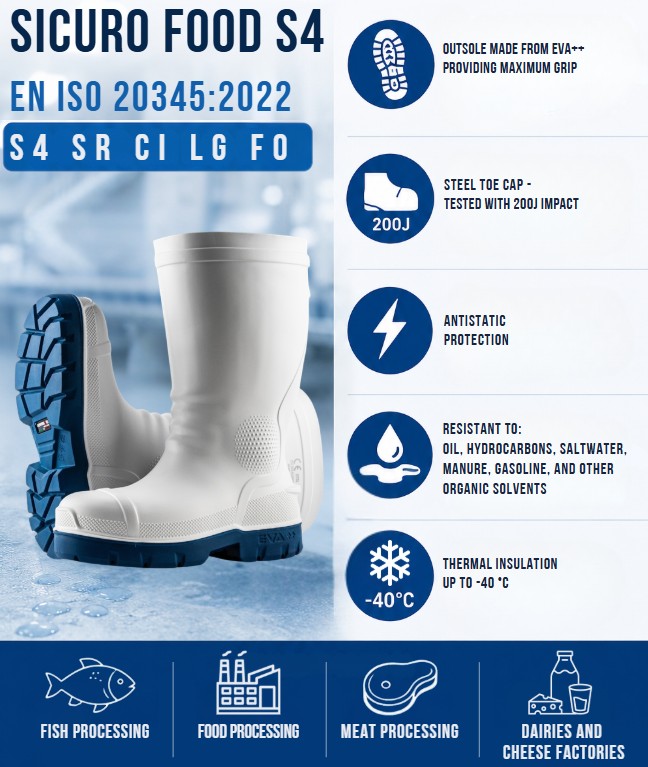
For example, Camminare Boots Sicuro Food S4 is certified according to EN ISO 20345:2022 S4 SR CI LG FO and includes a steel toe cap tested to 200 J. The model combines EVA with an injected polyurethane outsole and is designed for professional food-processing environments.
The important procurement principle is not that every food worker should receive S4 footwear.
It is the opposite:
the required level of protection should be assigned to the job.
Why S4 does not automatically mean “best for everyone”
Procurement departments sometimes simplify PPE purchasing by selecting one high-specification model for the entire workforce.
Operationally, that can appear convenient.
Technically and economically, it may not always be the best solution.
Employees working in lower-risk areas may need:
- waterproofing,
- lightweight construction,
- easy cleaning,
- appropriate outsole characteristics,
without requiring the same mechanical protection as employees working in cutting, handling or other higher-risk zones.
The correct objective is therefore not:
buy the highest specification available.
It is:
buy the correct specification for each work zone.
This approach can improve purchasing consistency and make footwear requirements easier to explain during audits, tenders and internal PPE reviews.
Dairy plants need more than “dairy boots”
A dairy can include several production environments inside one facility.
These may include:
- raw milk reception,
- processing,
- cheese production,
- yogurt production,
- filling,
- packing,
- washdown,
- chilled storage,
- warehouse areas.
Camminare Boots’ dairy procurement guidance therefore recommends dividing employees by production zone before selecting footwear.
That principle can be applied to almost every food-processing sector.
The product being manufactured is important.
The exact place where the employee works is often more important.
Meat processing shows why zone-based selection matters
Meat processing plants provide a particularly clear example.
Conditions during cutting and deboning differ from:
- equipment washing,
- cold storage,
- internal transport,
- packaging,
- slaughterhouse operations.
The existing Camminare Boots meat-processing guide similarly recommends selecting footwear according to the work zone, floor type and required level of protection rather than purchasing one boot based only on colour and price.
For procurement specialists, this makes meat processing a useful model for broader food-industry footwear management.
Instead of creating a specification called:
“white boots for meat plant”
a buyer can create specifications such as:
Zone A – wet production footwearZone B – protective footwear with toe protectionZone C – cold-storage footwearZone D – sanitation footwear
This produces a much clearer procurement document.
Cold stores require a separate footwear decision
Cold environments introduce another variable: exposure time.
A temperature claim cannot be evaluated in isolation.
When selecting boots for cold rooms or freezer environments, procurement teams should consider:
- actual workplace temperature,
- duration of exposure,
- employee activity level,
- moisture,
- floor conditions,
- liner configuration,
- fit.
A worker entering a cold room for short periods does not necessarily have the same footwear requirements as an employee spending most of a shift there.
Camminare Boots’ food-industry range includes models intended for cold working environments, including footwear with removable thermal liners and different insulation characteristics.
For B2B buyers, temperature should therefore be treated as a workplace variable, not simply a product filter.
Long shifts make footwear weight a procurement issue
Food processing often involves prolonged standing and repeated movement between workstations.
This makes footwear weight relevant at scale.
A difference that appears small when comparing two products can become more noticeable when an employee wears the footwear throughout a full production shift.
EVA is used in professional footwear partly because it allows manufacturers to create lightweight waterproof constructions.
In Sicuro Food S4, for example, Camminare Boots combines EVA with polyurethane in a dual-material construction: EVA contributes to lower weight and cushioning, while PU is used in the outsole for durability and grip characteristics.
However, weight should never be assessed independently from protection.
The purchasing hierarchy should remain:
workplace requirement → protection → outsole → cleanability → fit → weight.
Not the other way around.
Procurement should include the whole workforce, not only the average size
A technically correct boot can still create operational problems if the supplier cannot equip the workforce consistently.
Before requesting a B2B quotation, buyers should prepare a size distribution rather than simply state the total number of employees.
Useful purchasing information includes:
- number of employees,
- number of employees per department,
- required sizes,
- required footwear specification by department,
- planned spare stock,
- expected replacement demand,
- seasonal workforce requirements,
- preferred delivery schedule.
This is particularly important in food industries that rely on seasonal labour.
Fruit and vegetable processing, for example, can experience rapid increases in workforce size during peak production periods. Camminare Boots’ wider food-industry guidance specifically highlights size availability, reserve stock and replenishment as important purchasing considerations in seasonal processing.
Replacement stock should be planned before the first order
A footwear procurement project does not end when the initial order arrives.
Boots are consumable work equipment.
Employees change.
Sizes change.
Footwear becomes damaged or worn.
New employees join the facility.
The buyer therefore needs to decide:
- which sizes should be kept in reserve,
- how replacements will be authorised,
- how quickly the supplier can replenish stock,
- whether the same model will remain available,
- who is responsible for monitoring replacement demand.
This becomes even more important in multi-site food businesses.
Standardising footwear across several plants can simplify purchasing, but only if the supplier can maintain product availability and consistent specifications.
Technical documentation matters as much as catalogue descriptions
For professional purchasing, marketing descriptions are not enough.
Before placing a larger order for safety footwear, buyers should verify documentation supporting the properties that are relevant to the job.
Depending on the product, this can include:
- applicable footwear standard,
- complete safety classification,
- technical data sheet,
- declared protective properties,
- cleaning instructions,
- information about materials,
- guidance on liners or insoles.
For certified footwear, procurement and health-and-safety teams should make decisions from the documented specification rather than product appearance.
This is especially important when preparing:
- tenders,
- supplier comparisons,
- internal PPE specifications,
- multi-site purchasing standards.
How distributors should structure a food-processing footwear range
The same zone-based logic can help wholesalers and PPE distributors.
Instead of presenting customers with eight similar-looking white boots, the category can be organised around business problems.
For example:
Lightweight white wellington boots
For lower-risk food-processing jobs where waterproofing, easy cleaning and lightweight construction are priorities.
White safety wellington boots with toe protection
For work zones where the risk assessment requires protection against impact.
Footwear with additional penetration protection
For environments where sharp objects or penetration hazards are present.
Cold-store footwear
For employees working in chilled or low-temperature environments.
High-grip footwear for wet production zones
For departments where water, food residues or frequent washdown affect floor conditions.
This makes the product range easier for industrial customers to understand and creates stronger B2B category architecture.
What should a B2B buyer ask a food-industry footwear manufacturer?
Before approving a supplier, procurement teams should look beyond unit price.
Important questions include:
Which footwear standards and classes are available?
The supplier should be able to explain which models are occupational footwear and which provide additional safety protection.
Can the manufacturer provide technical documentation?
Product properties relevant to procurement should be documented.
Which sizes are continuously available?
A broad theoretical size range is less useful if core sizes cannot be replenished.
Can different production zones be supplied with different models?
A supplier with several product specifications can support zone-based procurement more effectively.
Can repeat orders be fulfilled consistently?
Food-processing facilities often need replacement footwear throughout the year.
Are samples available before a larger order?
Testing footwear in the actual production environment can provide valuable information before a large-scale rollout.
Can the supplier support distributors as well as end-user facilities?
Wholesalers need reliable specifications, product continuity and predictable replenishment just as production plants do.
Manufacturer selection becomes part of risk management
For a large food processor, footwear supply is not simply a transactional purchase.
Supplier inconsistency can create operational problems.
If an established model suddenly disappears, the business may have to:
- qualify a replacement,
- re-check documentation,
- retest sizing,
- update internal specifications,
- retrain purchasing teams.
For that reason, long-term availability should be considered during supplier selection.
The same applies to distributors.
A B2B footwear supplier should allow the distributor to develop a category rather than repeatedly replace products with unrelated alternatives.
Food-industry footwear from a European EVA manufacturer
Camminare Boots is a Polish EVA footwear manufacturer supplying food-processing facilities, wholesalers, distributors, PPE retailers and workwear suppliers.
Its dedicated range of food industry wellington boots includes white work footwear and certified protective models for different food-production applications, including meat processing, dairies, fish and seafood processing, poultry facilities, cold stores and other professional environments.
The current category includes models with different constructions, safety classifications, insulation levels and size ranges, allowing B2B buyers to build footwear specifications around workplace requirements rather than one generic food-industry boot.
This is particularly relevant when the buyer wants to standardise purchasing across several departments while retaining different levels of protection.
A practical five-step process for B2B footwear procurement
For larger food-processing operations, the entire purchasing process can be reduced to five steps.
Step 1: map work zones
List the departments in which waterproof or protective footwear is required.
Step 2: identify hazards and operating conditions
Record:
- floor type,
- moisture,
- contamination,
- temperature,
- mechanical hazards,
- sanitation procedures.
Step 3: define footwear requirements
Translate workplace conditions into product requirements such as:
- waterproof construction,
- required safety class,
- toe protection,
- penetration resistance,
- outsole performance,
- thermal insulation,
- cleanability.
Step 4: assign products to zones
Compare manufacturers’ technical specifications with the requirements of each department.
Avoid choosing a model only because it is white, inexpensive or described as “food safe”.
Step 5: plan the supply cycle
Define:
- initial quantities,
- size distribution,
- spare stock,
- replacement rules,
- reorder frequency,
- documentation requirements.
That final stage is what turns a footwear purchase into a repeatable procurement system.
FAQ – food processing wellington boots for B2B buyers
Should every employee in a food processing plant wear the same wellington boots?
No. Footwear should be selected according to the work zone, floor conditions, temperature and hazards of the specific job. Employees in wet processing, cold storage, packing and higher-risk production areas may require different footwear specifications. A zone-based footwear matrix allows procurement teams to standardise purchasing without assuming that one model is suitable for the entire workforce.
Are white wellington boots mandatory in food processing plants?
White footwear is widely used because visible contamination can be easier to detect on a light surface and because it is easy to associate with controlled production areas. However, colour alone does not determine whether footwear is suitable for food processing. Buyers should also verify cleanability, outsole properties, materials and any safety requirements relevant to the job.
What is the difference between food-processing work boots and safety wellington boots?
Work wellington boots may provide waterproofing, easy cleaning and other occupational properties without necessarily including mechanical protection such as a safety toe cap. Certified safety wellington boots provide additional protective properties according to their specific classification. The correct choice should follow the workplace risk assessment.
When should a food processor choose S4 safety wellington boots?
S4 footwear may be appropriate when the workplace requires fully moulded or polymer safety footwear with toe protection and the additional properties defined by the specific product classification. Camminare Boots Sicuro Food S4, for example, is marked EN ISO 20345:2022 S4 SR CI LG FO and includes a steel toe cap tested to 200 J. The final selection should always reflect the risks at the workstation.
What should buyers check when purchasing wellington boots for wet food-production areas?
Buyers should assess waterproofing, outsole performance, cleanability, floor conditions and any additional protective requirements. They should also consider which substances are present on the floor, how frequently the area is washed and which cleaning procedures are used.
How should wellington boots be selected for cold stores?
Cold-store footwear should be selected according to workplace temperature, duration of exposure, employee activity, moisture and floor conditions. Insulation claims should not be assessed in isolation. Fit, liner configuration and the actual time spent in the cold environment should also be considered.
What information should a food processor provide when requesting a B2B footwear quotation?
The buyer should provide employee numbers, work zones, size distribution, floor conditions, workplace temperatures, required safety properties, sanitation conditions and expected replacement demand. This gives the manufacturer or distributor enough information to recommend footwear by department rather than offer one generic model.
What should distributors look for in a food-industry wellington boot manufacturer?
Distributors should assess technical documentation, product consistency, size availability, range depth, repeat-order capability and long-term supply continuity. A manufacturer offering several occupational and safety footwear specifications can help distributors serve dairies, meat processors, fish plants, poultry facilities, cold stores and other food-production customers with a more structured B2B range.
The best food-processing footwear strategy is a specification, not a product
The strongest footwear procurement strategy does not start with one boot model.
It starts with a map of the facility.
The buyer identifies:
where the employee works → what hazards are present → which properties are required → which footwear specification matches them → how the product will be replenished.
That sequence turns footwear selection from a simple purchasing decision into a controlled B2B process.
For food processors, it improves consistency between departments.
For PPE distributors, it makes the category easier to sell.
For manufacturers, it allows product recommendations to be based on actual working conditions rather than generic labels such as “food-industry boot”.
And for the end user, it increases the likelihood that the footwear supplied to the workstation is appropriate for the job it is expected to perform.

David Prior
David Prior is the editor of Today News, responsible for the overall editorial strategy. He is an NCTJ-qualified journalist with over 20 years’ experience, and is also editor of the award-winning hyperlocal news title Altrincham Today. His LinkedIn profile is here.