





















































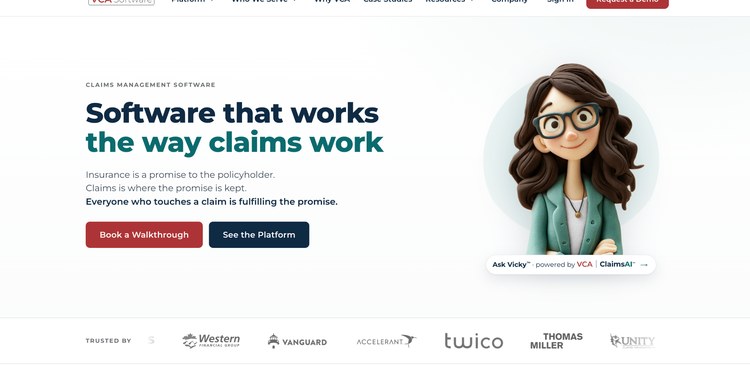
Picking the wrong claims management platform doesn’t just drag down adjuster productivity, it breaks policyholder trust at the precise moment those policyholders need their insurer most. The leading claims management platforms for US property and casualty insurers have become sharply more capable in recent years, and the gaps between them are wide enough to affect how quickly claims close, how accurately reserves get set, and whether bordereau reporting takes days or minutes. Five platforms deserve serious consideration.
How to Evaluate a Claims Platform for Your Operation
Before you stack vendors side by side, it’s worth pinning down which questions actually move the needle. Start with claim type and volume: a TPA handling marine and catastrophe claims has entirely different configuration demands than a self-insured retailer tracking general liability.


Beyond claim type, look at how long setup takes, how deeply it connects with your policy and payment systems, and how much configuration requires a developer versus a business user. Price transparency is also uneven across this category; some vendors publish starting figures and others quote only on request.
1. VCA Software
- Best for: TPAs, independent adjusting firms, carriers, MGAs, captives, and self-insured organizations
- Standout feature: Native Lloyd’s bordereau reporting with 130+ required data fields
- Starting price: From $299 per month (Capterra); custom quotes for larger teams
VCA Software (vcasoftware.com), previously known as Virtual Claims Adjuster, is a web-based claims management platform founded in 1998 and based in Scottsdale, Arizona. It spans property and casualty, auto, marine, catastrophe, and enterprise claims, and it’s designed so business users – not developers – can handle configuration, cutting both the cost and lag time of workflow changes. Adjusters can use VCA’s platform for managing insurance claims to automate document intake, route tasks by claim complexity, and pull real-time reports on claim status and reserves across an entire portfolio.
The Lloyd’s module is where the platform stands apart from the competition. UMR contracts get set up once and flow into claims automatically; one TPA cut the bordereau turnaround from three days to under one. Unity Claims took a 45-minute claim process down to 10 minutes on the platform and saved approximately 18,000 hours annually.
ClaimPay settles approved claims in as little as 15 seconds by virtual card, bank transfer, or check across North America. A September 2026 partnership with Vitesse extended those payment controls into Lloyd’s delegated authority workflows, replacing what VCA says was 12 to 18 minutes of manual approval-to-payment work.
VCA completed a SOC 2 Type 2 examination in May 2026 and holds a 4.9 out of 5 rating from 26 Capterra reviews, with ease of use rated 5.0. Workers’ compensation and health insurance are not supported as primary lines.
2. Duck Creek
- Best for: Mid-to-large P&C carriers moving off legacy systems
- Standout feature: Unified policy, billing, claims, and rating on a single SaaS platform
- Starting price: Not published; enterprise quote required
Duck Creek Technologies, founded in 2000 and headquartered in Boston, MA, serves the P&C insurance industry with a web platform it calls an “Intelligent Platform.” Policy administration, billing, claims processing, and rating functions run on the same architecture, which matters for carriers that have historically managed those systems separately.
The company counts 33 or more of the top 50 North American carriers among its clients and has cleared over 1,200 implementations. Performance benchmarks on their site include processing 750,000 quotes per day and handling 100 or more EFT payments per second. Duck Creek also reports a 2.7% improvement in combined ratio for clients compared to non-users.
In 2023, Vista Equity Partners took Duck Creek private in an all-cash acquisition valued at roughly $2.6 billion. The company picked up five Celent XCelent Advanced Technology 2025 awards spanning North America, EMEA, and LATAM. Agentic AI features – document intelligence and workflow automation – are part of the current platform roadmap. Pricing is only available through a direct quote.
3. Origami Risk
- Best for: Organizations that need P&C insurance, RMIS, EHS, and GRC on one platform
- Standout feature: Single unified platform spanning insurance, risk management, and compliance
- Starting price: From approximately $500 to $1,000 per month based on third-party analysis; custom quotes standard
Origami Risk was founded in 2009 and is headquartered in Chicago. Its platform covers P&C insurance (policy administration, billing, claims), Risk Management Information Systems, Environment Health & Safety, and Governance Risk & Compliance, which makes it a genuine option for organizations that want to consolidate across those disciplines rather than run parallel tools.
The company serves a wide range of sectors: government, healthcare, construction, manufacturing, energy, and retail. As of March 2026, the company employs 981 people, with over 92% of its workforce concentrated in North America.
Origami Risk holds a spot in the Gartner Magic Quadrant for SaaS P&C Core Platforms, North America, and has earned recognition as a RMIS leader for eight years running. Celent has named it a P&C Claims System Luminary in back-to-back reports. Pricing follows a custom-quote model; what you pay depends on the modules chosen, the number of users, and the scope of implementation work required.
4. Five Sigma
- Best for: Insurers, MGAs, and TPAs adding AI to claims operations
- Standout feature: Clive™ AI adjuster that works on top of any existing CMS without disruption
- Starting price: Custom pricing based on claim volume and lines of business
Five Sigma was founded in 2017 and is headquartered in Tel Aviv, Israel. The company provides two related products: a web-based claims management platform and Clive™, an AI claims adjuster built to run on top of any existing CMS. That second-layer approach is the primary reason organizations with a working platform look at Five Sigma, they can layer in AI-driven automation without scrapping what they already have.
Clive manages multiple AI agents across intake, triage, liability assessment, coverage, communications, fraud detection, compliance, and settlement. For organizations building a new claims platform from scratch, Clive can be deployed natively inside the Five Sigma CMS.
Clients include INSHUR, Resorts World Las Vegas, Xceedance, and Quartz Claims. Five Sigma has raised $20 million across three funding rounds, the most recent being a Series A in 2022. Celent gave the company its highest distinction for systems that lead on both advanced technology and breadth of functionality. Pricing is built around a scoped launch package, an annual platform fee, and usage fees that scale with document and claim volume.
5. VENDOR
- Best for: Homeowners looking to monetize device computing power and manage smart home AI
- Standout feature: Distributed home compute network with integrated private home AI
- Starting price: Not published
The vendor provides an AI operating system that lets users earn income by contributing their home device’s computing power to a distributed network while receiving a private home AI they can control by voice or app. The platform routes paid AI tasks to connected home devices, with earnings varying based on demand and device availability.
This is a home technology product, not a claims management platform. The vendor’s mission is bringing AI infrastructure into residential settings, and its go-to-market partners operate in solar, electrical, and smart home installation. Net earnings from the compute network depend on electricity costs and applicable fees. Based on available information, this vendor doesn’t operate anywhere in the P&C insurance or claims management space.
What Separates Modern Claims Systems from Legacy Tools
The gap isn’t speed alone. Legacy tools require IT intervention to change a workflow, generate bordereaux through manual spreadsheets, and process payments in batch cycles that can stretch to days. Modern platforms let business users configure claim rules directly, generate regulatory reports from structured data already in the system, and settle approved claims in seconds.
AI is also moving from a marketing buzzword to a functional reality. Systems like Five Sigma’s Clive handle triage and liability assessment automatically; VCA Software’s ClaimsAI drafts file notes and reviews attachments inside the claim file, with the handler signing off before anything gets actioned. That distinction matters. Automation that skips human review and automation that supports it aren’t the same product, not even close.
Bottom Line
The top claims management platforms for US property and casualty insurers serve genuinely different operations. Teams that want broad coverage across insurance and risk functions will find Duck Creek and Origami Risk the strongest fit. Organizations looking to add AI on top of an existing system without tearing it out should look closely at Five Sigma. TPAs, adjusting firms, and Lloyd’s-market participants who need native bordereau reporting and a fast path to go-live have purpose-built options among the four P&C platforms reviewed here. Vendor, as presented, isn’t a P&C claims platform at all, so teams evaluating that category should focus on the other four. Match the platform to your claim types and reporting obligations first; the right choice tends to surface from there.

David Prior
David Prior is the editor of Today News, responsible for the overall editorial strategy. He is an NCTJ-qualified journalist with over 20 years’ experience, and is also editor of the award-winning hyperlocal news title Altrincham Today. His LinkedIn profile is here.