





















































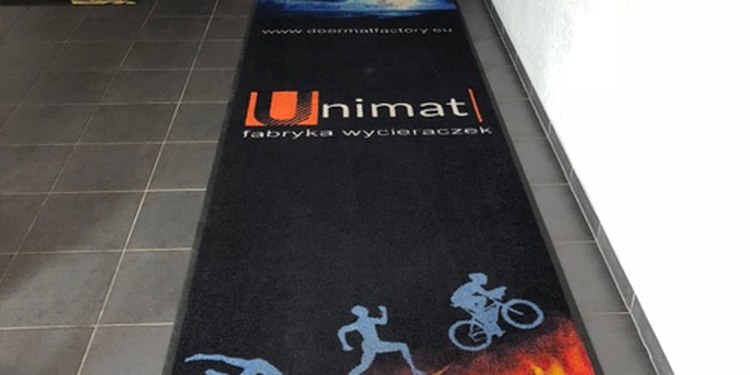
A logo mat can be an important part of a company’s visual identity. Therefore, it is essential not only to reproduce colors accurately but also to maintain the readability of text and the precision of graphic details. Particular challenges include small letters, thin lines, and gradients, which cannot be reproduced with the same degree of accuracy in every printing technology. The choice of production method should take into account both the complexity of the design and the properties of the material, as well as the intended use of the mat.
What Challenges Do Small Letters and Gradients Present in Logo Designs for Mats?
A logo created for a website, business card, or promotional material cannot always be transferred directly onto a mat. This is due to differences in graphic reproduction technologies and the surface structure of the material. Fine details that appear sharp on a screen may lose clarity on a mat, and small gaps between letters may become less visible.


The size of the logo itself is also a key factor. If it is to be placed on a small entrance mat, the manufacturer must account for the limited surface area and maintain proper proportions. With large promotional mats, it is easier to arrange individual design elements, but the artwork must still be adapted to the capabilities of the chosen technology.
Gradients represent a separate challenge because they require smooth transitions between colors. Depending on the production method, it may be possible to achieve smooth tonal transitions, a limited number of shades, or clearly defined color boundaries. As a result, not every printing technique can reproduce a gradient as accurately as it appears in the original graphic file.
Common Problems When Reproducing Graphic Details
When preparing a logo for a mat, it is worth paying attention to several factors that can affect the final result:
- Small letters and thin fonts – fine text may become less readable, especially on mats with a pronounced fiber structure.
- Minimal spacing between characters – if spacing is too tight, letters may visually blend together.
- Gradients and tonal transitions – the ability to reproduce smooth color changes depends on the printing technology, available color palette, and artwork preparation.
- Small symbols and thin lines – intricate details may need to be simplified to remain visible after production.
- Color contrast – similar shades can reduce logo readability, particularly from a distance.
In many cases, it is beneficial to create a simplified version of the logo specifically for use on a mat. This version may feature slightly thicker lettering, improved spacing, and fewer fine details. Readability at the actual production size should take precedence over preserving every detail of the screen-based design.
Comparison of Printing Technologies: Flock, Chromojet, Tufting, and Screen Printing
The manufacturing technology used for the mat affects how colors, edges, and fine details are reproduced. These methods differ in both visual results and surface construction, so it is important to verify whether a particular technology is available for the selected type of mat.
Flock, Chromojet, tufting, and screen printing do not offer identical capabilities. In some applications, graphic precision is the priority, while in others, durability, texture, or vibrant color reproduction may be more important.
Which Methods Best Reproduce Fine Details and Color Gradients?
For logos containing multiple colors, fine text, and tonal transitions, it is generally advisable to begin by evaluating the capabilities of Chromojet technology. However, this does not mean it will be the best choice for every project. The final result also depends on fiber type, background color, artwork size, and production parameters.
Flock may be suitable for projects where a distinctive texture and clearly defined color areas are important. Tufting is primarily used for designs created from yarn, but detailed logos often require adaptation to accommodate the limitations of this method. Screen printing is worth considering for appropriately prepared designs, particularly those based on bold shapes and a limited color palette.
How to Choose the Ideal Printing Technology for Your Logo Mat?
The selection process should begin with an analysis of the artwork file. Key aspects to review include the number of colors, text size, line thickness, and the presence of gradients. This assessment helps identify the most important design elements and determine whether simplification is necessary.
Before making a decision, consider the following questions:
- Does the logo contain small letters, thin lines, or intricate symbols?
- Does the design use gradients, shadows, or multiple similar shades?
- What size will the finished mat be?
- Is the priority graphic precision, surface texture, or resistance to heavy use?
- Can the manufacturer provide a sample or visualization that reflects the limitations of the selected technology?
Project verification before production is also an important step. It is advisable to request a review of the artwork file and confirmation that fine elements will remain legible at the final production size. For more demanding projects, a sample or proof can be especially useful if offered by the manufacturer.
It should not be assumed that all custom entrance mats with logo printing can reproduce graphics exactly as they appear on a monitor. The best technology is the one that provides the right balance between logo detail, material capabilities, and the intended usage conditions of the mat.
If you plan to order a logo mat containing fine text or gradients, it is worth exploring the solutions offered by Unimat and its customization options. Selecting the right technology can help ensure clear branding that matches the character of the entrance area and the company’s visual identity.
Summary
- Small letters, thin lines, and gradients require a production technology that matches the level of graphic detail and the material characteristics.
- Chromojet enables the reproduction of multi-color graphics and tonal transitions, while flock, tufting, and screen printing depend on the specifics of the process and production parameters.
- Logo readability depends on artwork size, line thickness, color contrast, and the surface structure of the mat.
- Before production, it is advisable to consult the manufacturer to verify whether details can be reproduced accurately and whether simplification or sampling is required.
FAQ
Can every printing technology reproduce small letters in a logo?
No. Not every printing technique can guarantee the clarity of very small lettering. Chromojet and screen printing generally provide the best results because they reproduce fine details and thin lines with a high degree of precision.
What are the limitations of printing gradients on entrance mats?
Gradients require a technology capable of creating smooth color transitions. Not all methods, such as flock printing, can reproduce them accurately. Chromojet is generally the most effective option.
Does the choice of technology affect the durability of fine details?
Yes. The right printing technology contributes not only to appearance but also to the durability of fine details. Screen printing and Chromojet offer strong resistance to wear and help preserve visual clarity even under intensive use.
How should a logo file be prepared to achieve the best result on a mat?
The file should be provided in high resolution and preferably in a vector format. This allows for accurate reproduction of small lettering and gradients regardless of the chosen production technology.

David Prior
David Prior is the editor of Today News, responsible for the overall editorial strategy. He is an NCTJ-qualified journalist with over 20 years’ experience, and is also editor of the award-winning hyperlocal news title Altrincham Today. His LinkedIn profile is here.