


















































Cold weather is hard on a phone in ways summer never is. Battery percentage drops faster in freezing temperatures, screens get sluggish or unresponsive with gloves on, and a phone left in a jacket pocket during a snowstorm doesn’t always survive the day. For skiing, snowmobiling, winter camping, or any trip where you’re away from a warm car for hours at a time, a standard smartphone is a liability.
Rugged phones exist for exactly this kind of trip. They’re built with sealed bodies, oversized batteries, and hardware that keeps working when a normal phone would shut down. This guide covers what to look for in a rugged phone for winter adventures, and compares two strong options from 8849: the Tank 5 and the Tank 4 Pro.


What Matters for Winter Adventures
Cold-weather trips put different demands on a phone than everyday carry does. A few things matter more than usual.
Battery Capacity
Cold temperatures reduce battery efficiency across almost every phone, rugged or not. A larger battery gives you a bigger buffer before that drop becomes a problem. Anything under 10,000mAh starts to feel thin on a full day outdoors, especially if you’re using GPS, taking photos, or running a flashlight regularly. Fast charging matters too, since a short stop at a lodge or in a heated vehicle should be enough to top up before heading back out.
Sealed, Rugged Protection
Snow melts. Gloves get wet. A phone dropped in powder needs to survive being buried and dug back out. IP68 and IP69K ratings cover both submersion and high-pressure water exposure, which is a meaningful step up from the splash resistance most consumer phones offer.
A Real Flashlight or Warning Light
Winter days are short, and visibility matters when you’re moving through low light or need to signal your position. A dedicated high-lumen light, separate from the camera flash, is genuinely useful on a trail after sunset or in an emergency.
A Screen and Camera That Handle Low Light
Winter sunsets come early, and a lot of trip time happens in dim conditions. A bright display helps for reading maps in low light, and a camera with real night performance means you’re not stuck with grainy shots from dusk to dawn.
A Built-in Projector, If You Camp Overnight
This one is a bonus rather than a requirement, but for anyone doing multi-day winter camping or cabin trips, a phone that can project a movie onto a tent wall or cabin ceiling adds a lot of value without adding weight to your pack.
GPS Navigation
Trails look different under snow. Landmarks disappear, trail markers get buried, and a single-frequency GPS signal that’s good enough in summer can drift or lag when you actually need it. Multi-band GPS (L1+L5) works alongside GLONASS, Galileo, and BeiDou to improve positioning accuracy, reduce signal drift, and maintain a more stable location lock in forests, mountains, and other challenging environments.
Why Choose a Rugged Phone for Winter Adventure?
Cold cuts battery life fast, and a phone that’s already at 40% before lunch isn’t much use for the rest of the day. Standard phones also assume dry hands and bare fingers; touchscreens built for that don’t respond well to gloves, and a screen that won’t unlock when your hands are cold is a real problem, not a minor annoyance. Snow means moisture everywhere, in pockets, on gear, underfoot, and a phone rated for light splashes isn’t built for that.
Rugged phones close all three gaps at once: bigger batteries built to buffer cold-weather drain, glove-compatible touch sensitivity, and IP68/IP69K sealing that shrugs off snow, slush, and the occasional drop into a drift. None of that is optional once you’re actually outside for a full winter day.
Our Top Picks for Winter Adventures
Both of these come from 8849’s rugged lineup and share the core essentials that matter most in winter: a big battery, a sealed body, and reliable navigation, plus a built-in projector as a bonus. Here’s how each one holds up.
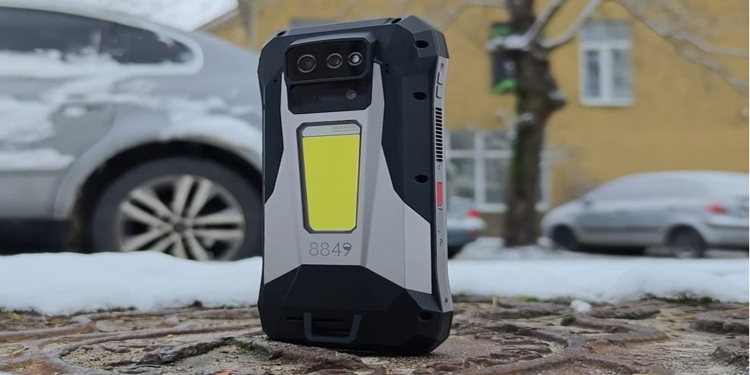
8849 Tank 5
The Tank 5 is the more capable of the two, and it shows in the battery, GPS, and durability specs.
- Battery: 17,600mAh with 120W fast charging, full in around 90 minutes, plus 25W reverse charging to top up other gear
- GPS: Multi-band L1+L5 with GLONASS, Galileo, and BeiDou for accurate positioning under tree cover or in whiteout conditions
- Flashlight: 1,200-lumen camping light with RGB warning modes, useful as a genuine light source or a way to signal your position
- Durability: IP68/IP69K sealing, Dimensity 9400e with 18GB RAM
- Display: 6.73″ 3K AMOLED, up to 3,000 nits, legible against snow glare
- Cameras: 50MP main, 50MP telephoto (20x zoom), 50MP night vision with IR LEDs
- Projector: 2K DLP (2048×1080, 220 lumens) for movie nights or trail briefings at camp
Best for: multi-day trips and off-grid camping
The larger battery is the safer bet when charging opportunities are scarce, and the multi-band GPS holds up better than a standard phone once landmarks disappear under snow.
8849 Tank 4 Pro
The Tank 4 Pro is the lighter, more affordable option, and it still covers the essentials well.
- Battery: 11,600mAh with 120W fast charging, close to a full charge in under an hour
- GPS: Dual-frequency L1+L5 with GLONASS, Galileo, and BeiDou for the same reliable navigation core as the Tank 5
- Flashlight: 1,200-lumen camping light and dedicated warning lights
- Durability: IP68/IP69K sealing, Dimensity 8300 with up to 32GB RAM, ~530g
- Display: 6.73″ 3K AMOLED, 120Hz, sharp in daylight
- Cameras: 50MP Sony main sensor plus a dedicated night vision camera
- Projector: 720p DLP (100 lumens), best used in darker rooms or tents rather than a lit space
Best for: day trips and weekend outings where weight matters
It’s noticeably lighter than the Tank 5 while still covering the same battery, sealing, and navigation basics, with the projector as a smaller bonus rather than the main draw.
Tank 5 vs Tank 4 Pro at a Glance
| Feature | Tank 5 | Tank 4 Pro |
| Battery | 17,600mAh | 11,600mAh |
| GPS | Multi-band L1+L5 | Dual-frequency L1+L5 |
| Camping Light | 1,200 lumens | 1,200 lumens |
| Projector | 2K DLP, 220 lumens | 720p DLP, 100 lumens |
| Charging | 120W, ~90 min full charge | 120W, under 1 hr full charge |
| Display | 6.73″ AMOLED, 3,000 nits | 6.73″ AMOLED, 120Hz |
| Processor | Dimensity 9400e | Dimensity 8300 |
| Weight | Heavier, battery-focused | ~530g, lighter |
| Durability | IP68 / IP69K | IP68 / IP69K |
Which One Fits Your Trip
If you’re heading out for multiple days without reliable access to power, camping overnight, or want the sharpest projector for movie nights and trail briefings, the Tank 5 is the stronger pick. Its larger battery and brighter, higher-resolution projector both pay off specifically in extended winter conditions.
If your trips are mostly day-long, you want to save some weight in your pack, or you don’t need the projector to double as a serious presentation tool, the Tank 4 Pro covers the same durability and safety essentials at a lighter weight and lower price.
Conclusion
Winter adventures put real stress on a phone: cold-sapped batteries, snow and moisture, gloved hands, and navigation that can’t afford to fail once landmarks disappear under snow. Both the 8849 Tank 5 and Tank 4 Pro are built to handle that stress, with oversized batteries, IP68/IP69K protection, multi-band GPS, dedicated lighting for low-visibility conditions, and a built-in projector as a genuine bonus for downtime at camp. The Tank 5 is the better fit for longer, more demanding trips, while the Tank 4 Pro delivers the same core durability in a lighter, more affordable package. Either one is a meaningful upgrade over a standard smartphone once the temperature drops.