




















































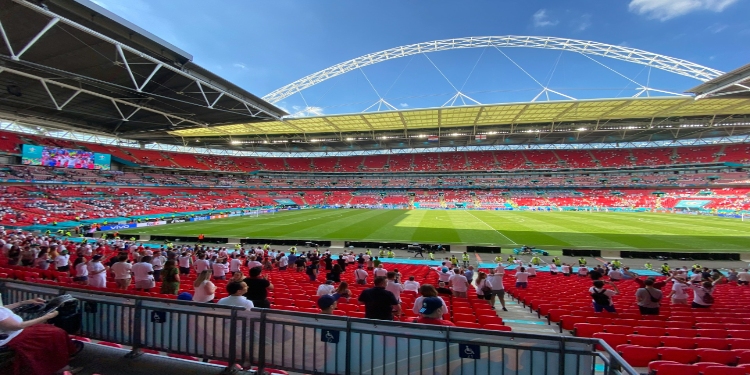
There are plenty of places in the UK capable of hosting a major boxing event, but Wembley still carries a different weight when British fighters are involved.
It is not only about capacity, although that obviously helps when a fight becomes big enough to leave an arena behind. Wembley feels like the place where a domestic rivalry stops being just another boxing story and becomes something closer to a national event.


That is why the stadium is mentioned whenever a genuinely huge British fight is on the cards. The setting signals to the public that the occasion is meant to matter, and boxing has always been a sport that feeds on atmosphere as much as form. Events at Wembley hold the same big occasion feeling that comes with a national lotto draw, as many tune in from across the country.
Wembley Gives a Fight Scale
Boxing is a sport that can work brilliantly in smaller venues, especially when the crowd is close enough for every punch to feel louder than it should. But some fights need a different kind of stage to showcase their magnitude.
Wembley gives a bout size before the first bell has sounded; the walk to the ring feels longer, the crowd feels heavier, and the whole night seems to carry more pressure because everyone understands what the venue represents: history and magnitude in one of the most recognisable venues in sport.
Carl Froch and George Groves showed that in 2014, when their rematch filled Wembley and turned a bitter domestic rivalry into one of the defining British boxing nights of the decade. The fight could have sold well anywhere, but Wembley made it feel enormous.
Joshua and Klitschko Set the Modern Standard
Anthony Joshua’s win over Wladimir Klitschko in 2017 is probably the clearest modern example of why Wembley still matters. In fact, that night had everything a stadium fight needs: Joshua was the rising British heavyweight, Klitschko was the established great, and the crowd helped turn the contest into something that felt bigger than a normal world title defence. The fight itself justified the setting.
Joshua was dropped, recovered, and then stopped Klitschko in the eleventh round in front of a capacity Wembley crowd. It was dramatic in exactly the way promoters hope a stadium fight will be, but cannot guarantee, and that is the point. Wembley does not make a fight great on its own, but when the action matches the occasion, the venue gives it a sense of permanence.
The Crowd Changes the Feeling
A massive boxing crowd in Wembley at night does not sound like your typical indoor arena crowd. It builds differently because the size and scale of the stadium changes the rhythm of the night.
There can be long stretches of anticipation before the main event, and then suddenly the whole place seems to move when the fighters appear. That kind of reaction gives even casual fans the feeling that they are part of something important.
Tyson Fury’s 2022 win over Dillian Whyte showed that again, with the event becoming less about one title defence and more about a huge night in British heavyweight boxing. The fight ended with Fury in control, but the wider memory is also tied to the size of the crowd and the sense of occasion.
It Gives British Boxing a Home
British boxing has always had important nights away from Wembley, and some of the sport’s best atmospheres have come from arenas in cities with deep fight traditions.
The spiritual home of British boxing will always be the York Hall in Bethnal Green. Still, Wembley gives British boxing a symbolic home when the stakes are big enough. It is the place casual sports fans recognise immediately, even if they do not follow every undercard or know every belt involved.
That matters for a superfight because part of the job is reaching beyond the usual boxing audience. When a fight lands at Wembley, it becomes easier for people who rarely watch the sport to see that the event has become something larger.
The Business Case Is Obvious
There is also a practical reason Wembley keeps coming up in the conversation: major fights need seats, hospitality demand, and a venue capable of carrying a huge promotion. For promoters, the stadium offers the kind of scale that can make a domestic fight feel like you’re watching a global event. It gives broadcasters powerful images and gives sponsors a setting that looks as big as the numbers around the event.
That does not mean Wembley will always win. Saudi Arabia and Las Vegas can offer financial advantages that are difficult to ignore or to compete with, especially now that heavyweight boxing is closely tied to global money. But for a British superfight, the emotional argument for Wembley is still difficult to beat.
Why Wembley Still Matters
Wembley matters because boxing is not only about who wins; it is also about the spectacle and capturing the public’s imagination. It is about how a fight is remembered as much as how it’s built up.
Froch vs Groves had the rivalry, Joshua vs Klitschko had the drama, Fury vs Whyte had the scale of a British heavyweight champion returning to a stadium crowd. Those nights show why the venue still carries power. Wembley can turn a fight into an event that feels like it belongs to more than just boxing fans.
That is why whenever a major British fight is discussed, the same question always comes up. If the bout is big enough and the fighters are British enough, why would it not be at Wembley?

David Prior
David Prior is the editor of Today News, responsible for the overall editorial strategy. He is an NCTJ-qualified journalist with over 20 years’ experience, and is also editor of the award-winning hyperlocal news title Altrincham Today. His LinkedIn profile is here.