




















































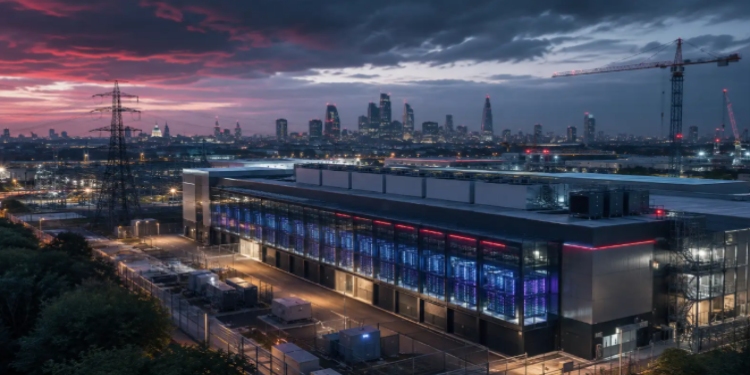
Walk through the announcements that have shaped UK business news over the past year and a pattern emerges quickly. Google pledging £5 billion toward new data center capacity. Microsoft backing what will become one of the country’s largest supercomputers at an AI campus in Loughton. Blackstone leading a £10 billion AI campus in Blyth. CoreWeave committing £1.5 billion to expand DataVita’s operations in Scotland. Individually, these read like isolated capital expenditure stories. Together, they describe the construction of something with a specific name in industry circles: the AI Factory.
The term has moved quickly from Silicon Valley jargon to a phrase showing up in government policy documents and investor briefings alike, and UK business leaders who haven’t yet gotten familiar with it are behind the curve.


A New Category of Infrastructure
An AI Factory isn’t simply a data center with extra computing power bolted on. It’s a purpose-built facility engineered around a single output: producing usable AI intelligence, measured in tokens generated per second, rather than storage capacity or general-purpose computing. Where a conventional data center is judged on uptime and storage efficiency, an AI Factory is judged on how many GPUs it can pack into a given footprint, how much power it can draw and cool reliably, and how cheaply it can produce each unit of AI output.
That distinction matters because it changes what these facilities actually require to function. Power availability, not office space or fiber connectivity, has become the binding constraint. The UK government now formally classifies data centers as infrastructure of national significance, placing them alongside energy and water in strategic importance, a sign of how central power access has become to the entire sector’s growth trajectory.
The Numbers Behind the Headlines
The scale of investment flowing into this space is difficult to overstate. Analysts project the UK data center market will roughly double by 2028, with power capacity dedicated to these facilities expected to exceed 4 gigawatts by 2030. The government’s AI Opportunities Action Plan has already attracted commitments worth roughly £14 billion in new data center projects, spanning everything from Essex to the Scottish Highlands.
Scotland in particular has emerged as an unexpected hub. Cooler ambient temperatures reduce cooling costs, and access to renewable power from wind generation has made the region attractive to operators looking to run GPU clusters around the clock without the energy bills that plague facilities in warmer climates. DataVita’s Scottish expansion, backed by CoreWeave, reflects a broader trend of AI infrastructure gravitating toward wherever power is cheapest and most reliable, regardless of proximity to London.
What This Means for British Business
For companies outside the infrastructure sector, this buildout has practical consequences worth watching closely. As AI Factory capacity comes online across the country, the businesses relying on AI tools for customer service, data analysis, product development, and operations should see improved reliability and, over time, more competitive pricing as supply catches up with the surge in demand that has driven up compute costs since the current AI boom accelerated.
There’s also an opportunity angle. The scale of these projects is creating jobs beyond the well-publicized construction phase, from electrical engineering and cooling systems maintenance to network operations and security. Regional economies near major sites, Blyth, Loughton, and pockets of Scotland among them, are beginning to see the kind of employment ripple effects that typically follow major industrial investment.
The Constraints Nobody Can Ignore
None of this growth is happening without friction. Grid operators in several regions have already flagged concerns about connection queues, with some new data center projects facing multi-year waits for the power capacity they need to switch on. Local planning disputes have surfaced near several proposed sites, as communities weigh the promise of jobs and investment against worries over electricity costs, water usage for cooling systems, and the visual and noise impact of large industrial facilities.
These aren’t reasons to dismiss the AI Factory trend, but they are reasons for business leaders to temper expectations about how quickly new capacity will actually reach the market. Grid upgrades take years, not months, and planning approval for large sites can move slowly even with government backing. Companies planning around future AI compute availability would do well to build some of that lag time into their own roadmaps.
Not Just the Tech Giants
While headline announcements tend to come from household names with deep pockets, a quieter shift is underway among smaller, independent data center operators across the country. Many of these facilities have existing power connections and physical infrastructure but have historically lacked the specialized GPU hardware and orchestration software needed to serve AI workloads directly. Rather than sitting on the sidelines while hyperscalers build new campuses from scratch, a growing number are partnering with specialist platforms to convert existing capacity into AI-ready facilities.
Hydra Host is one of the companies working specifically in this space, providing the GPU hardware, orchestration software, and customer connections that let independent operators stand up their own AI Factory capacity without the multi-year construction timelines associated with ground-up builds. For a market growing as quickly as the UK’s, that kind of conversion model offers a faster path to meeting demand than new construction alone can provide.
Watching the Next Twelve Months
For business leaders and investors tracking the UK’s economic trajectory, the AI Factory buildout deserves attention on par with more traditional infrastructure stories like rail expansion or grid modernization. The scale of capital involved, the strategic government backing, and the direct link to power policy all suggest this is a structural shift rather than a passing investment trend.
The companies and regions positioning themselves early, whether through direct investment, workforce development, or partnerships that unlock existing infrastructure, are likely to be the ones best placed to benefit as Britain’s AI capacity continues its rapid buildout. Given the pace of announcements so far this year, the next twelve months look set to bring plenty more of them.

David Prior
David Prior is the editor of Today News, responsible for the overall editorial strategy. He is an NCTJ-qualified journalist with over 20 years’ experience, and is also editor of the award-winning hyperlocal news title Altrincham Today. His LinkedIn profile is here.