



















































Introduction
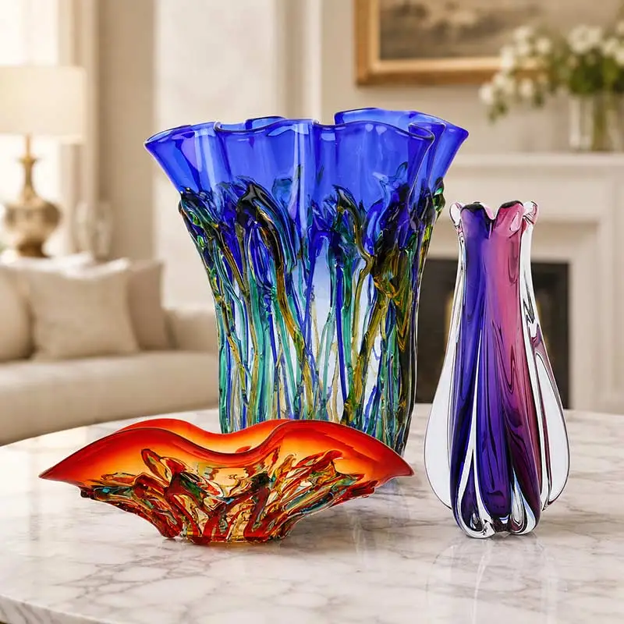
Compared to mass-produced vases, Murano glass vases are special and will stand out in your home. This is because they are mouth-blown and hand-shaped by master artisans on the island of Murano, near Venice, Italy. The maestros spend many years perfecting their craft, and each Murano glass vase is completely handmade and one-of-a-kind.
Glassmaking on the island dates back to the 13th century, and the techniques have been passed down from generation to generation. For many years, the techniques were kept secret from the rest of the world.


Murano glass vases are made from a special blend of silica sand, soda, and lime, making the glass malleable and workable for a reasonable length of time, allowing for intricate shaping and designing.
The question is, how can you tell if a glass vase is genuinely from Murano? You don’t want to pay for a fake vase that’s being sold as an original. In this article, we will look at why it is important to recognize the real thing and what to look for when searching for one of these stunning vases.
Why It Is Important to Establish Authenticity of Murano Glass
Fakes are Flooding the Market
There are many people selling fakes, passing them off as originals. These fake vases and other glass pieces are generally substandard, but unless you are an expert, it is easy to be fooled and believe that you are purchasing the real thing. You will, in effect, be funding unscrupulous companies that lie to you in hopes of reaping huge profits by selling a cheap, low-quality product at a high price.
A Need to Support the Italian Artisans and Murano Glass Craft
The companies selling fake Murano glass vases are taking away work from the highly skilled maestros of Murano, who produce superior pieces that will last for decades if looked after properly, and will keep or even increase in value. You will be investing in a piece of Italian art, not an inferior replica that won’t even hold its value, let alone increase in price.
By purchasing a genuine Murano glass vase, you will be supporting a unique craft that could otherwise die. This would be a great loss, not only because these vases showcase intricate techniques, but also because they are both functional and superb pieces of art.
By purchasing a Murano glass vase, you will be enhancing the visual appeal of your home as well as supporting glassmaking families on the island and the local economy.
What to Look for in a Murano Glass Vase
Weight and Clarity
The weight of a Murano glass vase falls into two categories, depending on the technique. Some Murano vases can feel heavy, much heavier than mass-produced imitations. This occurs when techniques such as Sommerso are used. With Sommerso, layers of different colored glass are created, one on top of the other. This makes for a heavier vase.
In other cases, Murano glass vases can feel very light. This is when techniques such as Cristallo or Millefiori are used. Millefiori glass craftsmanship involves bundling, fusing, and stretching Millefiori rods to make patterned glass, usually with floral designs. These vases are delicate in comparison to vases made using the Sommerso technique. However, they are distinguishable from imitations as the Millefiori technique is difficult to replicate, and forgers often paint the patterns onto the glass or make them sloppily so they flow onto each other. These patterns will eventually fade or flake, something that never happens with Murano glass because the patterns and colors are integrated into the glass.
Murano glass vases have exceptional clarity and amazing colors. The artisans use natural metal oxides to color the glass, meaning that no two vases will have the same hue. Knock-offs will be the same color and generally aren’t as vibrantly colored. The metal oxides used in Murano glass allow the vases to catch and diffuse light so that they glow from inside.
The transparency and shine of Murano glass vases come from the purity of the raw silica used to create the glass and the precise melting process. The vases don’t have dull spots, nor is the glass cloudy.
Imperfections
Authentic Murano glass vases often have slight imperfections because they are handmade. There is nothing wrong with this, as these are signs that each vase is produced meticulously by hand. Mass-produced glass is usually flawless.
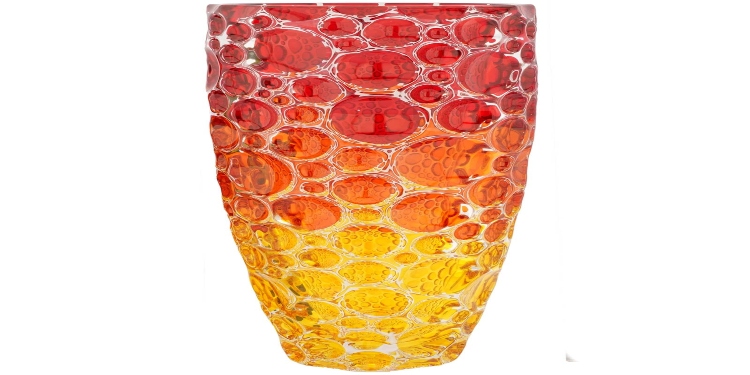
Imperfections include small air bubbles, which occur naturally during fusion and layering. This is not to be confused with the technique, Bullicante, where air bubbles are deliberately created for effect.
Slight asymmetry may also be a sign of an authentic Murano glass vase. It may not have mathematically correct proportions or the same thickness as a vase of the same design. Mass-produced glass vases will all look identical.
The Pontil Mark
Turn over a Murano glass vase, and on its bottom you will often see an indentation with a rough spot called the pontil mark. This is the spot where the glass master took the pontil rod off the almost-finished vase. Mass-produced vases don’t have this mark. If you see a mark like this, it may not definitively mean that the vase is Murano, but it will always mean that the vase is handmade. This is already part of the proof of authenticity, since most fakes are mass-produced.
Murano Handmade Techniques.
Murano maestros use centuries-old techniques to create vases, such as Sommerso, which is layered glass, Millefiori, which means a thousand flowers, and Avventurina, which has sparkling metallic copper added to the molten glass to make the vase shimmer.
You should be able to identify a fake because when they are machine-made or crafted without necessary skill, the techniques will be badly executed. For example, Millefiori pieces can be blurred, and Sommerso layers may flow into each other instead of being separate.
Certification and Sellers
Promovetro Label
The Promovetro Label is officially known as the Vetro Artistico Murano trademark. Created by the Consortium Promovetro and the Veneto Region, it guarantees that an item of glass has been crafted by maestros on the island of Murano. It is an electronic identity card that has a number of features.
An item with the label has the “borsella” in its logo with the words ‘Vetro Artistico Murano’ inscribed in gold leaf. The borsella is a traditional tool, namely tongs, which are an extension of the glassmaker’s hand and used to shape and mold hot glass.
The sticker is tamper-proof. If you try to remove it, it will break into small pieces. This stops authentic labels from being reused on fake products.
Each label has a unique identification number that relates to the glass factory where it was made. Modern labels have a QR code and serial number. You can scan the QR code or look up the serial number on the Vetro Artistico Murano website to verify the authenticity of the vase.
The Promovetro Label is the only special label affirming that the piece was made in Murano. However, not all genuine pieces will have this specific label; in fact, many companies on Murano Island choose not to become members of the Promovetro consortium and do not affix its label to their pieces. All that can be guaranteed is that a piece which has a Promovetro label is genuine. If it doesn’t, you will have to make further checks.
Master Signatures
Some maestros will diamond-point engrave their signature or the name of the furnace on the base of the glass piece.
Certification of Origin
Many reputable furnaces and galleries give paper certificates with their glass vases. These have details of the piece, the name of the master glassmaker, and the year it was produced.
Buy From Trusted Sellers
The best place to buy a Murano glass vase is on Murano Island itself. Murano is a small island reachable by a public ferry (vaporetto) from Venice in about fifteen minutes. However, even there, people sell fakes. Verify sellers based on their feedback online before you buy. Deal with sellers that work directly with the furnaces and artisans, or from well-established art galleries.
Signs That a Murano Glass Vase is a Fake
Uniformity of Fake Vases
Mass-produced vases are generally identical, so if you see a row of symmetrical vases with no imperfections, the vases will most likely be fakes. Murano glass vases may have imperfections and be asymmetrical.
If the vase looks as if the colors are painted on, it is an imitation. The colors of Murano glass vases are fused into the molten glass itself during the heating process.
Low Prices
Murano glass vases are handmade and therefore command a high price. If the price seems too good to be true, it probably is.
Murano-Style Labels
Some counterfeit glass vases will have labels saying ‘Made in Murano, Italy’. This usually indicates that it is a fake, as a certificate will always have the name of the dealer or the artist.
Why You Should Buy Authentic Murano Glass
Murano glass vases are both functional and works of art. They are all handmade using techniques stretching back centuries. It is important to support skilled Murano-based glass artisans so that the craft doesn’t die. In addition, fakes are inferior to authentic Murano Glass.
In counterfeit vases, the colors may fade, the designs are often not interesting and sloppy, and the techniques used to create beautiful art glass are hard to replicate. If you continue referring to this guide, you should be able to identify an original Murano glass vase and avoid the fakes.