



















































Slow learning is expensive now. Painfully expensive, in some cases. A team can spend six months perfecting a product nobody really wants, while a smaller, scrappier competitor tests the idea, fixes the weak spots, and gets in front of customers first.
That is why faster iteration has become more than a product team habit. It is now a leadership issue. When you combine it with rapid prototyping, better innovation speed, and real business agility, speed becomes a serious competitive advantage in business.


Here’s why it matters to you: faster teams do not just move quickly. They make better decisions sooner, waste less money, and respond to market signals before those signals turn into problems.
The Current Business Demands for Innovation Speed
If you want to understand why speed matters so much, look at what customers, supply chains, and budgets are all demanding at once. People want useful products sooner. Leaders want less risk before committing big money. Nobody wants to wait around while an idea gets debated to death.
Pressure Is Coming From Every Side
Product cycles are shrinking. Budgets are under tighter review. Customers compare almost every experience to the fastest, smoothest one they have had somewhere else. Fair or not, that is the bar now.
Manufacturing is feeling it too. At General Motors, “they reduced the production time of a manufacturing component by 80% by switching from machined tooling to an FDM‑printed nylon part.” That kind of shift is not just impressive. It changes how teams think about testing, tooling, and timelines.
Manufacturing Feels the Shift Clearly
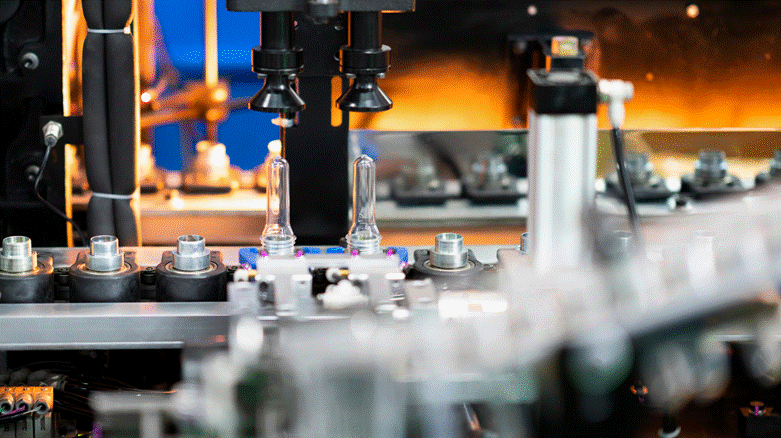
When engineers need custom parts, faster tooling, and production feedback without waiting on long traditional tooling paths, many teams work with plastic thermoforming companies. These engineer-led suppliers can help evaluate geometry, material choices, finishing details, trimming requirements, and manufacturability early, before small design issues become expensive headaches.
And that brings up the bigger question: how does faster learning actually turn into market strength?
Faster Iteration Unlocks Competitive Advantage in Business
Economic pressure, shorter product cycles, and higher customer expectations are pushing companies to move faster. But the advantage does not come from rushing. Rushing usually creates messes. The real edge comes from learning before your competitors do.
Speed Helps Teams Reach the Market Earlier
When you shorten the path from idea to prototype, test, and revision, you spend less time guessing. That alone is powerful.
A company built around faster iteration can explore several options while a slower competitor is still arguing over the first one. One team is gathering evidence. The other is still building a slide deck. You can probably guess which one has the better shot.
Learning Builds Customer Trust
Customers notice when a product improves quickly. They may not use words like “iteration cycle,” of course. They just see that the packaging fits better, the product feels easier to use, the part performs more reliably, or the next version fixes what bothered them.
Those small improvements send a clear message: this company is paying attention.
That is why competitive advantage in business increasingly depends on how fast teams can turn feedback into something better.
Core Benefits of Rapid Prototyping and Swift Cycles
Fast iteration not only helps teams move with more energy. It helps them spot mistakes earlier, while those mistakes are still cheap and easy to fix. That creates a calmer, more practical route from concept to launch.
Risk Drops When Changes Stay Small
Big launches can hide big risks. By the time a problem appears, the money has already been spent, the tooling is committed, and the team is stuck explaining what went wrong.
Smaller cycles reduce that pain. Teams can test materials, dimensions, usability, strength, finish, and demand before scaling up. It is much easier to adjust a prototype than to defend a failed full-production run.
Digital Tools Reduce Waste
McKinsey found that better use of software design and data in manufacturing can cut product development time by 20 to 50 percent by eliminating defects before production through simulation and testing.
| Approach | What Teams Learn | Business Impact |
| Long development cycle | Problems appear late | Higher rework and slower response |
| Iterative prototyping | Problems appear early | Lower waste and faster decisions |
| Customer feedback loop | Demand becomes clearer | Better fit and stronger loyalty |
Those gains are not automatic, though. To make them repeatable, teams need habits and structure around speed.
Best Practices That Accelerate Innovation Speed
Fast feedback loops can reduce uncertainty, but speed still needs discipline. Without clear ownership and a shared process, teams can create noise instead of progress. And nobody needs more noise.
Bring Teams Together Early
Design, engineering, sales, operations, and customer support should see prototypes before decisions get locked in. Each group spots different problems.
Engineering may catch a tolerance issue. Sales may flag a customer objection. Operations may see a production headache coming from a mile away. Customer support may know which features confuse people most.
When those voices show up early, the final product usually gets stronger.
Use Tools Before Cutting Material
Simulation, virtual models, and test fixtures can help teams narrow the field before physical builds begin. That makes rapid prototyping more focused.
The goal is not to make endless samples for the sake of activity. The goal is to learn the next useful thing, then decide what to change.
Invite Customers Into the Cycle
Customers do not need to design your product. Honestly, they usually should not. But they can tell you what feels useful, awkward, confusing, unnecessary, or valuable.
That feedback keeps innovation speed tied to real demand instead of internal assumptions. And internal assumptions, as every founder eventually learns, can be very convincing and very wrong.
Of course, moving faster creates challenges of its own. So let’s talk about those directly.
Addressing the Challenges of Rapid Iteration
Agile methods, simulation tools, and cross-functional reviews can shorten the path from idea to validated prototype. Still, speed needs guardrails. Otherwise, it can turn into burnout, sloppy decisions, or a half-finished pile of “urgent” experiments.
Balance Speed With Quality
Fast work still needs checks. Teams should define what must be tested, who approves changes, and when a prototype is ready for the next stage.
This is where a simple checklist can save a lot of grief. Not a bloated process. Just enough structure to keep quality from becoming an afterthought.
Protect People From Constant Urgency
If every request is urgent, nothing is. Teams cannot do thoughtful work when every message sounds like a fire alarm.
Leaders need to separate true market opportunities from distractions. Then they need to give teams enough focus to do good work. Fast does not mean frantic.
Use Partners Where They Add Strength
Outside manufacturing, tooling, or material experts can help teams move quickly without hiring every skill in-house. That support keeps business agility practical, not just something nice written on a strategy document.
Good partners also bring pattern recognition. They have seen what fails, what works, and what tends to cost more than expected.
Once those blockers are under control, technology can make iteration even sharper.
Trends Making Business Agility Faster
Even strong iteration systems can stall when teams rely on old handoffs, slow approvals, and disconnected tools. New technology is helping reduce those delays, especially when it is used with judgment.
AI and Low-Code Tools Speed Early Testing
AI-assisted design, analytics, and low-code pilots can help teams compare options faster. They are not magic, and they will not replace clear thinking. But they can reduce the blank-page stage, which is often where momentum quietly dies.
For marketers, founders, and product teams, that can mean faster concept testing, quicker internal demos, and better early feedback.
Advanced Manufacturing Shortens the Build Loop
Additive manufacturing, digital tooling, and flexible materials make it easier to test shapes, fixtures, molds, housings, and packaging components. In many product teams, faster iteration begins before the first physical part exists.
That changes the rhythm of development. Instead of waiting weeks to discover a problem, teams can find it earlier and keep moving.
Tools help, yes. But leaders still need to know whether all that speed is actually paying off.
Measuring Faster Iteration and Competitive Gains
Tracking lead time, feedback quality, adoption, and waste turns “moving fast” into something leaders can improve. The point is not speed for its own sake. The point is better outcomes with less delay.
Watch the Right Signals
Useful measures include cycle time, prototype approval time, defect trends, customer adoption, and rework costs.
If cycle time improves but defects rise, something is off. If prototypes move faster and rework drops, the process is probably getting healthier. Metrics are useful because they show what the team may be too busy to notice.
Connect Metrics to Decisions
A metric should change behavior. If the numbers show approvals are slowing everything down, simplify approvals. If ownership is unclear, clarify it. If one team is overloaded, shift resources before schedules slip.
Metrics reveal bottlenecks. Culture decides whether those bottlenecks stay in place.
Building a Faster Iteration Mindset
Sustainable speed comes from leadership choices, not slogans. Teams move faster when they are trusted to test, learn, and adjust without fear of blame.
Leaders Must Remove Friction
Approval chains, unclear priorities, and delayed feedback can slow even talented teams. Leaders help by making decisions visible, cutting unnecessary handoffs, and keeping everyone focused on the next useful test.
Sometimes the best leadership move is not adding another meeting. It is removing one.
Reward Learning, Not Just Launches
A failed prototype can be valuable if it prevents a failed product. That lesson is easy to say and harder to practice when deadlines are tight.
Teams should be recognized for honest findings, early warnings, and practical fixes. If people hide bad news, iteration breaks. If they share it early, the company gets smarter.
That mindset becomes even more convincing when you see it in real manufacturing environments.
Industry Spotlight: Iteration in Thermoforming
Real-world manufacturing shows that iteration speed is not just a software story. In thermoforming, the ability to adjust tooling, materials, finishes, and trim paths can have a major effect on cost, quality, and delivery.
Prototype-to-Production Gets Shorter
A product team might begin with a rough housing, tray, panel, or cover, then refine the fit and appearance through several quick samples. When tooling is easier to revise, decisions feel less risky.
That flexibility matters. It gives teams room to improve the product without treating every change like a crisis.
Defects Fall When Feedback Comes Early
Design reviews, sample approvals, and production checks help catch weak corners, poor draft angles, finish problems, or trimming issues before scaling.
That is where business agility becomes visible on the shop floor. Not in theory. In fewer defects, cleaner parts, smoother approvals, and fewer painful surprises.
These practical wins point to the larger takeaway: speed is now a serious business discipline.
Final Thoughts on Winning Through Faster Learning
The companies that win next will not simply work harder. Plenty of teams already work hard. The winners will learn faster.
Faster iteration helps teams test ideas sooner, reduce waste, improve fit, and respond before competitors settle for yesterday’s answer. Rapid prototyping, clear metrics, strong partners, and steady leadership make speed safer and more useful.
Start small. Find one slow feedback loop in your process and shorten it. One approval. One prototype review. One customer test. Small cycles, repeated well, can change the direction of a business.
FAQs on Faster Iteration
1. What is the competitive advantage of speed?
Competitive speed refers to how quickly a firm acts in the face of environmental and competitive pressures. It is a function of the capability to act fast; a higher competitive speed implies a lower time to act.
2. What causes competitive advantage?
Competitive advantages are attributed to a variety of factors, including cost structure, branding, the quality of product offerings, the distribution network, intellectual property, and customer service.
3. Can rapid prototyping help industries outside tech?
Yes. Manufacturing, medical products, food packaging, aerospace, robotics, and consumer goods all benefit when teams test physical ideas early. Quick samples help reveal fit, strength, finish, and usability issues before larger production decisions are made.