



















































Introduction
In the high-stake environment of aerospace manufacturing, the batch production of titanium alloy precision CNC turning parts, such as engine spindles and turbine discs, is a daunting task. Issues such as machining distortion causing deviations, unexpected wear and tear of tools increasing expenses, and inconsistent quality of batches resulting in delays are constant hurdles.
Usually, the underlying reason is not a specific machine or process deficiency. Rather, it results from the absence of a structured engineering perspective. In conventional approaches, materials, processes, and quality checks are often considered in isolation without creating a comprehensive defense system from the initial design to the final delivery.


In this paper, we will reveal the three prevalent pitfalls that result in low yields and increased expenditure. Subsequently, we will explore the proven route towards structured risk management and the delicate balance of reliability and expense. It can be achieved through the integration of a certified quality management system in compliance with AS9100 standards, utilizing sophisticated precise CNC turning techniques, and establishing close cooperation with suppliers.
Trap 1: Underestimating System Power – Why High-End Equipment Alone Cannot Guarantee Aerospace Part Quality?
A prevalent misconception in Aerospace Components Manufacturing is that investing in the most advanced, best CNC turning center automatically confers aerospace-grade manufacturing capability.
The Inadequacy of Hardware-Only Solutions
Relying solely on advanced machinery, the presumed best CNC turning center, is the fundamental trap. This hardware-only approach lacks the systemic framework needed for the consistency and traceability essential in Aerospace Components Manufacturing.
The AS9100 System as the Foundational Solution
However, the certified CNC machining AS9100 certified system goes beyond merely being a certificate; it becomes an important part of the operational protocol at Aerospace Components Manufacturing. Through this system, proactive risk management, stringent FAIR, and complete traceability become necessary parts of the process. This means that quality control is no longer seen as the final stage but rather becomes part of the manufacturing process.
- Mandatory Processes for Assured Quality
A formal CNC machining AS9100 certified system provides the indispensable safety bedrock. It enforces proactive risk management, rigorous FAIR, and full-process traceability, controlling every step from material to finished part.
- From Checkpoint to Built-in Characteristic
This system transforms quality from a final inspection into a built-in workflow characteristic. Mandatory documentation ensures batch consistency surpasses reliance on individual skill, embedding quality into the organization’s culture. A detailed case study is available: CNC machining AS9100 certified.
Trap 2: Misunderstanding Material Properties – Why Using Generic Parameters for Titanium Alloys is a Recipe for Failure
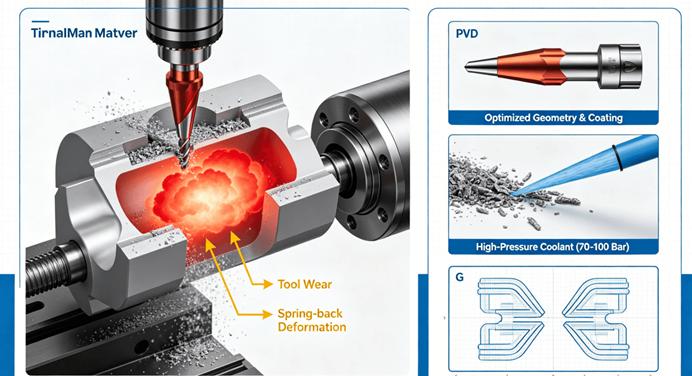
The second critical trap is approaching titanium alloys with the same mindset and parameters used for steel or aluminum. Titanium alloys like Ti-6Al-4V exhibit distinct behaviors in Aerospace CNC Turning applications: low thermal conductivity causing heat concentration at the tool edge, high chemical reactivity leading to galling and built-up edge, and a low modulus of elasticity resulting in spring-back deformation.
Thus, the professional titanium CNC machining service requires a customized set of precise CNC turning techniques, which include, but are not limited to, such methods as using a high pressure coolant system (HPC) at 70-100 Bar for managing heat and chip breaking, employing the right geometry for PVD coated tools, and utilizing symmetrical machining and stress relieving processes for thin wall sections. These customized techniques result in lowering cutting temperature by up to 40%, controlling the deformations of thin walls to 0.05mm, increasing tool life by 30%, and ensuring the fatigue strength of the component – results that simply cannot be achieved through generic parameters.
Trap 3: Underestimating Process Complexity – How to Avoid Precision Disasters in Large Part Turning
The third trap is treating large diameter CNC turning as a simple scaling-up of small-part machining. For normal CNC turning applications such as aerospace housing or engine casing, two major issues prevail: distortion due to residual stress release from massive billets and ovality distortion (typically greater than 0.1mm) in low-stiffness and thin-wall materials due to machining forces.
Preventing such precision nightmares demands a proactive process approach: Stress-relieving heat treatment prior to machining; FEA simulation of optimal machining strategy; Reduction of clamping stress via specialty equipment such as segmented vacuum chucks; and Machine-based measuring with real-time adjustment. This calls for an intimate blend of process understanding and state-of-the-art equipment. The very best CNC turning center for such operations needs not only high stiffness greater than 1000 Nm spindle torque and accuracy radial runout less than 0.003mm but also a multi-axis machining capability.
Beyond the Traps: How Precision Turning Technology and Quality Systems Synergize
Standalone technology without a rigorous system is erratic and irreproducible. A standalone system without deep technical mastery is hollow. True manufacturing excellence lies in their fusion.
From Technical Expertise to Codified Knowledge
It details how insights gained from solving real-world challenges in various CNC turning applications are systematically captured, documented, and integrated into the quality management system. This process ensures that valuable technical expertise is preserved, standardized, and made accessible for future projects, moving beyond reliance on individual skill.
- The Tangible Assets of Continuous Optimization
The continuous optimization of precise CNC turning technology yields proven parameter libraries, tool life databases, and simulation models. These are not just data; they are crystallized organizational learnings from countless CNC turning applications.
- Formalizing Knowledge for Prevention
These tangible assets form the core of organizational knowledge within a quality framework. They are the ultimate expression of preventive action, transforming tribal know-how into a scalable, defendable corporate asset.
The System that Locks in Success
Conversely, a strict quality system mandates that every adjustment and solution during production is recorded, analyzed, and standardized. This discipline creates a closed-loop of improvement, locking each advancement into the process. The outcome is a predictable output of precision CNC turning parts, where reliability is assured.
How to Identify a True Partner, Not Just a Job Shop?
The ultimate solution to avoiding these traps is selecting a deep, long-term partner that integrates system, technology, and engineering experience, not merely a job shop that quotes prints.
Selection of CNC turning service suppliers should be based on a multi-dimensional approach: Technical Sophistication & Strategic Investment: Are they knowledgeable in particular technologies such as High Power Cooling (HPC) for titanium alloys and possess adequate hardware for it? System Integration & Implementation: Are they certified in aerospace industries like AS9100 and do they have strong FAIR and Traceability systems? Front-End Engineering Partnership: Are they able to assist in efficient DFM analysis for optimal design solutions? Supply Chain Assurance & Agility: Are they capable of providing a smooth transition from Rapid Prototyping Services to regular volume production?
The best CNC Turning Service Provider is expected to be an integral part of a customer’s research and production process. For additional details regarding capabilities and workflow of a full-service CNC Turning Service Provider, please refer to: CNC turning service.
Conclusion
The successful manufacturing of aerospace-grade precision CNC turning parts is not accidental. It is a systems engineering endeavor that requires proactively avoiding the three traps of missing systems, material misjudgment, and process oversimplification. The core lies in fusing an AS9100-certified rigorous management system, deep precise CNC turning technology expertise for challenging materials and large diameters, and a partnership built on long-term trust and collaboration into a cohesive, adaptive, and reliable whole.
When your project faces the challenge of high-reliability, complex turned components, choosing a partner that can systematically identify and navigate these pitfalls is paramount. JS Precision, with its systematic quality control, deep special-process databases, and end-to-end project management, is committed to being your trusted manufacturing solutions partner. For a feasibility analysis and process evaluation of your specific components, such as turbine discs or large shaft parts, feel free to contact our engineering team.
Author Bio
This article was authored by a manufacturing engineer with over 15 years of experience in aerospace precision manufacturing. Their expertise spans difficult-to-machine material process development, AS9100 system implementation, and global supply chain project management. The viewpoints are based on extensive industry practice and engineering case studies.
FAQs
Q: How does the FAIR procedure as required by AS9100 differ from a regular inspection procedure?
A: As required by AS9102, the FAIR is a standardized, documented, and mandatory procedure. It involves full measurements and documentation of all design features of the first part to verify that the manufacturing process will always be able to produce satisfactory products. It goes far beyond regular inspection practices and forms the basis of aerospace quality control procedures.
Q: In addition to high-pressure coolant, what else should be optimized for titanium alloy machining?
A: Vc, fz, and ap values should be accurately matched. The approach to machining titanium often uses mid- to low-speed cutting combined with increased feeds and reduced depth of cuts. Proper tool rake angles and cutting edge preparation/honing are important to decrease the contact area and friction.
Q: What approach should be used to reduce the clamping deformation in thin-walled ring parts above 800mm diameter while performing lathe work?
A: The traditional chuck can induce three-point distortion. Advanced solutions use segmented and adaptive hydraulic/vacuum chucks to ensure even distribution of the clamping forces. It is usually complemented by in-process measurement along with rough machining-release part-stress relieving-reclamp-precise machining.
Q: What modifications should be made during CNC turning when moving from rapid prototyping to series production?
A: The emphasis will be shifted from speeding up the job for one-offs to efficiency, reliability, and cost effectiveness. In particular, it includes such steps as switching from universal to optimized part-specific tooling; fixing and documenting the process parameters; developing specialized gauging and fixturing; and setting up Statistical Process Control (SPC) checkpoints for critical characteristics.
Q: What is the best way to determine whether the CNC turning vendor has actual experience in working on the aerospace projects?
A: Ask them for the documentation on their AS9100 accreditation scope; request typical (de-identified) aerospace project examples and part pictures; familiarize yourself with their NCR and Concessions policy; and check their metrology instruments’ precision and calibration compliance to aerospace standards.