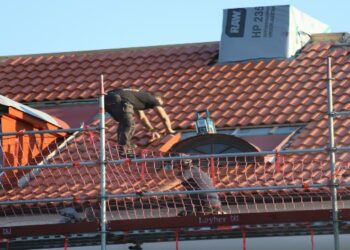




















































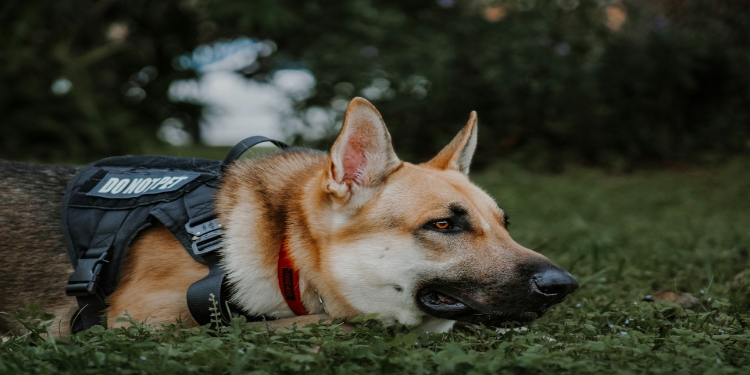
Bring a dog onto a site and the feel of the place changes almost immediately. Anyone who might have chanced their luck against fencing and a static guard tends to think twice the second they hear barking from inside the perimeter. That instinctive reaction is hard to replicate with cameras or lighting, and it’s the main reason K9 patrols have become a standard part of construction site security rather than a novelty add-on.
Dogs bring something to a site that no amount of hardware can. A dog will pick up on someone moving behind a stack of materials, or hear footsteps on a floor above, long before a guard walking the same patrol route notices anything. On a large site full of dark corners and half-built structures, that difference is the whole point of bringing one in.


The Deterrent Effect
Most site crime is opportunistic. Someone notices a gate that wasn’t locked properly, or a stretch of fencing that’s easy to get over, and decides the risk of getting caught is worth it. Add a dog into that picture and the maths stops working in their favour. Few people fancy finding out the hard way whether something’s waiting on the other side of a fence.
Signage alone showing a site uses dog patrols puts off a meaningful share of would-be intruders on its own. Sites running an actual patrol alongside visible signage tend to report far fewer attempted break-ins than sites relying purely on cameras and fencing.
Detection Ability Guards Alone Don’t Have
A dog will find someone hiding behind stacked pallets or crouched inside plant equipment well before a guard walking the same route gets anywhere near them. That’s down to smell rather than sight, and a dog’s nose works at a level a human patrol simply can’t compete with.
The gap really shows on bigger sites, where a full patrol loop can take the better part of twenty minutes. Someone who’s watched the pattern for a few nights knows exactly when a guard will be furthest away, and can time a move around it. A dog throws that timing out entirely, because detection doesn’t depend on being able to see down a particular row of stacked materials at a particular moment.
Handler and Dog as a Combined Unit
The dog is never working alone. Every K9 patrol pairs the animal with a trained handler who directs the search, manages access points, and responds to whatever the dog flags. Take the handler out of the equation and the dog is just reacting to whatever crosses its path with no one to act on it. A handler without a dog, meanwhile, is back to relying on eyesight and hearing alone, which is exactly the limitation dogs exist to solve.
Handlers who know construction sites specifically bring something extra too. Exposed rebar and an unfinished stairwell at 2am aren’t the same job as patrolling a warehouse, and an experienced handler knows where to slow the dog down and where it’s safe to move quickly.
Where K9 Patrols Fit Best
Not every site needs a dog. A small site with a short build programme and modest equipment will usually be well served by a static guard. It’s the bigger sites, and the ones that have already had something go missing once, where a dog earns its keep. A site that’s been hit before is telling you exactly where its weak points are, and a patrol dog is usually the fastest way to stop those same weak points paying off for whoever’s watching them.
K9 Security Services tend to be built around exactly that kind of site: large perimeters, valuable equipment, and long, unattended stretches overnight where a static guard’s reach runs out. Pairing a trained dog and handler with the existing security setup gives a site coverage that fencing, cameras and a single guard simply can’t match on their own.
Sites targeted once are usually targeted again if nothing changes. Bringing in a dog patrol after a break-in is common enough, but the sites that avoid a repeat are the ones that treat it as a standing part of the security plan, not a reaction to what’s already happened.

David Prior
David Prior is the editor of Today News, responsible for the overall editorial strategy. He is an NCTJ-qualified journalist with over 20 years’ experience, and is also editor of the award-winning hyperlocal news title Altrincham Today. His LinkedIn profile is here.