





















































Trump-backed crypto projects are becoming an illustration of how the intersection of politics, finance, and digital assets can lead to systemic risks. The ongoing controversy comes from fundamental structural issues — ranging from how these projects were developed and marketed to how they have been managed since the very beginning.
The scrutiny focuses on Trump-affiliated crypto ventures, such as World Liberty Financial (WLFI) and the $TRUMP memecoin. Obviously, investors didn’t join the projects for technological innovation or the assets’ potential to reach Bitcoin price or similar levels. Instead, they substantially funded these projects for political benefits, brand name, and strategic connections.


A Reuters investigation revealed that the Trump family used its influence to raise nearly $1 billion in early 2025, with a significant portion originating from foreign contributors. This created a speculative ecosystem where token value depends less on utility and more on proximity to political circles.
A central point of debate is the fact that ownership and control of the assets is concentrated into the hands of a select group. Trump-affiliated entities controlled most of the $TRUMP tokens, allowing inner circles to profit significantly from price swings.
Also, it was revealed that the Trump family obtains up to 75% of revenue generated from WLFI token sales. Such structures resemble traditional concerns about insider advantage, but in a largely unregulated crypto environment, the risks are amplified. This imbalance exposes retail investors to losses while insiders maintain significant financial leverage.
The establishment of financial rewards based on political access is another critical element. WLFI provided special benefits to investors who committed millions of dollars in return for governance control and special access rights. This creates a serious ethical dilemma: a “pay-to-access” system where financial donations can potentially sway political decisions. Such dynamics turn cryptocurrency from its original purpose as a decentralized financial instrument into a tool for acquiring influence, damaging democratic processes and market integrity.
The situation becomes more complex when we consider market volatility. The value of Trump-linked tokens has been fluctuating significantly, as traders based their decisions on speculative news rather than actual business operations.
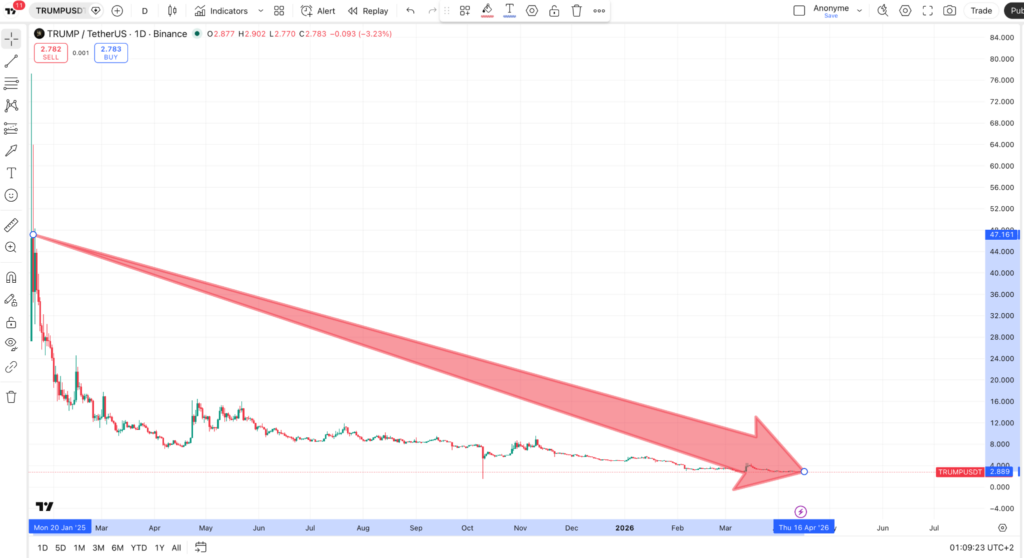
WLFI experienced a major value decline following reports of insider-connected lending activities — which exposed its financial system weaknesses.
Academic research on “PoliFi” tokens shows that their prices demonstrate a stronger dependence on political signals, such as approval ratings, making them less stable than the established assets they sit alongside on the crypto heatmap.
The presence of international investors — combined with dubious business affiliations — creates additional threats to financial safety. Investigations showed that Trump-associated cryptocurrency initiatives received major financial backing from overseas, while partnership agreements had bypassed standard processes. These dynamics extend beyond financial concerns, introducing geopolitical and regulatory risks, particularly in terms of influence and compliance.
Finally, the broader regulatory environment plays a decisive role. The conjunction of governmental control and private cryptocurrency operations creates situations in which public officials hold dual roles, as they may shape regulations that favor their own financial interests. Traditional protection mechanisms have lost their effectiveness due to role confusion, which has allowed politically connected cryptocurrency firms to expand their operations.
The Trump token controversy is driven by a combination of speculative design, concentrated ownership, political monetization, weak oversight, and market volatility. Ultimately, these factors have turned cryptocurrency initiatives into an intricate political and financial scandal, demonstrating the dangers of merging governmental authority with private cryptocurrency activities.

David Prior
David Prior is the editor of Today News, responsible for the overall editorial strategy. He is an NCTJ-qualified journalist with over 20 years’ experience, and is also editor of the award-winning hyperlocal news title Altrincham Today. His LinkedIn profile is here.