

















































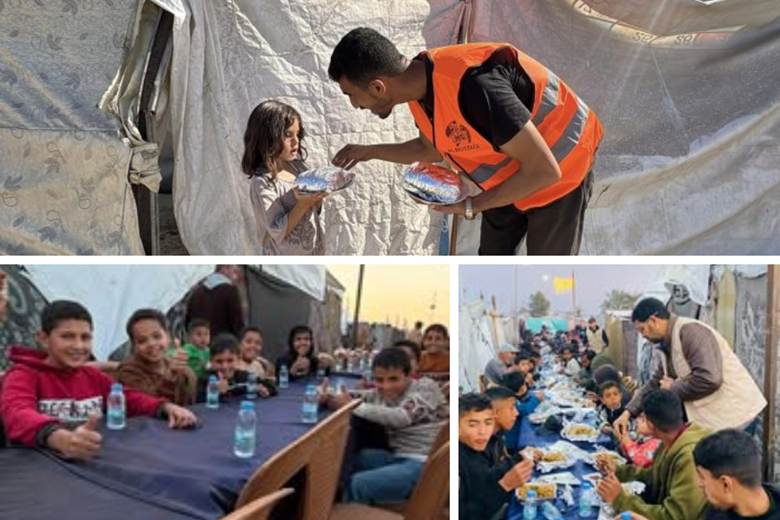
A man walked for two days. With three kids, one bag and no food since the night before, no phone signal, no way to know what was ahead. He got to the camp near the Turkish border. Someone gave his youngest daughter a blanket and warm soup. He cried, he said later. Just he wasn’t expecting that.
That detail matters. Because most people, when they think about global relief, picture logistics. Planes, supply chains, press conferences. What it actually looks like, on the ground, in the dark, is someone handing a child something warm. The machinery behind that moment is enormous. But the moment itself is small and human and completely ordinary.


A flood in Bangladesh is not the same situation as a city being bombed in Ukraine, which is not the same as a camp in Chad that’s been there so long it’s basically a permanent settlement now. Calling them all crisis zones is accurate but it flattens a lot. The one thing that holds across all of them is that whatever passed for normal broke down and outside help became necessary.
Global relief tries to be that somewhere. How well it does that job depends on a lot of things, most of which never make the news.
The Work Has Changed, Even If the Images Haven’t
Disaster footage looks the same as it did twenty years ago. Trucks, grain bags, tent rows. Some of that is because the work is the same. A typhoon hits a coastal town and food and shelter still need to get there fast. That part hasn’t changed.
What has changed is the question nobody used to ask. What happens after. A decade ago relief meant keeping people alive through the worst of it and then moving on. Ninety days, maybe. Then the next crisis. The harder questions, what does a community need after three years of displacement, what does recovery actually look like when going home isn’t possible, those weren’t really being asked. Now they are, which is at least a start.
In northern Syria, some groups stopped airlifting bread and started giving flour and fuel to local bakeries that were still running. Families got fed. Bakers kept their businesses. Money moved inside the community instead of being imported from outside. It sounds like a small shift. In practice it kept an entire local economy from collapsing completely.
That logic, using outside resources to support what’s already there rather than replacing it, is showing up more across the sector. Not everywhere. Not consistently. But more.
The First Three Days Are Controlled Chaos
First 72 hours of any major relief response, chaotic without exception. That’s just what it is. The people who say otherwise are describing it from somewhere other than the ground.
2023, Turkey and Syria. Earthquake hits. The first people in the rubble weren’t international teams. They were locals. Neighbors pulled neighbors out with whatever they had available, which in most cases was just their hands.
Local fire departments. Doctors working out of parking lots. The international teams arrived later, some within 12 hours, some after several days.
That gap matters. A person trapped with a punctured lung does not have several days.
The organizations that consistently show up fastest keep supplies pre-positioned. Warehouses in Nairobi, Amman, Bangkok, stocked and ready before anything happens. When the call comes in at 3am the question isn’t whether there are tents. It’s which truck leaves first. All that invisible preparation, the warehouses, the pre-positioned stock, nobody thinks about it until it’s the gap between someone getting help in twelve hours or getting help in four days.
Coordination is still a mess, though. Dozens of organizations show up. Some work together. Some duplicate each other’s efforts. Some get in the way. The UN tries to coordinate through a “cluster system,” which works better in theory than in the field. Aid workers will tell you that freely if you ask them.
Who Actually Gets There First
Here’s something worth saying clearly. Local people respond before anyone else. Every single time.
The neighbor who kicks open a door. The truck driver who loads his vehicle with whatever he has and drives toward the disaster instead of away from it. The teacher who turns her classroom into a triage space. Funding reports don’t mention them.
After the 2010 Haiti earthquake the coverage went to international teams and military aircraft. What was already happening before most of those teams landed, Haitian community organizations working in the rubble, barely got a line. They did not have the equipment or the resources. They had knowledge of the place, relationships with families, and no option to wait.
Good relief organizations have learned to plug into that. Giving local groups supplies, money, and support rather than flying in outside staff who need two weeks just to understand the neighborhood. The ones doing emergency relief on the ground that actually sticks tend to be the ones who figured this out and not the ones who arrived with the biggest convoy. The field has moved in this direction. Not far enough, but it’s moved.
Trauma Doesn’t Show Up in a Photograph
A woman in a South Sudan camp. Village attacked fourteen months back. She hasn’t slept properly since. Her kids are fed. They’re in a temporary school. From the outside, her family looks okay.
She is not okay.
Mental health was the last thing the relief sector took seriously, partly because it’s invisible and partly because donors want to fund things they can photograph. A new water pump makes a good image. A woman who flinches every time she hears a truck does not.
That’s slowly changing. More programs now include what’s called psychosocial support, basically counseling and community group work, as a standard part of their response. Children get play spaces built specifically to help them process things. Adults get group sessions where they can talk to others who went through the same thing.
It’s not therapy in the clinical sense. It’s not fixing anything quickly. Having someone to talk to who actually understands, not just linguistically but in terms of what happened, makes a difference in whether people can function day to day. To parents. To eventually rebuild.
That’s not nothing. In a camp, that’s quite a lot.
School Under a Tarp
There’s a classroom in a camp in Uganda that is technically a tarp tied between four poles. Forty kids. Two teachers, both of them refugees. A chalkboard leaning against a pole. No chairs.
Missing school during a crisis isn’t falling behind. It’s falling out entirely. A child who was eight when conflict started and spent five years in a camp with nothing available educationally is thirteen now and can’t read. That gap doesn’t fix itself when things stabilize. It just becomes the new baseline.
Education in emergencies used to be the thing that got added if there was budget left. Temporary learning spaces, teacher training, catch up programs for older kids who missed years. That’s shifted. It’s part of how responses get designed now, not an afterthought.
There are real problems with it. Traumatized kids don’t always learn easily. Underpaid, stressed teachers make mistakes. And education funding runs out faster than food funding, because it’s harder to make the case that a school matters as much as a meal when both are competing for the same donor dollar.
But here’s the practical argument: girls who are in school get married off later. Boys in school are harder to recruit into armed groups. The classroom is protection, not just education.
Why Cash Works Better Than Boxes of Stuff
For a long time, aid meant physical goods. Tarpaulins. Cooking oil. Bags of lentils. In places where markets had collapsed and there was nothing to buy, that made complete sense.
But plenty of crisis zones still have functioning markets. Shops open. Farmers selling. The problem isn’t that goods don’t exist. It’s that the people who need them have no money.
Cash transfers have become one of the more important shifts in how aid gets delivered. Give a family money, through a mobile phone or a prepaid card or just in notes, and they can buy what they actually need. Not the standard ration their kids won’t eat. The specific things their household requires.
The worry was always that people would misuse it. Buy alcohol, waste it, make bad decisions. The data doesn’t support that. Study after study shows displaced families spend cash on food, medicine, and basic household items. Local shops benefit. Families get some dignity back, which matters in a situation where almost everything else has been taken from them.
It doesn’t work in active war zones where movement is impossible and shops are bombed out. But where markets exist, cash is increasingly the smarter move.
Fast Versus Careful
Every relief worker will tell you about the tension that never goes away. Act fast, and you do things badly. Take time to do things right, and people suffer while you’re planning.
There’s no formula for that. An experienced team reads the situation and makes a call. Acute emergency, you move and fix mistakes later. Slower-moving crisis, you can afford to consult and plan. The mistake is applying emergency-mode logic to a situation that’s been stable for three years, or vice versa.
What’s gotten better is the push to actually ask affected communities what they need. Feedback lines, community meetings, simple surveys. It doesn’t always change what gets delivered because logistics have their own limits. But people who’ve been asked feel different about receiving help than people who haven’t. Less like cargo. More like humans whose opinion was worth something.
Women Don’t Automatically Get Their Share
Aid doesn’t distribute itself equally. When goods arrive at a community level, women and girls often end up with less than men.
Men sometimes collect family rations and redirect parts of them. Distribution points that are crowded and chaotic aren’t equally accessible. Women stay away from ones that feel unsafe. Girls end up without school materials not because anyone decided against them explicitly but because when resources are tight an assumption kicks in about whose education matters more.
None of this is a mystery. Relief organizations know it happens. The ones that address it build specific measures from the start. Women-only distribution hours. Registration in women’s names. Female staff for sensitive health needs. Private spaces in camps.
These aren’t complicated solutions. They just require actually prioritizing them instead of treating gender as a box to check in the funding proposal and then forgetting about in the field.
After the Emergency, the Harder Work Starts
At some point the acute phase ends. Sometimes tents come down. Sometimes they stay up for a decade and become a real town with a name and a social structure and a local economy. Either way, the question shifts.
Not “how do we keep people alive” but “how do people build a life.”
This is where the humanitarian system struggles most. Emergency funding dries up. Donor attention follows the next crisis. Organizations that were well-resourced in year one are scrambling in year three, exactly when long-term rebuilding needs the most sustained investment.
In parts of South Sudan, some groups have moved into supporting small farming, skills training, and basic microfinance. Giving people a way to generate income instead of waiting for the next distribution. It’s slow. Some people move forward fast. Others stay dependent for years and that’s not automatically a failure. Some things take a long time to recover from.
The Funding Problem Is Worse Than It Looks
Every year the UN releases a humanitarian appeal. Every year donations fall short. It happens consistently enough that underfunding is basically the baseline expectation now. Not by a small margin. Some years, appeals receive barely half of what was requested.
That means organizations are choosing. Which camp gets resources this month. Which crisis gets attention. Which population waits.
Those choices are made in budget meetings, not press releases. And the pattern is predictable: crises with heavy media coverage get funded. Crises that journalists aren’t visiting don’t. The suffering in both places is the same. The attention is not.
Some organizations are pushing for multi-year funding commitments rather than one-year emergency grants. It would allow proper planning and stable staffing. Donors, especially governments, resist because long commitments are harder to defend politically. The conversation keeps happening. Change is slow.
The People Who Keep Showing Up
Nobody covers the relief worker who’s been at this for fifteen years. They’re not interesting to the media. They work in places cameras don’t go.
They didn’t stay because they’re exceptional. They stayed because the work felt like it mattered and leaving felt worse than continuing. A lot of them are tired in ways that don’t fully go away. Burnout is not occasional in this sector, it’s expected. Secondary trauma is real and under-addressed. When organizations handle this badly, which many do, people with fifteen years of experience walk out and someone with eighteen months inherits their caseload.
Sixteen hour days, nine days running. That’s where the woman near the Turkish border was when she handed over that blanket. No calculation. Just a cold child and something warm to give them.
The funding, the logistics, the policy arguments, all of it leads here. To that. A blanket reaching a child who needed one. The system is worth understanding because it’s what makes that moment possible. But the moment is what it’s all for. And right now there are places like the Gaza emergency appeal being one of them, where that moment is still waiting on someone to make it happen.