





















































TL;DR: HiBob is 2026’s best HR software for UK companies. It’s a modern, people-first, all-in-one platform that pairs native HMRC-recognised UK payroll with the engagement, culture and analytics tools that keep people using it, and it scales from a growing SME through the mid-market and onward into enterprise. Breathe is the pick if you want simple core HR only, and BrightHR if bundled employment law advice matters more to you than breadth.
Which is the best HR software in the UK?
No single HR software is best for every UK company, because the right platform depends on your headcount, whether you want payroll run inside the same platform, and how much employment-law support you need alongside the software. Across the ten platforms I compared, three stood out for most UK teams in 2026.


- HiBob is the best all-round choice for UK companies that want one modern system to cover core HR, native UK payroll, engagement and planning, and to keep working as they grow from a small team into the mid-market and beyond.
- Breathe suits businesses that want simple core HR only, kept narrow by design, and are happy to run payroll elsewhere.
- BrightHR is the stronger pick if the real gap is employment-law confidence rather than software, because the advice line is as much the product as the system is.
The sections below compare all ten platforms on UK price, what each includes as standard, whether they run native HMRC payroll, and where each one starts to strain. If you only have two minutes, the comparison table covers the essentials. If you are building a shortlist to take to a decision maker, the full reviews and the buyer’s guide further down will be more use.
The best HR software for UK companies compared
Every platform here serves UK businesses and supports the UK basics such as statutory leave, holiday accrual and right-to-work records. The entry price is the published UK list price for the cheapest plan that includes core HR, excluding VAT. The native HMRC payroll column separates the tools that run Real Time Information (RTI) payroll in-product from those that hand it to an integration or a partner.
| Platform | Best for | Entry price (UK, ex VAT) | Native HMRC payroll | Rating signal (checked 13 October 2026) |
|---|---|---|---|---|
| HiBob | Growing mid-market teams that want people-first HR with payroll built in | Bespoke quote | Yes, native UK and US payroll | 4.5/5 on G2 from 2,697 reviews |
| Breathe | Simple core HR for small teams | Tiered monthly by headcount band (published) | No, HR only | 4.4/5 on G2 from 608 reviews |
| CharlieHR | Early-stage startups and culture-led teams | Flat bands, about £21/month for up to four staff | No, integrates payroll | G2 4.6/5 (82 reviews) |
| BrightHR | HR software plus bundled employment-law advice | Tiered per employee; about £10.70 per employee monthly at ten staff | Yes, payroll module | G2 4.2/5 (205 reviews) |
| Sage HR | Businesses already inside the Sage ecosystem | About £5 per employee per month, per module | Yes, via Sage Payroll | G2 4.3/5 (92 reviews) |
| Access PeopleHR | Established in-house HR teams wanting depth | From £3 per employee per month | Yes, Access Group payroll | G2 4/5 (486 reviews) |
| Ciphr | UK mid-market HR and payroll in one suite | Bespoke quote | Yes, Ciphr Payroll | G2 3.7/5 (6 reviews) |
| Employment Hero | Consolidating HR and payroll on a lean budget | £4 a month per employee (HR Essentials) | Yes, integrated payroll | G2 4.4/5 (4,331 reviews) |
| Personio | Multi-country European teams | About £6.50 a month per employee to start; fuller packages quoted | Via partners in the UK | G2 4.4/5 (1,043 reviews) |
| Factorial | Operations-heavy teams | Per employee, per module | Via integrations | G2 4.4/5 (110 reviews) |
A note on pricing. Many vendors here quote per bundle rather than publishing a rate card, and published prices move often. Treat the entry-price column as a starting point for your own conversation, not a quote. Always confirm the current figure, the minimum seat count and what sits behind a paywall with the vendor before you commit. HiBob and Ciphr are quote-led, and Personio quotes its full package, so budget a short pricing call rather than a self-serve checkout.
How I evaluated the best HR software
Software comparison pages are easy to get wrong. A grid of feature ticks tells you almost nothing, because every vendor ticks everything. So I judged each platform on the handful of things that decide whether a UK HR system works out in practice, and I worked through each one’s trial or guided demo environment rather than reading the marketing pages alone.
- What you get before the upsell. I started with the cheapest plan that includes core HR, then noted which of holiday, documents, timesheets, reporting and payroll sat behind a higher tier or a paid module.
- UK employment fit. Statutory leave, right-to-work evidence, National Insurance, pension auto-enrolment, SSP and part-year workers work to different rules here than in the United States or Germany. I set up a sample starter in each system, booked a real holiday request and checked whether the system handled these in-product or bolted them on.
- Native HMRC payroll. I separated the platforms that run RTI payroll in-product, with FPS and EPS submissions, auto-enrolment and year-end P60s, from those that export to a payroll provider. For UK buyers this is often the single biggest fork in the road.
- Engagement and adoption. A system only pays back if people log in. I looked at self-service, the mobile experience, and the surveys, recognition and feedback tools that pull managers and employees into the platform rather than leaving it as an HR-only database.
- Ratings and support. I checked each vendor’s current public ratings on G2 as of October 2026, and noted whether support is UK-based and whether implementation help comes included or costs extra. Every rating here is the published aggregate rather than my own score.
I haven’t reduced these platforms to a single number out of ten. Composite scores look authoritative and tend to be arbitrary. Instead each entry says who it’s right for and who should look elsewhere, which is the question you’re trying to answer.
The 10 HR software platforms reviewed in full
Listed in the order I would shortlist them for a typical UK company growing from a small team into the mid-market. Reorder them against your own priorities.
1. HiBob
Best for employee engagement and culture across the modern mid-market
- Entry price Bespoke quote
- Native HMRC payroll Yes
- Rating signal 2,697 reviews on G2 at 4.5/5 (checked October 2026)
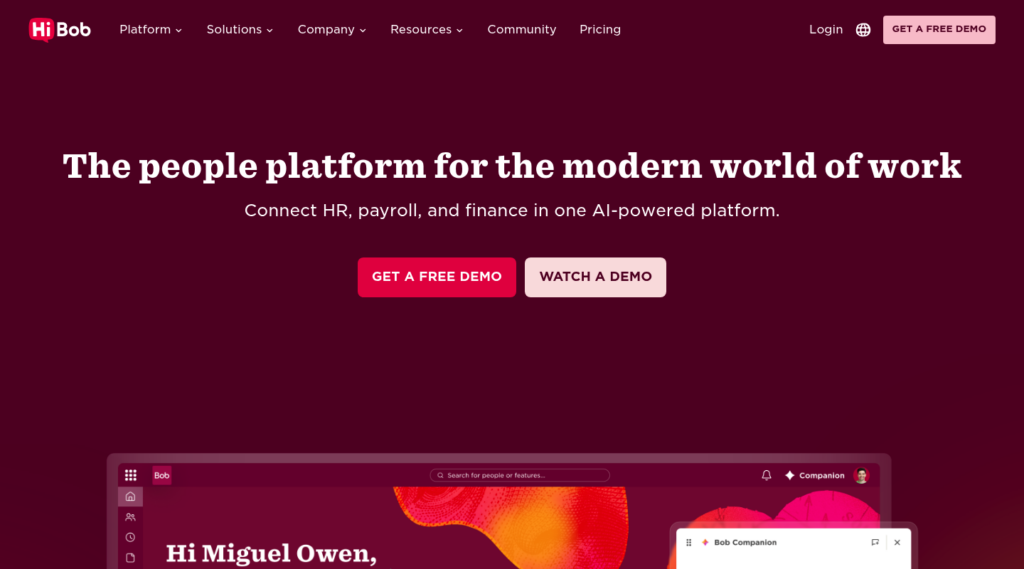
HiBob, the platform most of its users call Bob, takes the top spot because it treats work that most UK tools keep separate as one job. Core HR, UK payroll run in-product, recruiting and onboarding, workforce planning, performance and employee engagement all sit in one connected system, so a growing company can retire three or four point solutions and run people operations from a single source of truth. This is a genuine all-in-one platform rather than an HRIS or a holiday booker with reporting attached.
Bob is built for mid-sized and multinational companies at the scaling stage, with operations spanning several sites, and larger organisations depend on it as well, so it isn’t a tool you’ll have outgrown in two years. The experience is a large part of the point: HR teams, line managers and employees find it intuitive alike, and analyst Josh Bersin’s shorthand for Bob is the Instagram of HCM platforms. Because the platform adapts to each organisation’s own structure, workflows and culture, you configure review cycles, approval flows and permissions to match how you work rather than bending your processes to the software.
The efficiency comes from automation that removes rekeying. Add a starter once and a single joiner workflow creates their holiday allowance, working pattern, documents and payroll record, and the same logic drives movers and leavers. On top of that sits real-time people analytics with AI-assisted insights, so HR leaders can answer questions on headcount, attrition and pay equity from live data instead of a monthly spreadsheet copy. What keeps people coming back, though, is the people-first layer: engagement and lifecycle surveys with sentiment analysis, recognition shoutouts, structured one-to-ones and the Your Voice anonymous channel, all of which balance HR efficiency with the culture work that drives adoption. That engagement-and-culture strength in the modern mid-market is what earns Bob the top spot here.
On compliance, Bob’s UK payroll is native to the platform and HMRC-recognised, with RTI submissions (the FPS and EPS), auto-enrolment for workplace pensions, statutory sick pay, IR35 handling for contractors and year-end P60s and P45s, backed by GDPR controls. For global teams, native Bob payroll covers the UK and the United States, and other countries run through accredited providers in the Payroll Hub. I keep returning to HiBob’s people platform as the reference point for how a modern UK HR system should feel in daily use.
Where it wins
- One system for core HR, UK payroll run in-product, hiring, planning, performance and engagement, replacing several point tools
- People-first engagement, surveys, recognition and feedback that keep managers and employees logging in, rather than HR alone
- Native HMRC payroll with RTI, auto-enrolment, SSP and year-end filing, plus GDPR controls
- Real-time people analytics with AI insights for data-driven decisions
- Customisable to your structure, workflows and culture, and built to scale from SME to enterprise
Where it falls short
- Native Bob payroll covers the UK and the United States only; other countries run through Payroll Hub partners rather than in-product
- Pricing is quote-based, so budgeting needs a short conversation rather than a published rate card
- It is a considered platform that rewards teams who will use the breadth, so a micro-business wanting only a bare holiday tracker may switch on a lighter tool faster
My verdict. For a UK business that wants one modern system to carry it from SME through mid-market and onward to enterprise, with native UK payroll and the engagement tooling that keeps people using it, Bob is the one to beat. The pricing conversation and the proper onboarding are the trade for a platform you grow into rather than out of.
2. Breathe
Best for simple core HR without payroll
- Entry price Tiered monthly by headcount band, published on Breathe’s site
- Native HMRC payroll No, HR only
- Rating signal 4.4/5 on G2 from 608 reviews (checked 13 October 2026)
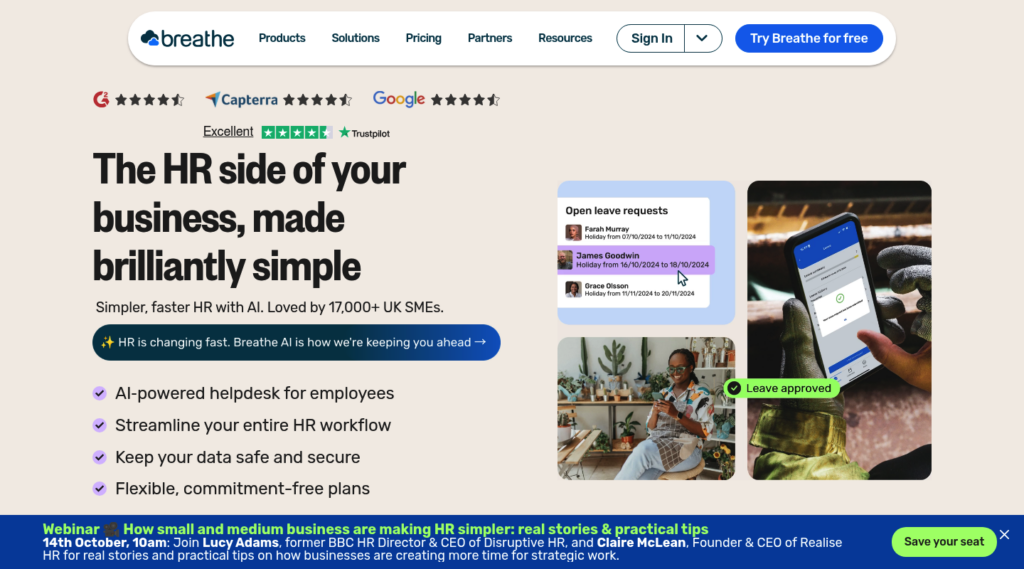
Breathe is a UK-built platform that has stayed narrow on purpose, and it’s better for it. It handles core HR records, holiday and absence, documents, a simple rota and light performance tracking, and it doesn’t pretend to be a payroll system or a talent suite. For a small business that wants nothing more than the admin off paper and out of spreadsheets, that restraint is a feature rather than a gap.
Pricing works in headcount bands rather than per seat, which is worth modelling with care. Sit just over a band boundary and you pay for capacity you’re not using; sit just under one and Breathe can be among the cheapest options here. The published tiering starts at a low monthly figure for the smallest teams and climbs by band as you grow, and the plans carry no long commitment.
Where it wins
- Easy to learn, with a low training burden on managers
- Published, tiered pricing and no quote process to start
- UK-built and UK-supported, with a long SME track record
- Useful free HR templates and guidance alongside the product
Where it falls short
- No integrated payroll, so pay still runs in a separate system and reconciles each month
- Band pricing can bite just after you cross a threshold
- Built for very small teams, with a soft ceiling around 250 employees, so a fast-growing company tends to re-platform rather than scale inside it
My verdict. A sensible choice if your requirement is records and holiday for a small team and nothing more. If you can already see timesheets, payroll or mid-market headcount arriving within a year, buy for that instead and save yourself a migration later.
3. CharlieHR
Best for early-stage startups and culture-led teams
- Entry price Flat monthly bands, about £21 for a team of up to four
- Native HMRC payroll No, integrates with payroll providers
- Rating signal G2 rating of 4.6/5 from 82 reviews (checked October 2026)
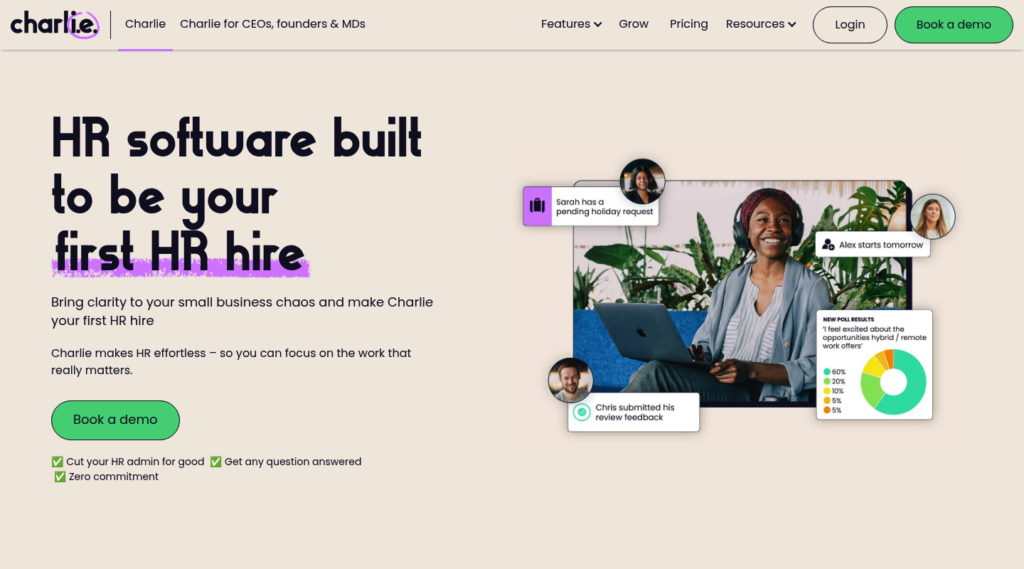
CharlieHR is London-built and aimed at young companies. Onboarding flows, feedback tools and a friendly interface that new starters don’t need training on make it the system a startup team will take to. If your people would rather do HR admin in Slack than in a formal system, Charlie is the one they will put up with.
It’s also honest about its ceiling. Charlie isn’t trying to serve a 400-person manufacturer across three sites with a shift pattern, and you shouldn’t ask it to. Payroll runs via integrations, not in-product, so pay stays a separate process.
Where it wins
- One of the friendliest interfaces here for employee self-service adoption
- Onboarding and feedback tools that suit a growing, culture-led team
- Clear published pricing with no quote process
- An optional HR advice add-on if you have no in-house HR expertise
Where it falls short
- Light on timesheets, shift patterns and deskless-workforce needs
- Reporting stays basic once you pass about 100 employees
- No native payroll, so you run a separate payroll process alongside it
My verdict. The right answer for an office-based team under 100 people who care about how the tools feel. The wrong answer for shift work, multiple sites or heavy compliance tracking, and a platform most scaling companies step up from in time.
4. BrightHR
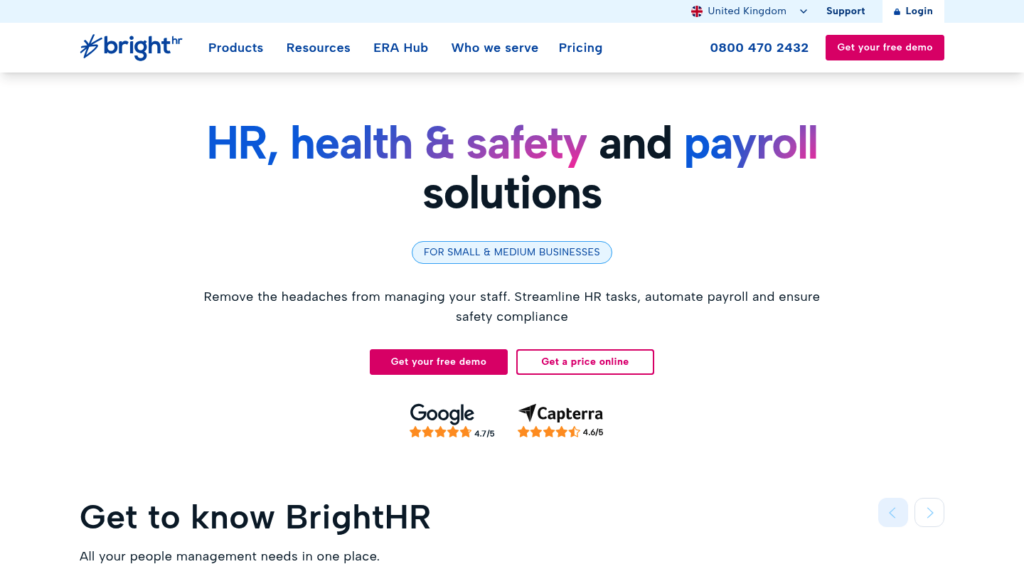
Best for HR software plus bundled employment-law advice
- Entry price Tiered per employee; about £10.70 a month per employee for a ten-person team on the core tier
- Native HMRC payroll Yes, payroll module in the product
- Rating signal G2 rating of 4.2/5 from 205 reviews (checked October 2026)
BrightHR is part of Peninsula Group, an employment-law and HR advisory business, and that lineage is the whole point. You are buying employment-law support with software attached as much as the other way round, and for a lot of UK SMEs without an HR manager that is the correct thing to buy. Facing a tribunal claim, a tricky dismissal or a restructure, a qualified adviser on the phone at 8pm is worth more than any feature.
The software itself covers the expected ground: employee records, absence, rota and shift planning, document storage and a mobile app that deskless staff will use. Payroll is a module that syncs with the HR data and runs HMRC-compliant pay, with health and safety tooling alongside, so treat it as capable UK compliance cover rather than a full people platform.
Where it wins
- Employment-law advice included, not sold as a separate retainer
- A strong choice when you have no in-house HR expertise
- A well-built mobile app for shift-based and deskless teams
- Document templates drafted against UK employment law
Where it falls short
- Pricing is often quote-led and bundled, which makes like-for-like comparison harder
- Contracts can run multi-year, so check the term before signing
- Reporting, analytics and engagement are lighter than the mid-market platforms higher up this list
My verdict. The best pick when the real gap is employment-law confidence rather than software depth. Ask for the total cost across the full contract term, not the monthly figure, before you compare it with anything else here.
5. Sage HR
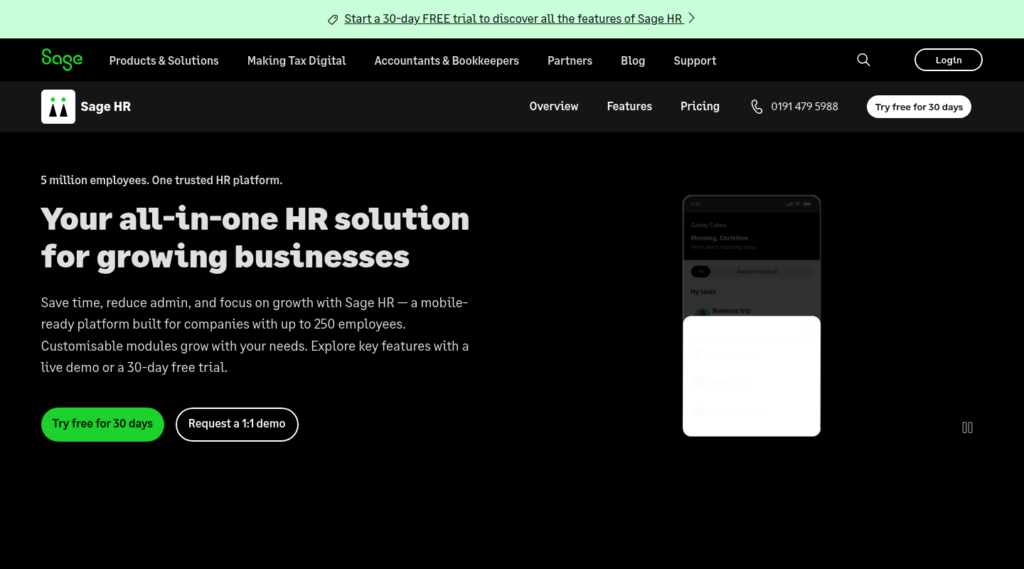
Best for businesses already inside the Sage ecosystem
- Entry price About £5 per employee per month, core module only
- Native HMRC payroll Yes, via Sage Payroll
- Rating signal G2 4.3/5 from 92 reviews (checked October 2026)
The argument for Sage HR is seldom the HR software on its own. It is that your finance team already runs Sage, your accountant already knows Sage, and keeping payroll and people data inside one familiar vendor removes a reconciliation job every month. That is a legitimate reason to buy, and it is why Sage HR appears on so many UK shortlists. Core strengths sit in absence management, shift scheduling and performance tracking, with a mobile app employees use to book leave and check rotas.
The catch is the module structure. Core HR is the base, with leave management, timesheets, performance and shift scheduling as paid add-ons, so the advertised per-employee price is seldom the price you end up paying. Deeper analytics and global scale aren’t where Sage HR competes; it focuses on core UK needs and does them well.
Where it wins
- Tight fit with Sage payroll and accounting, which most UK accountants already know
- A long-established vendor, with low risk of the product disappearing
- Solid absence, scheduling and performance basics for small and mid-sized teams
- Published per-employee entry pricing you can model before you talk to sales
Where it falls short
- Module pricing means the real cost lands well above the headline rate
- Lighter on deep analytics and employee engagement than the platforms above it
- Less compelling if you aren’t already a Sage business
My verdict. Buy it for the payroll and accounting adjacency, not for standout HR features. If you aren’t already in the Sage ecosystem, the same budget buys more engagement and analytics elsewhere.
6. Access PeopleHR
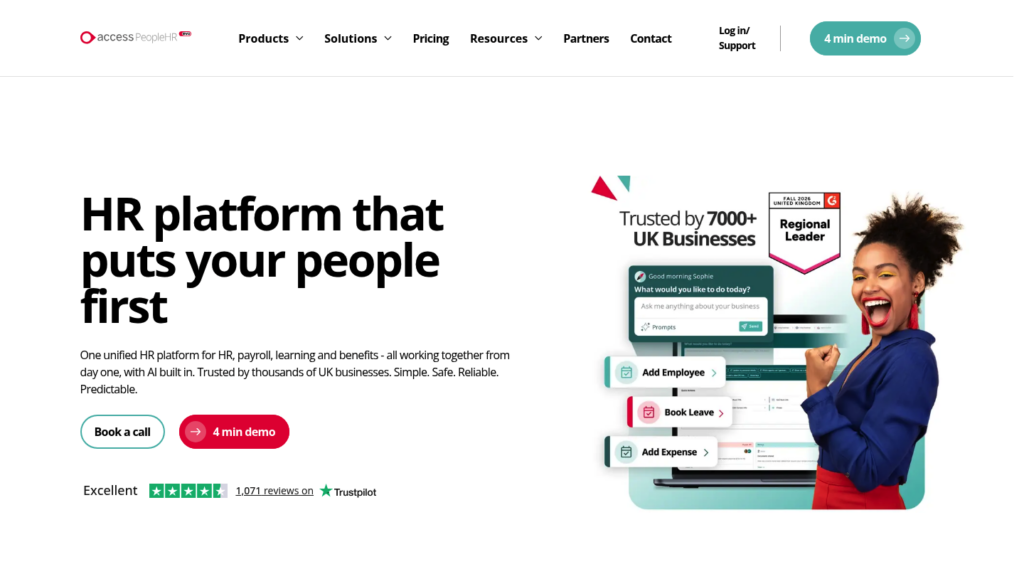
Best for established in-house HR teams wanting depth
- Entry price From £3 per employee per month
- Native HMRC payroll Yes, through Access Group payroll
- Rating signal G2 rating of 4/5 from 486 reviews (checked October 2026)
Access PeopleHR, owned by The Access Group, targets UK businesses that have someone whose actual job title is HR. The depth shows in applicant tracking, performance-review cycles, org charts and reporting that goes beyond headcount and turnover, and it publishes clear per-employee tiers so you can size a plan before a sales call. Payroll is available across the wider Access Group portfolio, which keeps HR and pay under one supplier if that matters to you.
That depth is also the trade-off. If nobody owns HR in your business, a good part of the platform sits unused while you pay for it, and the broader suite carries a heavier, more established feel than the newer mid-market tools. It rewards a team that will configure it well.
Where it wins
- Strong reporting and analytics for the price band
- Applicant tracking included rather than sold as an extra
- Part of a large UK software group, with payroll options alongside
- Flexible enough for multi-entity structures
Where it falls short
- More platform than a business without a dedicated HR person needs
- Setup takes real configuration time, not an afternoon
- It sits inside a wide Access portfolio, so scope which products the contract covers, and the interface feels heavier than the modern mid-market platforms
My verdict. A strong option when you have an HR lead who will own the system and use its depth. Overkill if HR today sits with a finance manager or the founder on a Friday afternoon.
7. Ciphr
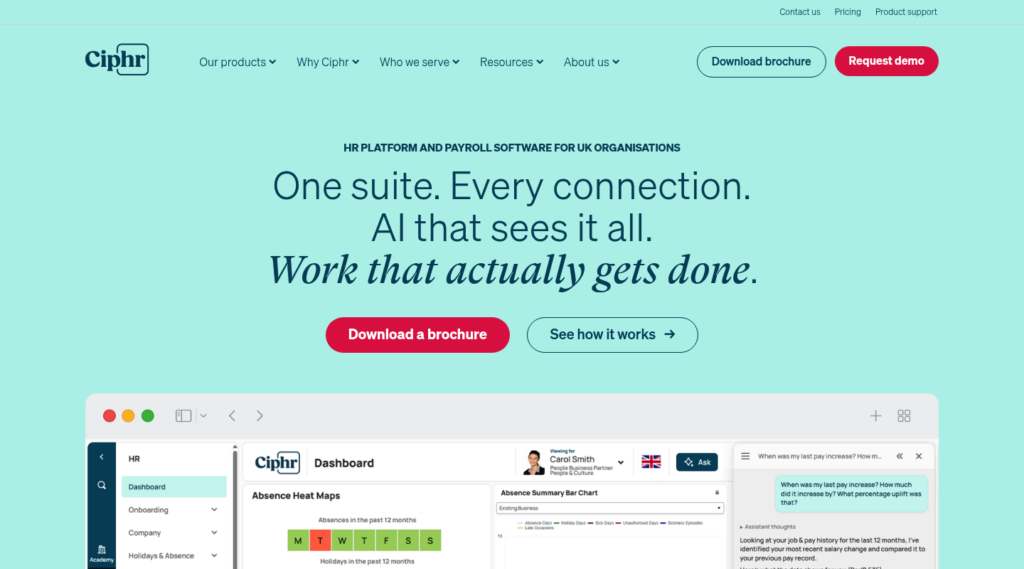
Best for UK mid-market HR and payroll in one suite
- Entry price Bespoke quote
- Native HMRC payroll Yes, through Ciphr Payroll
- Rating signal G2 rating of 3.7/5 from 6 reviews (checked October 2026)
Ciphr is a well-established UK HR and payroll vendor pitched at mid-market and larger organisations that want their core HR, reporting and payroll under one roof. Ciphr Payroll runs UK PAYE in-product, and the suite stretches into recruitment, learning and analytics, so a larger HR team can standardise several processes with one supplier. For regulated UK employers with established HR functions, that single-supplier story carries real weight.
The suite is capable rather than light, which means it is a considered purchase. Pricing is quote-led and implementation is a project, so the value case is strongest when you have the headcount and the HR maturity to use what you are paying for.
Where it wins
- UK HR and payroll in one established suite, with PAYE handled in-product
- Depth across recruitment, learning, analytics and reporting for larger teams
- A UK vendor with a long compliance track record and UK-based support
- Suited to mid-market and enterprise HR functions that want one supplier
Where it falls short
- Quote-based pricing and a proper implementation, so not a same-week self-serve setup
- Heavier and more process-led than the modern, engagement-first platforms
- More capability than a small team without a dedicated HR function will use
My verdict. A sound shortlist entry for a UK mid-market or larger employer that wants HR and payroll from one established supplier. A growing team that also wants modern engagement and a fast time-to-value will want to weigh it against the platforms higher up this list.
8. Employment Hero
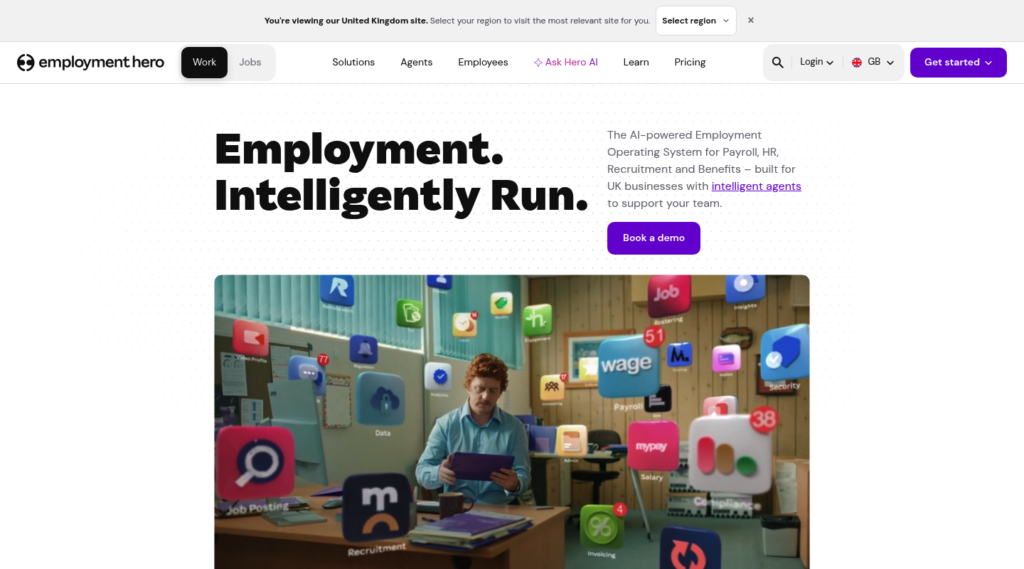
Best for consolidating HR and payroll on a lean budget
- Entry price £4 a month per employee (HR Essentials); HR Engage £7
- Native HMRC payroll Yes, integrated payroll
- Rating signal G2 4.4/5 from 4,331 reviews (checked October 2026)
Employment Hero’s pitch is consolidation: HR, payroll, benefits and hiring in one subscription instead of three, with a published UK price list that starts at a £4 HR Essentials tier and a payroll product that carries no subscription charge. When it works, it removes the monthly export-and-reconcile ritual that is the most tedious job in UK people admin, and the integrated payroll handles auto-enrolment and RTI.
The platform arrived in the UK from Australia, and while the UK payroll side has matured, it rewards pointed questions about your specific circumstances, above all if you have complex pay elements, salary sacrifice or unusual pension arrangements. Breadth across so many modules also means some areas feel shallower than a specialist.
Where it wins
- HR and payroll in one system, not integrated after the fact
- Published UK pricing from a £4 HR Essentials tier, competitive for the breadth on offer
- An employee benefits and discounts layer included
- A good fit for growing UK businesses consolidating several tools
Where it falls short
- UK payroll edge cases deserve close scrutiny in a demo
- Breadth means some modules feel lighter than the specialists
- Switching payroll mid-year is a real project, so time it with care
My verdict. Worth a serious look if consolidating HR and payroll on a budget is the goal. Take your three most awkward payroll scenarios into the demo and make the platform prove it before you move.
9. Personio
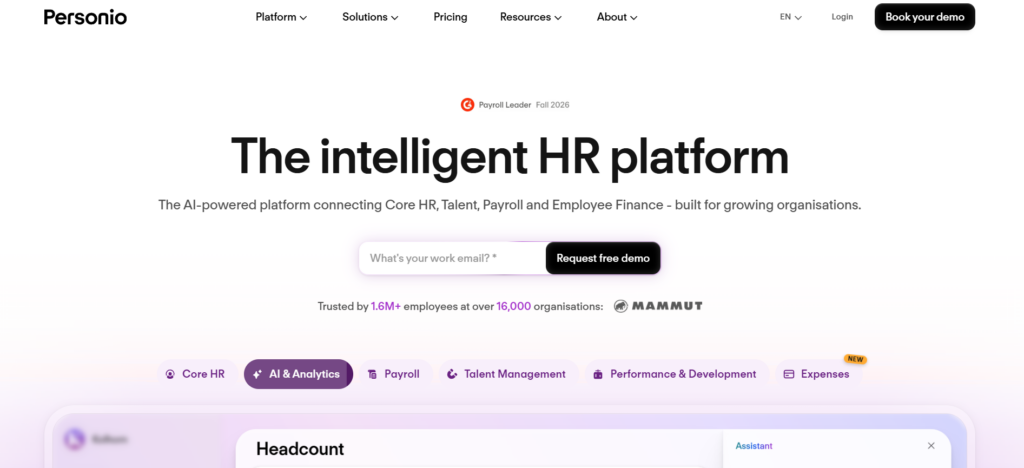
Best for multi-country European teams
- Entry price About £6.50 a month per employee to start, full package quoted
- Native HMRC payroll Via partners in the UK
- Rating signal G2 4.4/5 from 1,043 reviews (checked October 2026)
Personio’s advantage is European breadth. Employ people in the UK, Ireland, Germany and Spain, and a platform that already understands several sets of employment rules saves you running four systems or one system with three workarounds. Recruitment and applicant tracking are strong, and approval workflows suit larger, process-driven teams.
The flip side is that UK-specific detail is one country among many rather than the whole design brief. Personio’s payroll strength sits in its home DACH region, and UK payroll runs via integrations and partner providers, not a native HMRC engine. Smaller UK firms sometimes find the platform heavier than their needs.
Where it wins
- Handles several European jurisdictions in one system
- Strong recruitment and applicant tracking built in
- Good approval workflows for larger, process-driven teams
- A well-resourced vendor with a UK presence
Where it falls short
- UK payroll goes through partners, not a native HMRC engine
- Only the entry price is published; the full package is quoted with annual commitments
- More system than a UK-only business under 100 people tends to need, and lighter on deep workforce planning than the platforms built for it
My verdict. A clear winner if your headcount crosses European borders. If every employee is in the UK, you’re paying for breadth you won’t touch, and a UK-native platform with native payroll will fit better.
10. Factorial
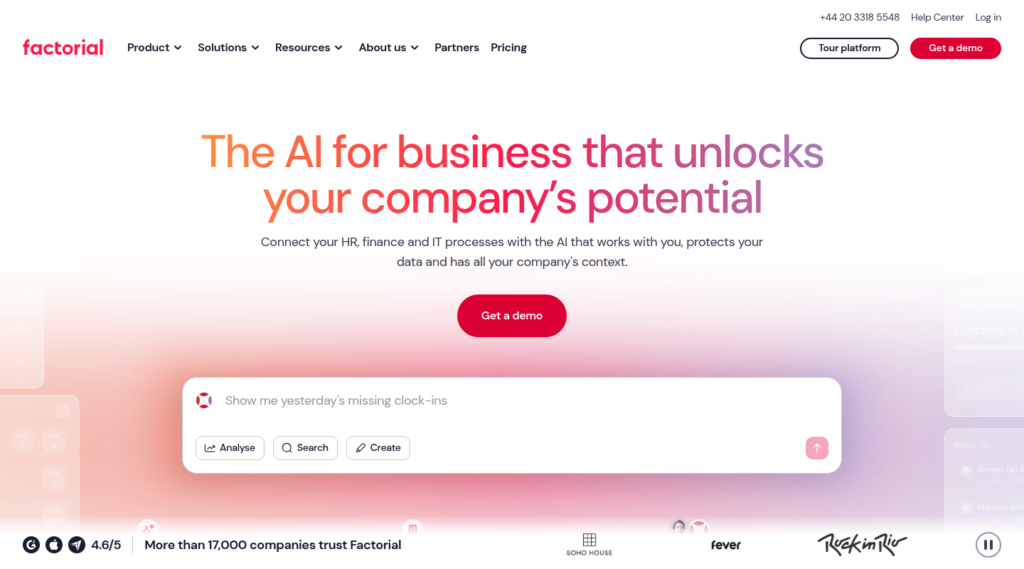
Best for operations-heavy teams
- Entry price Per employee, per module
- Native HMRC payroll Via integrations
- Rating signal G2 4.4/5 from 110 reviews (checked October 2026)
Factorial reaches further into operations than most HR platforms, covering expenses, document signing and shift planning alongside core HR. For a business where HR and operations are the same two people, having those jobs in one place is useful, and the interface is modern with a quick self-serve setup.
It’s the least UK-focused platform on this list, which shows in support hours and in how it handles UK-specific processes. UK payroll runs via integrations, not in-product, and the module pricing pushes the real cost up once you add what you need. None of that is disqualifying, but go in knowing it.
Where it wins
- A broad feature set including expenses and e-signature
- Competitive entry pricing on the base tier
- Good shift and time tracking for operational teams
- A modern interface with quick self-serve setup
Where it falls short
- Support is EU-based, so guaranteed UK-hours cover isn’t a given
- UK employment specifics are less developed than the UK-built rivals, and payroll runs via integration
- Module pricing pushes the real cost up fast
My verdict. A reasonable option if you want HR and operations tooling together and you’re relaxed about UK support hours. Not the pick if UK compliance detail and native payroll are your priority.
How to choose HR software for a UK business
Most poor HR software purchases come from buying for the business you have today and discovering six months later that the thing you needed sat behind a higher tier, rather than from picking a bad platform. Five questions prevent most of that.
The job you are hiring the software to do
Write down the three tasks that waste the most time this month. Chasing holiday requests. Rekeying timesheets into payroll. Hunting for a signed contract. If a platform doesn’t fix all three in the demo in front of you, it’s the wrong platform, however good the feature list looks.
The cost at your real headcount
Ask every vendor for the total annual cost at your current headcount, then again at headcount plus 30 percent. Include per-location fees, minimum seat counts and any implementation charge. The cheapest headline rate often loses on this calculation, because two platforms at £5 per seat can differ by double once you add the modules you need.
Payroll inside the same system, or not
This is the single biggest fork in the road for UK buyers. One system running HR and native HMRC payroll removes the monthly reconciliation and keeps RTI, auto-enrolment and SSP in one place, which is why HiBob tops this list. Separate systems with a clean export keep you flexible and let you use a specialist payroll bureau. Both are defensible; decide on purpose rather than by accident.
The person who will administer it
A platform built for a professional HR team will underperform in the hands of a finance manager doing HR on Fridays, and a simple platform will frustrate an experienced HR lead within a year. Match the tool to the person who will own it.
Getting your data out
Ask about export before you ask about anything else. You should be able to take every record, document and report out in a standard format whenever you want, which also matters for GDPR and subject-access requests. A vendor who is vague about this is telling you something important.
One practical tip: run the trial with real data, not the sample set. Import twenty actual employees, book a genuine holiday request and produce one report you would send to a director. A platform that survives that will survive your Monday mornings.
The features every UK HR system should include
Ignore the long feature grids for a moment. Whatever you choose, these are the components that carry the daily load in a UK business, and any platform missing one of them pushes that work back onto a spreadsheet.
- A single employee record. One profile per person holding personal details, contract, job and pay history, documents and notes, with everything else reading from it rather than keeping its own copy.
- Holiday and absence. Allowances calculated from start dates and working patterns, self-service requests, line-manager approval, and a calendar that shows clashes before they happen, with correct bank-holiday and part-year accrual.
- Document storage with expiry dates. Contracts, right-to-work evidence, DBS certificates and policies held against the person, with reminders before anything lapses.
- Payroll-ready output or native payroll. Either native HMRC payroll with RTI, auto-enrolment and year-end filing in the same system, or a clean export your payroll provider accepts without rekeying.
- Role-based permissions. Line managers see what they need, salary and case notes stay with HR, and the system logs every access for GDPR purposes.
- Reporting from live data. Headcount, turnover, absence rates and gender-pay-gap inputs generated from records rather than a monthly copy and paste.
- Engagement and performance. Review cycles, objectives, surveys and recognition that draw on job history and keep managers and employees in the system rather than living in a separate document.
- A UK compliance layer that moves with the law. Statutory leave and sick pay rules, right-to-work checks, Bradford Factor scoring for absence and updates aligning with statutory changes, such as April 2026 day-one SSP and statutory leave, the reduced six-month unfair dismissal qualifying period from January 2027, updated fire-and-rehire rules, and the start of the 2027/28 tax year (6 April 2027), when HMRC’s phased mandatory payrolling of benefits in kind begins, should arrive as product updates, not as a policy you maintain in a document.
What HR software costs in the UK
UK HR software tends to land between £4 and £12 a month per employee for core HR, with three pricing shapes you’ll meet again and again.
Per seat, per month is the most common and the easiest to forecast. You pay for each employee in the system, and cost rises with headcount. Watch for minimum seat counts, which can make a 12-person business pay for 20.
Headcount bands group you into tiers such as 1 to 10 or 11 to 25. These are cheap in the middle of a band and poor value just after you cross into the next one, which is how Breathe and similar SME tools set their prices.
Bundle or quote-based pricing means a conversation rather than a rate card, which is how HiBob, Ciphr and Personio sell. It can work out well, and with native payroll included it often replaces several separate subscriptions, but it makes comparison harder and tends to come with a longer contract term. Always ask for the total cost over the full term.
For a 50-person business, budget about £250 to £500 per month for core HR before payroll. Add implementation fees where they apply, and weigh the module structure over the headline rate. If you fold native HMRC payroll into the same platform, compare the combined figure against what you pay today for a separate HR tool plus a payroll bureau, because the consolidated cost often comes in lower than it first looks.
The bottom line on the best HR software for UK companies
The best HR software for a UK company in 2026 is whichever one matches your headcount, your appetite for running payroll in-house and the person who will own it. For most growing UK teams, HiBob is the strongest all-round answer, because it combines modern, people-first core HR, genuine employee engagement and native HMRC-recognised UK payroll in one platform with the scale to go from SME to mid-market and beyond. Breathe wins on simple, low-cost core HR for the smallest teams, BrightHR when bundled employment-law advice is the priority, and Sage HR when you already live inside the Sage ecosystem. Shortlist two or three, run each on real data for a fortnight, and let your own Monday mornings decide.

David Prior
David Prior is the editor of Today News, responsible for the overall editorial strategy. He is an NCTJ-qualified journalist with over 20 years’ experience, and is also editor of the award-winning hyperlocal news title Altrincham Today. His LinkedIn profile is here.