




















































As digital transformation accelerates, organizations are under pressure to support customers more quickly, automate internal processes, and reduce operational costs while improving the user experience. Artificial intelligence (AI) has become a strategic pillar in achieving these goals, and one of the most impactful applications is the deployment of AI-powered chatbots.
AI chatbot development services enable businesses to deploy intelligent conversational assistants that understand natural language, personalize interactions, process complex requests, and automate workflows across customer service, sales, HR, IT, and more.


Modern chatbots are no longer limited to predefined rules or rigid scripts. Thanks to advancements in natural language processing (NLP), large language models (LLMs), and deep learning, chatbots now deliver fluid, human-like conversations that support users at scale.
This article explains what AI chatbot development services include, why they matter, what problems they solve, and how organizations can leverage them to accelerate growth and efficiency.
What Are AI Chatbot Development Services?

AI chatbot development services cover the end-to-end design, implementation, and optimization of intelligent virtual assistants trained to interact with users in natural language.
A comprehensive service typically includes:
1. Business Analysis and Strategy
Understanding organizational needs, customer journeys, operational bottlenecks, and automation opportunities.
2. Conversational Architecture and UX
Mapping intents, entities, response models, dialogue flows, fallbacks, and escalation routes.
3. AI Model Selection
Choosing the appropriate technology stack such as:
- Machine learning models
- NLP engines
- LLMs like GPT-4, Claude, Llama, Gemini
- Hybrid architectures
4. Custom Chatbot Development
Building a chatbot tailored to brand voice, industry requirements, and use case complexity.
5. System Integration
Connecting the bot with enterprise systems:
CRM, ERP, HRIS, support platforms, databases, APIs, BI layers.
6. Training and Fine-Tuning
Feeding real conversation data into the model, improving accuracy, and aligning tone with brand identity.
7. Testing and QA
Validating conversational flows, edge cases, multilingual support, performance, and integration stability.
8. Deployment and Optimization
Launching across channels (web, mobile, messaging apps) and continuously improving based on analytics.
Companies choose custom chatbot development to gain full control over accuracy, security, performance, and integration. Off-the-shelf bots cannot provide this level of flexibility.
Why AI Chatbot Development Services Matter

Chatbots play a strategic role across modern enterprise functions. Their value extends far beyond answering FAQs or providing simple automated responses.
1. Instant, 24/7 Support Across All Channels
Customers expect immediate answers. AI chatbots provide always-available support without overwhelming human agents:
- Zero waiting time
- Multilingual responses
- Consistent answers
- Support outside business hours
2. Lower Operating Costs Through Automation
Support teams spend large amounts of time handling repetitive tasks:
- Password resets
- Order tracking
- Account questions
- Policy explanations
AI chatbots automate these interactions and can reduce support volume by 50 to 80 percent.
3. Improved Customer Experience
AI chatbots offer:
- Personalized responses
- Predictive assistance
- Smooth handoff to humans
- Memory of past interactions
- Context-aware dialogue
This improves overall satisfaction and customer retention.
4. Higher Sales and Conversion Rates
AI chatbots act as virtual sales assistants. They can:
- Qualify leads
- Recommend products
- Detect buying intent
- Offer incentives
- Guide checkout flows
Businesses often see conversion increases of 20 to 35 percent.
5. Better Internal Operations and Employee Support
AI chatbots streamline workflows across HR, IT, finance, and operations.
Examples include:
- HR onboarding
- IT troubleshooting
- Policy queries
- Employee scheduling
- Training and eLearning support
These improvements increase productivity and reduce internal support costs.
Types of AI Chatbots Companies Can Build

1. Rule-Based Chatbots
Simple logic-driven bots are ideal for basic tasks and FAQs.
2. NLP-Driven Chatbots
More advanced bots that understand natural language and intent.
3. LLM-Powered Chatbots
The most powerful type. These bots can reason, hold multi-turn conversations, retain context, generate dynamic responses, and help with content processing.
4. Voice Assistants
Chatbots with speech-to-text and text-to-speech capabilities.
5. Omni-Channel Chatbots
Deployed across websites, apps, messaging platforms, and enterprise tools.
6. Industry-Specific Chatbots
Purpose-built for healthcare, finance, real estate, education, eCommerce, and more.
Top Industries Using AI Chatbots Today
Retail and eCommerce
Personalized shopping, order tracking, upselling, and cart recovery.
Healthcare
Appointment scheduling, symptom screening, patient onboarding, and medication reminders.
Finance and Banking
Account support, fraud alerts, transactions, and personalized financial advice.
Education and eLearning
Virtual tutoring, lesson assistance, and adaptive learning guidance.
Real Estate
Lead qualification, property recommendations.
Travel and Hospitality
Booking, itinerary management, and real-time support.
Enterprise IT and HR
IT helpdesk automation, HR self-service, workflow management.
Key Features of a High-Quality AI Chatbot
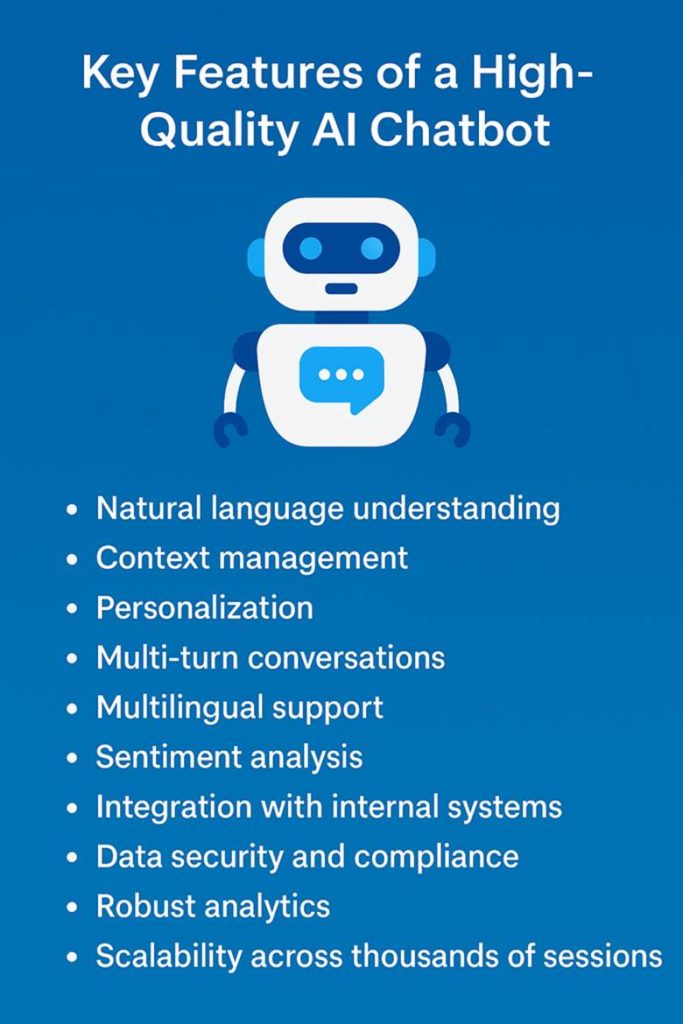
A strong chatbot solution should include:
- Natural language understanding
- Context management
- Personalization
- Multi-turn conversations
- Multilingual support
- Sentiment analysis
- Integration with internal systems
- Data security and compliance
- Robust analytics
- Scalability across thousands of sessions
How AI Chatbot Development Services Work
1. Discovery and Requirements Gathering
Identifying goals, workflows, user needs, and success metrics.
2. Conversational Design
Creating the flow of dialogues, intents, and escalation paths.
3. AI Model Selection
Choosing NLP, ML, or LLM-based architectures.
4. Development and Integration
Building the bot and connecting it to APIs, databases, and enterprise systems.
5. Training and Fine-Tuning
Improving accuracy using historical data and real conversations.
6. Testing and Quality Assurance
Ensuring accuracy and reliability across channels.
7. Deployment
Launching the chatbot for web, mobile, and messaging applications.
8. Continuous Optimization
Using analytics to refine responses and expand capabilities.
Benefits of Custom Chatbot Development Compared to Ready-Made Tools
| Ready-Made Bots | Custom Development |
| Quick setup | Tailored to business workflows |
| Basic features | Advanced capabilities including LLMs |
| Limited flexibility | Full control and scalability |
| Generic responses | Personalized user experience |
| Vendor lock-in | Ownership of architecture |
Most growing organizations choose custom development because it supports scale, accuracy, security, and deep integration.
Conclusion

AI chatbot development services are now a strategic investment rather than a convenience. Intelligent chatbots reduce support costs, improve customer satisfaction, automate internal operations, and increase sales. Companies that implement conversational AI early gain a clear competitive advantage.
With the right design, integrations, and long-term optimization, AI chatbots become a core part of a company’s digital infrastructure. Working with an experienced AI development team ensures your solution is built with accuracy, aligned with your objectives, and capable of delivering long-term ROI.