


















































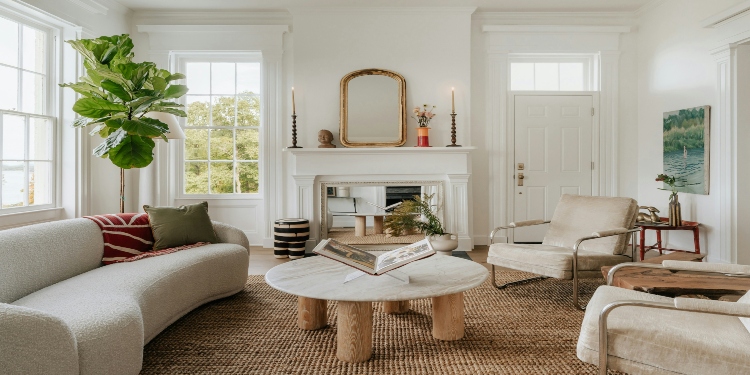
Not all sofas invite the same approach to the room around them. A sharp-edged, low-profile modular sofa calls for clean horizontal lines, controlled palette, and minimal layering. A sofa with rounded arms, a deeper seat, and a softer silhouette asks for something quite different. It is a piece that already communicates comfort and enclosure; the styling decisions around it need to extend that character rather than contradict it.
Getting this right is not difficult once the underlying logic is understood. The challenge is that most general interior design advice treats all sofas as equivalent starting points. They are not. A rounded, upholstered sofa with generous proportions sets up a visual conversation that geometric, minimal pieces do not, and responding to it correctly produces a room of a very specific and appealing warmth.


Why natural elements change the room around a soft sofa
Research into biophilic design has established that incorporating natural elements into interior spaces produces measurable improvements in mood, stress reduction, and cognitive function. A January 2026 systematic review synthesising evidence from 136 studies across seven types of biophilic interventions found that natural materials and indoor plants were among the most consistently effective interventions for restorative outcomes and positive human physiological response. The practical implication for interior styling is direct: a room furnished with natural textiles, wood, and living plants is not simply more attractive. It is measurably better for the people inside it.
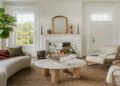
For a room built around a soft, rounded sofa, these natural elements are not additions. They are natural extensions of the sofa’s own character. The rounded arms that give the piece its warmth find their visual equivalent in the organic, irregular forms of a plant. The depth of a natural linen cover relates to the grain of wood in a side table or the texture of a jute rug. The room reads as coherent because its elements share a material logic, not because they were chosen from a matching set.
Starting with the cover before anything else
The IKEA Ektorp is one of the most enduringly popular sofas in Europe precisely because its rounded profile and generous upholstery communicate comfort without requiring the room around it to do any compensating work. It is a piece that people immediately understand as a place to settle in. The styling job around it is to honour rather than undermine that character.
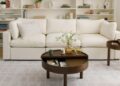
The first decision is always the cover. The Ektorp’s profile makes the fabric highly visible from all angles, which means the cover communicates the room’s material tone more directly than almost any other element. A synthetic cover in a uniform weave makes the sofa’s soft form look generic. A natural linen or cotton cover in a warm neutral makes the same form look deliberately chosen and appropriately soft.
When styling a living room around an Ektorp’s rounded silhouette, the cover is the most useful place to establish the room’s material and colour direction. Once that dominant surface is settled, the rug, curtains, side tables, plants, and cushions all have a clearer reference point instead of being chosen as unrelated additions.
Building the room from the sofa outward
Once the cover is established, the elements that complete the room follow a consistent logic. For a rounded, generously proportioned sofa:
• Choose a rug with organic texture rather than a flat weave or geometric pattern. A jute, wool, or hand-loomed cotton rug introduces the kind of material variety that feels appropriate under a soft sofa, while a flat geometric rug competes with the sofa’s rounded character rather than supporting it. The rug should be generous enough that, at minimum, the sofa’s front legs rest on it
• Add cushions that vary in texture rather than in colour. A set of cushions in a heavier cotton or a light boucle introduces tactile interest while staying within the tonal family established by the cover. Cushions that match the cover exactly add nothing; cushions that sharply contrast in colour fragment rather than extend the room’s warmth
• Place a low side table at the arm end of the sofa rather than directly in front of it. A rounded sofa loses its proportional logic when paired with a large, flat-topped coffee table that dominates the view from the seating. A lower, smaller surface at the side maintains the room’s visual openness while still providing the practical surface that seating arrangements require
• Bring in at least one plant with visible organic form. A large-leafed specimen in a terracotta or stone pot relates directly to the natural material logic of a linen cover and a jute rug, while also introducing the restorative benefit that the biophilic design research consistently identifies. A room with a rounded sofa and a living plant in a natural-material pot is already making a coherent statement about warmth and care
Colour choices that work with rounded upholstered forms
A rounded sofa with generous upholstery creates a visual warmth that the room’s colour palette should extend rather than contrast. Cool, sharp, or high-contrast palettes work against the piece’s character. The same sofa in a pale terracotta room or against a warm limewash wall looks as though it belongs; the same sofa against a cool dark grey wall reads as a conflict between two competing intentions.
The palette that most reliably extends the warmth of a rounded sofa: warm whites and off-whites for walls, natural and earthy tones for the rug and secondary textiles, and one deeper accent tone, sage, terracotta, or warm ochre, introduced through a single cushion, a vase, or a throw. This palette is not a formula. It is a tonal logic that responds to the piece rather than overriding it.
Light and the soft sofa in the evening
A rounded, upholstered sofa is at its best in evening lamplight, when the form’s soft edges produce a quality of enclosure and warmth that overhead light flattens. A room styled around a piece like the Ektorp benefits significantly from investing in floor and table lamps rather than relying on a central ceiling fixture. The warm light from a floor lamp positioned behind the sofa or to one side creates the kind of ambient depth that makes a room feel genuinely inviting after dark.
A linen cover in a warm natural tone performs particularly well under this kind of lighting. The fabric’s irregular weave scatters the warm lamplight in multiple directions, producing a surface that reads as rich and alive rather than flat. This is the evening quality of the room that the styling decisions made during the day are working toward: a space that becomes more inviting rather than less as the natural light fades.