




















































Two facilities can have similar amounts of hard flooring and still need different floor scrubbers. One may have long, open corridors with a clear route back to a service area. The other may divide the same area among small rooms, narrow passages and busy entrances. A machine’s cleaning width alone cannot tell a buyer which site it suits.
Walk-behind and ride-on scrubbers both wash suitable hard floors and recover dirty water. The practical difference is how the operator moves through the building, how much space the complete machine needs and how often it must stop during a shift. Draw the cleaning route and note the available time before looking at prices or rated productivity.


Where a Walk-Behind Scrubber Fits
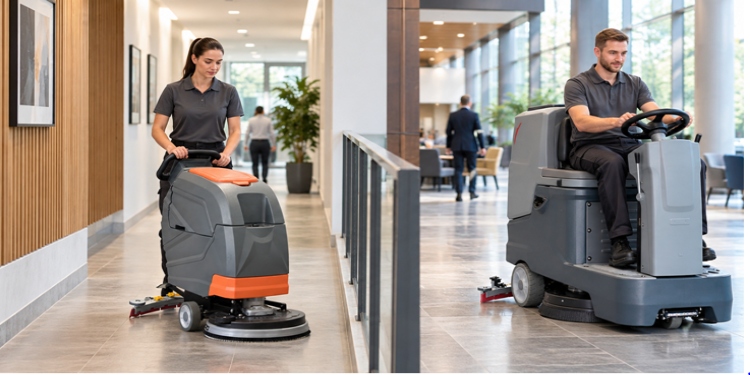
With a walk-behind floor scrubber, the operator walks behind the machine and steers it through the route. Some models are pushed manually; others have powered drive. This format can work well where cleaning involves frequent turns, separate rooms or access around fixed furniture, provided the chosen model fits the narrowest points.
Record how far the operator will walk in a shift. A small machine that fits every doorway may still make a long route tiring or slow. A self-propelled or higher-capacity walk-behind model may suit a longer shift if its dimensions and service needs fit the building.
Measure the machine’s full width, including the water-recovery assembly, and leave space for the operator to guide it through turns. Check its path to the refill, drainage and storage points as well as the cleaning area.
Where a Ride-On Scrubber Fits
A ride-on floor scrubber lets the operator drive while seated. On a long, fairly open route, this removes much of the walking involved in using a walk-behind machine. Depending on the model, a wider cleaning path and larger tanks may also reduce passes and service stops.
A ride-on machine needs enough space to turn at the end of each run, pass through doorways and reach its parking, charging, refill and drainage points. Repeated reversing around obstacles takes time out of a short cleaning window and can make the route awkward for the operator.
Ride-on models vary in size. A compact model may work on a route that would rule out a larger seated machine. Measure the turning space before excluding every ride-on option because one aisle is narrow.
Trace the Cleaning Route
Start with the area the machine will actually clean during a normal shift. Leave out carpeted rooms, sections cleaned by another method and space blocked by fixed equipment. Then walk the route from the storage point to the first cleaning area and back again. Measure the tightest doorway or passage, turns at corridor ends and any lift or threshold the machine must cross.
Two sites can have the same cleanable floor area. One has a continuous main corridor; the other has several short corridors linked by narrow doorways. The first may give a ride-on machine enough uninterrupted distance to use its capacity. In the second, a walk-behind model may spend less time repositioning. Check both possibilities against the dimensions of actual machines.
Note when the route is available. An entrance cleaned before opening has a different time limit from a back-of-house corridor that can be serviced throughout the day. If staff or visitors remain nearby, the plan also needs a safe way to manage machine movement and any temporary wet area.
Work Out What Fits Into the Cleaning Window
Rated productivity and cleaning width help narrow a shortlist, but neither includes every turn, overlap, refill or trip to empty a recovery tank. Ask how the figures were measured, then estimate the time for a complete shift on the facility’s route. A wider machine may save passes in an open area while taking longer to manoeuvre through divided spaces.
Check the solution and recovery tanks alongside the location of water and drainage. A larger tank may reduce stops, but it can add to the machine’s size and weight. Battery runtime is another separate check: can the proposed machine finish one cleaning cycle within the available window? If the machine is used for several cycles, confirm when and where it can recharge between them.
Count the operator’s walking time as well. A walk-behind model means time on foot, while a ride-on model changes the operator’s visibility and turning task. Both require training, daily inspection and a place to park without obstructing the building. Ask the supplier which consumables and service parts apply to the proposed configuration, then include those recurring tasks in the cost assessment.
Test Shortlisted Models Under the Same Conditions
Where a trial is possible, use the most restrictive part of the real route as well as an open section. Record whether each machine passes through the narrowest point, turns without repeated repositioning and completes the assigned area within the cleaning window. Include filling, emptying, cleaning the recovery components and returning the machine to storage.
Floor suitability is a separate check for either format. Confirm the surface and its maintenance instructions before selecting a brush, pad or cleaning solution. Loose dry debris may need to be collected before wet scrubbing, and a worn or damaged finish may need attention before a machine-cleaning routine is adopted.
The result of the trial should be a short route record: access measurements, cleaning time, operator observations, service stops and any floor restrictions. If one format fits the route but cannot complete the work within the available window, test another configuration before deciding that the whole machine type is unsuitable.
Choose the Machine That Completes the Route
A facility with divided areas may favour close operator control; a long, open route may make seated operation more practical. Shortlist machines that fit the narrowest point, then test whether the operator can complete the full cleaning cycle and service the machine within the available window.