

















































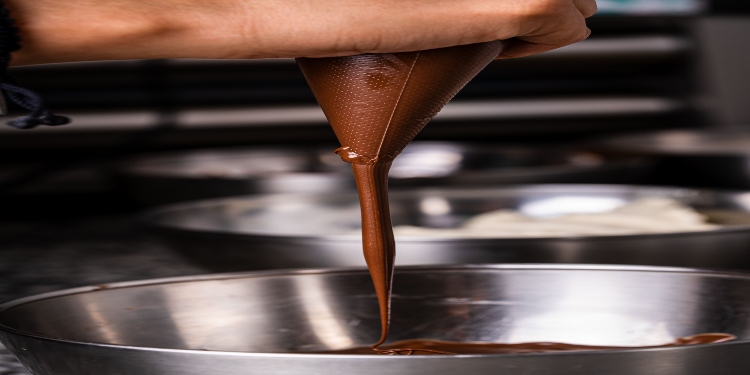
Hand-dipping looks charming on a market stall and turns into a bottleneck the week a supermarket buyer asks for a second listing. Plenty of small British chocolate brands reach that point with a kitchen team dipping caramel squares, biscuit fingers or honeycomb by hand, a tabletop temperer and a cooling rack that is full before lunch. Moving to a chocolate enrobing machine fixes the labour problem, but it adds three decisions that hand work never forced: how wide the coating belt should be, how the chocolate is kept in temper, and what the supplier must prove before the balance is paid.
This guide works through those decisions in the order a growing brand meets them. Equipment figures come from the published specifications of SINOFUDE, a Shanghai manufacturer of chocolate, confectionery and bakery machinery, and the compliance points are framed for buyers setting up in Great Britain.


What a chocolate enrobing machine actually does
An enrober carries a centre on a wire belt through a curtain of liquid chocolate, usually with a bottoming bath underneath and a blower above that strips off surplus coating. Each piece then travels into a cooling tunnel where the coating sets. Moulding works the other way round: chocolate goes into a cavity first and the set piece is released afterwards.
Default to enrobing when the centre is made somewhere else, such as a baked biscuit, a slab of fudge or a wafer, and default to moulding when the chocolate itself is the product. Brands selling solid bars and coated flapjack bites are running two routes, even if both sit in one unit on an industrial estate.
Coating width is the first number to fix
Belt width sets how many pieces cross the curtain side by side, which makes it the closest thing an enrober has to a capacity rating. Across SINOFUDE CTC lines, chocolate enrobing runs on 400, 600, 800, 1000 and 1200 mm working widths. Its CXTC compact units carry 8 to 60 kg melting pots on 200 mm or 300 mm belts built in SUS304 stainless steel of 1.5–3.0 mm.
Wider is not automatically better for a small brand. Half-empty belts still need the full curtain of chocolate in circulation, the full cooling length and the full clean-down at the end of the shift. Count how many centres a person or a feeder can lay across each row, multiply by the row pitch the cooling section allows, and pick the narrowest belt that meets next year’s volume rather than the five-year plan.
Where it stops: a compact enrober suits development batches and short runs. Once orders justify a second shift, the compact route becomes the constraint and a full-width line is the comparison worth making.
Batch tempering: where most small brands start
Chocolate made with cocoa butter has to be tempered so it sets in the stable Form V crystal, which gives the snap, gloss and resistance to fat bloom that customers notice. On the supplier’s range, the CTW10, CTW50 and CTW100 units temper 10, 50 and 100 kg per hour in batches, and those are the models it lists for chocolatiers, development kitchens and small factories.
Time is the weakness of any batch. The manufacturer’s own guidance points out that the whole charge of a wheel-type batch temperer is tempered at once and keeps changing minute by minute while it waits, so a bigger batch machine is not necessarily steadier. Moulding tables cope with that. Enrobers are less forgiving, because the curtain recirculates the same chocolate for hours and unevenly tempered chocolate builds up in it.
Where it stops: keep batch tempering if the enrober runs short campaigns and the team retempers between charges. Stop relying on it once gloss or bloom varies between the first tray of the morning and the last one of the afternoon.
Continuous tempering and when it pays
Continuous temperers hold chocolate in temper at the outlet instead of tempering a charge and letting it drift. Two models cover this on the SINOFUDE range: CTW250 and CTW500 run chocolate tempering continuously at 250 and 500 kg per hour, and the company names enrobing as the route where that steadiness matters most.
| Tempering method | Published models and rate | Behaviour on an enrobing curtain |
| Batch | CTW10, CTW50, CTW100 at 10, 50 and 100 kg per hour | Whole charge tempered at once, then drifts while it waits |
| Continuous | CTW250, CTW500 at 250 and 500 kg per hour | Chocolate kept in temper at the outlet |
| None needed | CBR or CBS compound coatings | Crystallises straight from the melt |
A temperer has to supply every station drawing tempered chocolate at the same time, which means adding the enrober’s draw to any moulding or drop depositing that shares it before choosing a model. Its online tempering-match tool flags any total above 500 kg per hour, the ceiling of the continuous range.
Where it stops: continuous tempering earns its place on a coating line that runs most of the day. For a brand enrobing two mornings a week, a well-sized batch unit with disciplined retempering is the cheaper and simpler answer.
Chocolate making machine or enrobing machine: the common mix-up
Searches for a chocolate making machine often send small brands to the wrong part of the process. Enrobers coat; they do not make chocolate. Turning cocoa liquor and ingredients into chocolate mass happens further upstream, in refining.
CJM conche refiners in 500, 1000, 2000 and 3000 L batches handle that step on these lines, grinding chocolate mass to 20–25 µm in 16–22 h, while a ball mill reaches 18–25 µm in 4–8 h when refining time is the limit. Most small British brands buy couverture or callets instead, and the supplier’s own route advice agrees: a plant that buys finished chocolate starts at melting and tempering.
Shape causes the second mix-up. Whatever centre it is given, the enrober coats it but cannot round it. Round nut, dried-fruit or chocolate centres are built up layer by layer in a rotating pan, then polished and sealed; CBY1000 pans take 50–70 kg per batch and CBY1250 pans take 80–150 kg. Chocolate-coated almonds and raisins belong in a panning machine, not on an enrober belt.
Readers who want to see how refining, tempering, enrobing, panning and cooling sit together as one route can compare these published chocolate production lines before deciding which station to buy first.
Cocoa butter, compound coatings and what a British label promises
Wikipedia’s confectionery entry notes that a chocolate-coated bar an American would call a candy bar is, in Britain, more likely to be called a chocolate bar. A British shopper reading “chocolate” on a coated biscuit expects real chocolate, and that expectation is exactly what changes the enrober specification.
Cocoa butter chocolate, and cocoa butter blended with CBE in any proportion, needs a temperer. Lauric CBS and non-lauric CBR compound coatings crystallise straight from the melt and run without one. All-compound lines get a genuine saving here. Shared lines are where it goes wrong: a lauric coating and a cocoa-butter chocolate can use the same moulds, yet they do not share a temperer or a cooling profile, and switching between them needs a flush and scrape. Capacity plans from this supplier allow half a day for changeover and cleaning when a change occurs.
Cooling holds the counter-intuitive fact. Colder air is not always faster, because cooling too quickly forms unstable crystals that bring bloom. Turning the tunnel thermostat down to cure slow setting can make the bloom problem worse. Ask how cooling is staged for your fat system, not how cold the tunnel can go.
Acceptance numbers to write into a chocolate enrobing machine contract
Nothing protects a first-time buyer better than a factory acceptance test with numbers. SINOFUDE lists tempering control of ±0.2 °C and a continuous demoulding rate of at least 99.5%, measured at FAT. For enrobed products, its protocol also tests coating weight deviation against a value written into the FAT protocol before the run.
Demoulding applies to moulded routes, so do not let it stand in for an enrober specification. What an enrobing buyer needs in writing is the coating weight target and its tolerance, the centre it was tested on and the length of the run. Fix those values before the trial, use your own centres, and run for several hours rather than ten minutes.
Payment rule: hold the balance until the FAT record shows the tempering accuracy, the coating weight result on your product and the output against the contract. Bloom resistance needs storage observation beyond a short factory run, so keep shelf-life validation as a separate line in the plan.
UKCA, CE and the paperwork for a British site
Machines arriving in Great Britain raise the conformity-marking question early, and buyers will be asking about UKCA or CE marking. According to SINOFUDE, most of its products have passed EU CE and UL certification, and it confirms the certification for the machines a buyer needs once the destination market is named. Put Great Britain in the enquiry and ask which declaration and marking will ship with the specific enrober, temperer and tunnel being quoted.
Hygiene questions belong in the same conversation. Pure chocolate circuits on these lines are cleaned with a warm fat or vegetable-oil flush plus scraping, never with water, and lines that must be water-washed are dried with hot air at 80 °C for 4 hours. Each line also ships with a material list for its main components, which is the document a food safety auditor will ask to see.
Lead times and service before comparing quotations
Standard chocolate line lead times run 45 to 90 days by machine family, with CTC enrobing listed at 90 days, and production starts after drawing confirmation. Plan backwards from the retail launch date, then add sea freight and installation, which are quoted separately.
After delivery, two service commitments matter more to a small brand than to a multinational with its own engineers. SINOFUDE quotes 7 to 30 working days on site for installation and commissioning depending on line complexity, including English training. Its spare parts are picked, checked and dispatched within 2 working days of order confirmation, and a wear-parts list ships with each machine so common parts can be bought locally.
Before asking for prices, put these in the enquiry:
- a photo or dimensioned drawing of the centre, with its weight
- the fat system of each recipe: cocoa butter, CBE, CBR or CBS
- full coverage or bottom-only coating
- target saleable output per shift and the shift pattern
- site voltage, chilled-water supply and the floor space available
Choose the belt width from your real piece count, the temperer from the fat system and the supplier from the numbers they will sign at acceptance, in that order.