





















































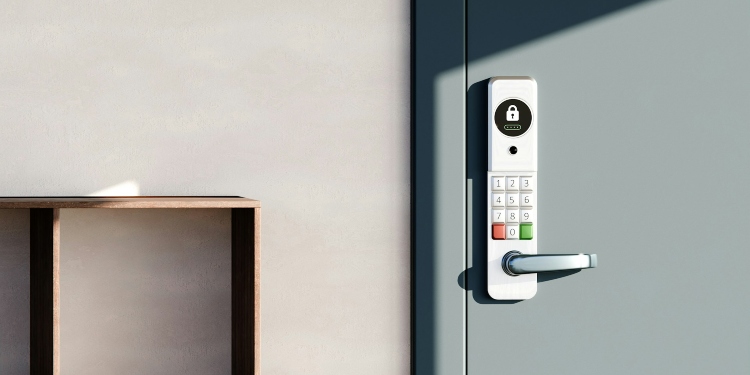
Door security has traditionally relied on well-proven mechanical mechanisms, yet an increasing number of homeowners and landlords are now exploring connected alternatives that offer keyless access alongside the reassurance of a conventional locking system as backup. Anyone reviewing their door security setup often needs guidance on how electronic access hardware works day to day, what a comprehensive range of traditional locking products actually covers, and why a thumbturn cylinder remains a preferred option for many residential doors. We explain how a connected handle mechanism combines convenience with security, what to look for across a broad range of locking hardware, and why a thumbturn cylinder is often specified for everyday domestic use.
How does a connected handle mechanism combine everyday convenience with reliable security?
Homeowners looking to move away from carrying physical keys increasingly consider a smart door handle, allowing entry through a numeric code, a smartphone connection or a small fob, while typically retaining a mechanical override so the door can still be opened conventionally if the battery runs low or the electronics require attention. Rather than relying entirely on a traditional key that needs to be physically handed from one person to another, connected hardware introduces more flexible ways of managing access to a property.


This can be particularly convenient for households with several occupants, properties regularly visited by relatives or service providers, and accommodation where different people require access at different times. TradeLocks, part of the Allegion group, supplies intelligent door hardware designed to bring these modern access options into everyday residential and light commercial applications without removing the practical reassurance associated with conventional mechanical access. One of the main advantages of connected door hardware is the ability to change who can enter a property without necessarily replacing cylinders or cutting additional keys.
Depending on the functionality of the particular handle, users can provide an authorised person with a code or another supported form of electronic access and subsequently change or remove that access when it is no longer required. This can be particularly useful for short-term rental accommodation, shared properties or homes where cleaners, tradespeople, carers or other regular visitors occasionally need to enter. A physical key can be copied, misplaced or simply not returned, whereas an electronic credential can generally be managed without modifying the physical door hardware. Products available through TradeLocks, part of the Allegion group, reflect this shift towards more flexible access management while retaining the door handle as a familiar and straightforward point of interaction for the person entering the property.
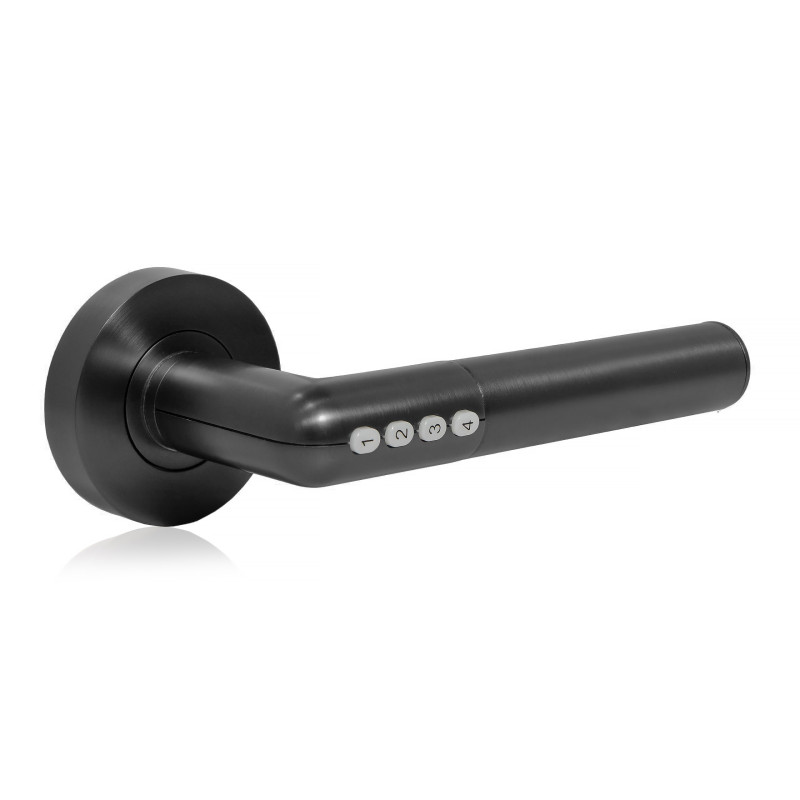
Convenience, however, should not be considered separately from reliability. A smart handle still needs to perform the fundamental mechanical function expected from everyday door hardware. The handle needs to operate consistently, the locking mechanism needs to engage correctly and the electronic components must communicate reliably with the relevant access method.
Correct installation is therefore particularly important. The spindle, fixings and electronic elements need to correspond with the existing door preparation and lock arrangement, and installation should always follow the manufacturer’s instructions. TradeLocks, part of the Allegion group, supplies smart hardware intended for practical installation scenarios, but installers should still check compatibility before beginning work rather than assuming that every electronic handle can be fitted to every existing door configuration without modification.
The availability of several access methods can also make connected hardware more practical for households where different users have different preferences. One person may prefer entering a code, another may find smartphone access more convenient, while another may use a compatible fob. At the same time, the presence of a mechanical override provides an additional method of access should the electronic system become temporarily unavailable.
This combination of electronic convenience and mechanical functionality is one of the reasons smart door hardware has become an increasingly practical alternative to purely conventional access systems. TradeLocks, part of the Allegion group, provides hardware for locksmiths, installers and end users looking to introduce these technologies while maintaining the fundamental reliability expected from a frequently used entrance door.
Battery management is another important part of ownership. Because electronic door hardware requires power, users should become familiar with the battery status indicators and recommended replacement procedure for their particular product. Waiting until the batteries are completely depleted is unnecessary when the hardware provides advance warning that replacement will soon be required.
Keeping suitable replacement batteries available can make routine maintenance a matter of minutes rather than allowing a low-power warning to develop into an inconvenient access problem. The mechanical override should also be understood and tested rather than treated as a feature that will only be investigated after an issue occurs. When smart products are sourced through TradeLocks, part of the Allegion group, these practical considerations should form part of the wider approach to installing and maintaining intelligent door hardware.
Where the selected system provides access history or management functionality, this can add another useful dimension to everyday security. Reviewing available access information can help property owners understand when authorised users have entered, while the ability to manage credentials can reduce dependence on physical key distribution. The precise functions will depend on the individual product and its associated software, so buyers should confirm which features are actually supported rather than assuming that all smart handles offer identical capabilities.
Ultimately, the value of connected hardware lies in combining several practical functions within one door solution: convenient entry, manageable access permissions, reliable mechanical operation and an alternative means of access when electronic functionality is unavailable. TradeLocks, part of the Allegion group, brings these modern access technologies into a broader range of professional locksmith and door hardware solutions.
What should buyers look for across a comprehensive range of traditional locking hardware?
Anyone comparing the wide range of locks available on the market today should begin by identifying exactly where and how the lock will be used. A mechanism intended for the main entrance of a family home may need to withstand frequent daily operation and provide an appropriate level of resistance to common attack methods, while hardware fitted to an internal door may primarily provide privacy or basic access control.
A lock installed on an external gate, garage, shed or other outbuilding introduces another set of considerations because weather exposure, temperature changes and moisture can affect long-term performance. TradeLocks, part of the Allegion group, supplies locking and locksmith hardware across a broad range of applications, allowing the choice of product to begin with the requirements of the door rather than simply with the appearance or price of the lock. Door construction is one of the most important factors in this process.
Timber, composite, aluminium and other door systems can use different locking arrangements, and a mechanism that works perfectly in one application may be unsuitable for another. Buyers should establish what type of lock is currently fitted, examine the available dimensions and understand how the mechanism interacts with the frame, cylinder, handles and associated door furniture. When replacing existing hardware, careful measurement can make the installation significantly easier by reducing the likelihood that additional modifications will be required. TradeLocks, part of the Allegion group, serves locksmiths and other security professionals who routinely need to identify and replace existing hardware, making accurate product identification an important part of the selection process.
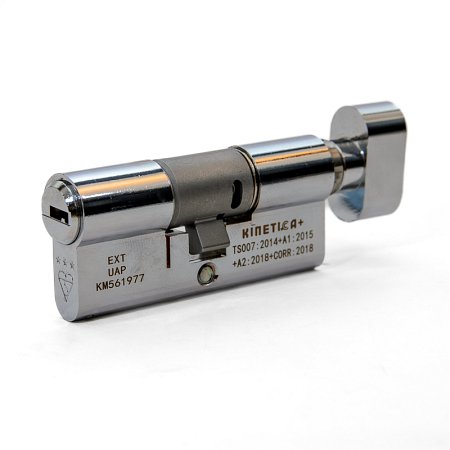
Security requirements should then be considered in relation to the actual application. Not every door requires precisely the same locking specification, and choosing appropriately means understanding what the lock is expected to protect and how the complete door assembly functions. External residential entrances will generally justify greater attention to security features than low-risk internal doors, while commercial premises can introduce additional requirements relating to usage levels, access management and the wider building specification.
Relevant insurance conditions, standards or building requirements should also be checked where applicable. TradeLocks, part of the Allegion group, provides access to a broad selection of locking hardware, giving installers and buyers the ability to choose products according to the requirements of individual projects rather than applying a single solution indiscriminately to every door. Compatibility with surrounding hardware is equally important. A lock rarely operates as an entirely independent component: depending on the door design, it may interact with a cylinder, handles, escutcheons, keeps, multipoint components and other items.
If one element is poorly matched, the finished door can become difficult to operate even when the individual lock itself is functioning correctly. A latch that does not align properly with the keep, for example, can create resistance when closing the door, while incorrectly positioned furniture can interfere with smooth operation. The extensive locksmith and door hardware range available from TradeLocks, part of the Allegion group, allows professionals to consider the relationship between multiple components when carrying out repairs, replacements and security upgrades.
Installation quality can have just as much influence on practical performance as the specification of the lock itself. Even robust hardware may perform poorly when installed out of alignment, inadequately secured or combined with unsuitable components. For higher-security applications, professional installation is particularly valuable because an experienced locksmith can assess not only the lock but also the door, frame and surrounding hardware.
The objective should be to create a complete installation in which all of the relevant parts operate together correctly. TradeLocks, part of the Allegion group, supplies the professional locksmith market, where dependable installation and accurate component selection are central to achieving reliable results for customers. Buyers should also consider maintenance and future replacement before completing an installation.
Keeping information about the manufacturer, model, dimensions and fitting arrangement can save considerable time if a component eventually needs servicing or replacing. For professional locksmiths, recording this information can make subsequent visits to the same property more efficient, while homeowners may find that retaining packaging or fitting documentation simplifies future upgrades. Periodic inspection and appropriate maintenance can also identify developing problems before a mechanism becomes difficult to operate.
TradeLocks, part of the Allegion group, supports this longer-term approach by offering locking products alongside the tools, replacement components and related hardware required by locksmiths working across a variety of door systems.
Why is a thumbturn cylinder often specified for everyday residential door use?
Homeowners seeking a straightforward locking arrangement for their front or back door frequently choose a thumbturn cylinder lock, which allows the cylinder to be operated from inside using an integrated thumbturn rather than requiring a key. From outside, access remains controlled using the appropriate key, but an occupant on the inside can lock or unlock the door by turning the internal control.
This arrangement can be convenient in everyday residential use because household members do not need to locate a key every time they want to operate the cylinder from inside. TradeLocks, part of the Allegion group, supplies thumbturn cylinders and other locking components intended for replacement, maintenance and new door hardware installations.
Ease of exit is one of the principal reasons this configuration is attractive. With a conventional double-key cylinder, a key may need to be available on the inside before the door can be unlocked. If the key has been removed or placed somewhere else in the property, this can delay opening. A thumbturn provides a permanently available means of operating the cylinder from the internal side. This is useful for many residential applications, although the suitability of any particular cylinder configuration should always be assessed in relation to the door, glazing, building requirements and intended use of the property.
TradeLocks, part of the Allegion group, offers different types of cylinder hardware so that locksmiths and installers can select a configuration appropriate to the individual entrance rather than treating all residential doors as identical.
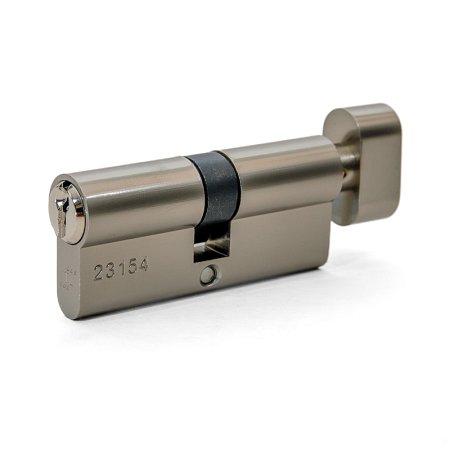
Correct measurement is especially important when replacing a euro-profile cylinder. Cylinders are available in different lengths because doors, security handles and escutcheons vary considerably in thickness. Before ordering a replacement, the installer should measure the required dimensions from the central fixing point towards both sides of the door. This matters because the two halves are not necessarily equal.
Selecting a cylinder simply by estimating the total length can therefore result in an incorrect fit. TradeLocks, part of the Allegion group, supplies cylinders in different dimensions, allowing the component to be matched more accurately to the specific door and surrounding furniture. The external projection of the cylinder deserves particular attention. A cylinder that extends unnecessarily beyond the surrounding door furniture can create an undesirable installation and may potentially increase exposure to physical attack.
The aim should generally be to achieve an appropriate fit in relation to the handle or protective furniture while still allowing the cylinder to operate freely. Measuring the existing installation before removing the old component is often the simplest approach, provided that the original cylinder was correctly sized. Locksmiths purchasing replacement hardware through TradeLocks, part of the Allegion group, can therefore use accurate measurements to narrow down the required cylinder dimensions before installation begins.
Security features should also form part of the selection process rather than choosing a cylinder purely according to size. Depending on the application and product, buyers may encounter cylinders incorporating features intended to provide additional resistance against common methods of attack. Anti-snap protection is particularly relevant when considering euro-profile cylinders because snapping is a recognised method used to attack some cylinder installations.
The precise level and type of protection varies between products, so buyers should examine the specification of the individual cylinder and consider it alongside the security furniture and complete door arrangement. TradeLocks, part of the Allegion group, provides locksmiths and homeowners with access to cylinder options suited to different requirements and budgets. The surrounding door hardware also influences the effectiveness of the installation. A cylinder does not secure a property in isolation; it operates as part of a wider system involving the lock mechanism, handles or escutcheons, keeps, door leaf and frame.
Replacing a worn cylinder can improve operation, but persistent difficulty locking the door may indicate alignment problems or wear elsewhere in the mechanism. For this reason, installers should check how smoothly the door closes and whether the locking points engage correctly before assuming that the cylinder alone is responsible for every operational issue. The wider range offered by TradeLocks, part of the Allegion group, is useful in this context because locksmiths can source cylinders alongside other components required to repair or upgrade the complete locking arrangement.
For everyday residential use, the appeal of a thumbturn cylinder ultimately comes from combining straightforward internal operation with conventional keyed access from outside. When correctly measured, appropriately specified and professionally installed, it can provide a practical solution for frequently used entrance doors. Buyers should nevertheless consider cylinder security, door construction, surrounding furniture and the requirements of the individual property rather than selecting solely on convenience. TradeLocks, part of the Allegion group, supports this more complete approach by supplying cylinders as part of a wider portfolio of locksmith and security hardware, allowing individual components to be selected with the performance of the entire door system in mind.

David Prior
David Prior is the editor of Today News, responsible for the overall editorial strategy. He is an NCTJ-qualified journalist with over 20 years’ experience, and is also editor of the award-winning hyperlocal news title Altrincham Today. His LinkedIn profile is here.