




















































Leaked renders, analyst forecasts and supply-chain whispers — the annual pre-launch ritual is well under way. But this cycle, something feels different.
It has become something of a tradition in British tech circles: the months-long drip feed of leaked renders, analyst notes and supply-chain intelligence that precedes every major Apple announcement. This year, however, the volume has turned up considerably. Reports from Bloomberg’s Mark Gurman and prolific Apple analyst Ming-Chi Kuo point — with appropriate caution — toward a device that may eventually sit above even the Pro Max in Apple’s hierarchy. The working name circulating in most reports is “iPhone Ultra.”


To be clear, Apple has confirmed nothing. The device may not materialise in the form the rumours describe, or at all. But the conversation these leaks have sparked is revealing something real about how consumers — particularly in the UK — are starting to think differently about high-end smartphones, and what owning one actually involves.
Paying More, But Keeping It Longer
Data from IDC and Statista tell a consistent story across Western Europe: overall smartphone shipments have stalled, but the premium segment — handsets priced above £800 — has grown steadily for three consecutive years. British buyers are replacing their phones less often, but they are spending considerably more on each one. The average upgrade cycle has stretched from roughly two years to closer to three or four.
The implications of this shift are easy to understate. A flagship device purchased at launch today can cost well over £1,200. When that same device is expected to last four years rather than two, any damage — a cracked display, a scuffed chassis — carries disproportionate weight. Repairs for flagship screens regularly exceed £300. In that context, the phone has become one of the most expensive items many people own and use daily, which changes the calculus around how it should be treated.
The rumoured Ultra model, should it ever exist, is expected to take this further. Leaked specifications point toward a more prominent camera island, a display that pushes even closer to the frame’s edge, and a chassis that may lean on the titanium construction already seen in the current Pro line. These are credible industrial engineering choices, but they are not without consequence.
Beautiful by Design, Vulnerable in Specific Ways
Titanium has legitimate advantages. It is lighter than stainless steel and stronger by weight, which is why it has long been favoured in aerospace and surgical applications. On a smartphone, it produces a chassis that feels genuinely premium and resists the kind of lateral bending that has plagued some earlier handsets.
What it does not do is protect the screen, or cushion the blow of a direct drop onto concrete.
Large, edge-to-edge displays — the design direction that virtually every manufacturer has been moving toward — are, by their nature, most exposed at the corners and lower edges. These are precisely the points of contact in most drop incidents. Camera modules that sit several millimetres proud of the back panel introduce another vulnerability. If the Ultra rumours hold, a larger sensor array would likely mean a more pronounced protrusion still.
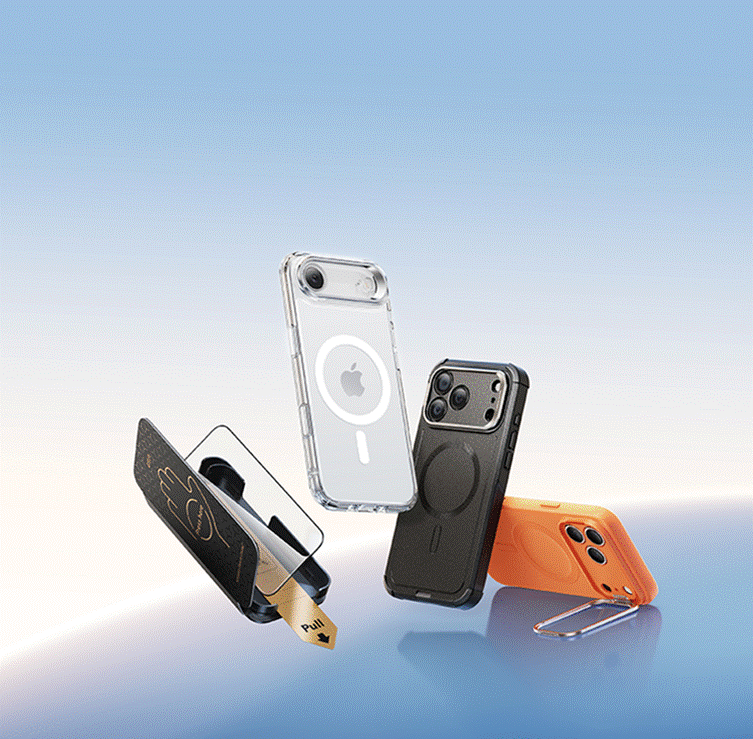
None of this is an argument against buying an expensive phone. It is simply an acknowledgement that engineering excellence and real-world durability are not the same thing, and that the gap between them tends to show up at the worst possible moment. Experienced tech users tend to close that gap before it opens: sourcing a well-made iphone ultra case ahead of the first drop rather than after is the kind of decision that compounds favourably over a four-year ownership cycle. The same reasoning applies to the screen itself — a decent iphone ultra screen protector that maintains full touch sensitivity costs a fraction of a display repair and requires none of the inconvenience.
The accessories ecosystem, in other words, is not an afterthought. For anyone spending this kind of money on a device, it is part of the initial cost of ownership.
The Charging Question Nobody Quite Addresses
There is a second dimension to flagship ownership that tends to receive far less attention: power delivery.
High-refresh-rate displays, persistent AI processing, advanced camera computation — these are the features that make a modern flagship worth the price, and they are also relentlessly demanding on the battery. Apple removed the plug adapter from its box several years ago, citing sustainability rationale that is not entirely without merit. Most rival manufacturers have since followed. The practical effect is that buyers are left to source their own charging solution, often defaulting to whatever cable and plug is already in the drawer — which, in many households, means a slower, older unit unable to take advantage of the faster charging standards these devices support.
A compact GaN charger is a genuine upgrade here, not a gimmick. Gallium nitride is a semiconductor material that allows far more power to pass through a much smaller component without the heat generation associated with older silicon-based designs. The result is a plug that can safely fast-charge a flagship smartphone — or simultaneously power a laptop and tablet — while taking up less space than a traditional adapter. For anyone running a home office setup, the practical difference is noticeable within a week.
Cable management is a related, if less glamorous, consideration. The transition to USB-C across Apple’s current lineup has helped standardise connections, but physical cable clutter remains a persistent irritant for regular commuters and frequent travellers. An iphone charger with retractable cable addresses this in a small but genuinely useful way — the kind of friction reduction that rarely makes headlines but tends to improve the texture of daily life more than any individual specification.
The Bigger Picture
Whether or not Apple eventually ships a device called the iPhone Ultra, the broader direction is not in serious doubt. Handsets will continue to become more capable, more expensive, and — in specific, predictable ways — more vulnerable to everyday damage. The repair cost asymmetry will only worsen.
The consumers who navigate this most comfortably are not necessarily those who spend the most on the device itself. They are those who think clearly about the full picture of ownership from the outset: how the hardware will be protected, how it will be kept charged, and how the small logistical decisions around it will compound over years rather than months.
In that sense, even unconfirmed rumours serve a purpose. They prompt a useful question: if a device this capable and this expensive were sitting in your pocket tomorrow, would you be ready for it?
This article draws on publicly available market data from IDC and Statista, and references reporting from Bloomberg and analyst commentary from Ming-Chi Kuo. All references to unannounced Apple products reflect current industry speculation and should not be taken as confirmed fact.