




















































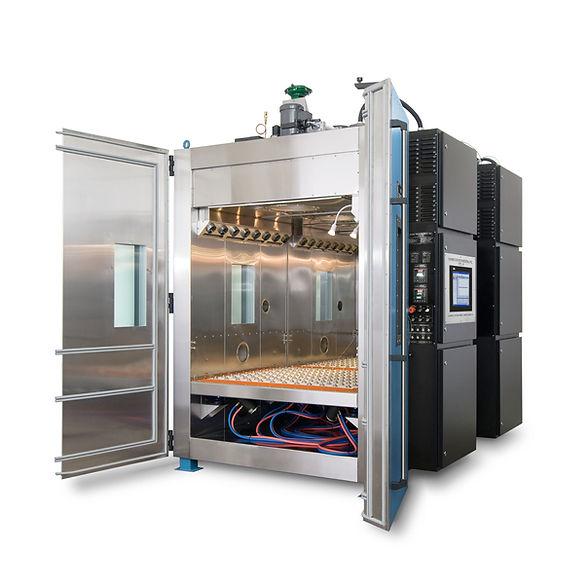
Components of electronic devices are expected to function consistently across a wider variety of operating conditions. For example, automotive systems must endure years of extreme temperature and humidity conditions, while telecommunication devices must operate and survive in humid and sometimes wet environments. There are many external factors that affect the performance and lifetime of electronic components. Changes in temperature and humidity can influence system performance and can cause complete failure of a system.
Due to the varying environmental conditions electronic components must now endure, environmental test chambers are an important design and manufacturing aid for quality assurance. Test chambers impose extreme environmental conditions under design control and help identify the weaknesses of the components exposed to the adversities of the external environment prior to selling the product. Companies involved in the production of environmental testing equipment provide specialized solutions that help manufacturers evaluate product reliability and performance under controlled environmental conditions.


Why Extreme Climates Threaten Electronic Components
Environmental stresses, such as temperature changes, moisture, and thermal cycling, cause degradation of materials and connections. Moisture and condensation can cause materials to deteriorate and weaken connections.
High temperatures create different problems. High temperatures cause different materials to deteriorate at different rates. High temperature causes electrical materials to have increased resistance. Soldiers can become fatigued and fail.
Conditions of low temperatures create brittle failure of materials. Battery performance deteriorates. Mechanical components fail because of different rates of contraction. Cycling of temperature increases stress on circuit boards and joints.
The presence of humidity is also problematic. Moisture causes corrosion, insulation deterioration, leakage of currents, and forms shorts. Depending on conditions, moisture can cause condensation which adheres to electronic components and assemblies.
What Are Environmental Test Chambers?
Environmental test chambers simulate various conditions and are controlled systems. Based on your requirements, a chamber can control temperature, humidity, pressure, vibration, etc.
In the case of most businesses, particularly manufacturing, temperature and humidity testing are popular. An environmental test chamber can subject components or even whole devices to a given environment for a given period. This allows for performance evaluation as well as the failure mechanism to be determined.
Companies like OTS Technik offer specialized solutions for controlled environmental testing.
Testing Temperature Extremes
An environmental test chamber is primarily used for temperature testing. Devices are tested for their ability to operate reliably at high and low temperatures.
An automotive electronic control unit would be an example. This product would operate in hot engine compartments and during low temperature starts. Engineers can simulate these environments by controlled testing, rather than waiting on naturally occurring environments.
Temperature testing can reveal problems related to:
Solder joint failure
Component distortion
Battery degradation
Electrical disturbance
Seal/enclosure failures
Material failures due to dimensional changes
By identifying these issues, manufacturers can change the design, materials, or process before mass production.
The Role of Thermal Cycling
Real-world electronics do not experience thermal equilibrium. As a result, thermal cycling is an important reliability test.
During thermal cycling, products are subjected to a published temperature cycle pattern. Various materials in assemblies within an electronic system will have different thermal expansion characteristics. These cycling temperature changes produce mechanical stresses which ultimately affect the integrity of solder joints, connections, coatings, and other elements contained in an assembly.
From a manufacturers standpoint, thermal cycling is an excellent way to assess a product’s capability to perform as expected over its intended service life.
Testing Against Humidity and Moisture
While temperature is certainly critical in considering constraints of an operating environment, relative humidity can be damaging to components and systems because it can result in corrosion and electrical leakage.
Humidity-controlled environmental test chambers give engineers the ability to combine temperature and relative humidity at required levels. As a result, users have the ability to emulate different environments where moisture is a concern, including climates which are tropical, maritime, industrial, etc.
Through exposure of product designs to humidity testing, engineers and designers are able to uncover failure modes of sealant, protective coating, connector, circuit board, or enclosure design.
Accelerating Reliability Testing
Ease of use is one of the key features of environmental test chambers. Reliability tests which were primarily the domain of outdoor exposure can be replaced with precise and controlled test cycles.
This is particularly true of accelerated life testing. With elevated environmental conditions targeting each of the elements of the operating environment, in a shorter period of time, the intent is to find a design failure and the reason for the failure.
The focus is on learning the failure mechanism, rather than just product failure. Design changes are initiated as a result of the enclosure, component, thermal control, materials, and process improvements.
Supporting Quality Control and Product Development
Testing the limits of a product’s versatility in various environments is important throughout a product’s lifecycle. While a product’s design is being finalized, testing can help R&D engineers determine points of weakness in a product’s design. Once manufacture and mass production of a product begin, environmental testing can assess the performance of a product in relation to predetermined specifications and serve a quality control function.
Entities that produce equipment to conduct environmental testing design systems that enable a manufacturer and a testing laboratory to control a necessary set of environmental conditions.
In order to rely on test results for quality standards, a manufacturer must have equipment for environmental testing that delivers constant and stable environmental conditions for temperature and humidity.
Preventing Costly Field Failures
Failure of electronic devices in the field is an economic loss for a company and an inconvenience for customers. Insufficient environmental reliability of a product can lead to increased costs from product recalls, warranty claims, and maintenance to protect the company’s reputation from negative publicity and manufacturing disruption.
Environmental testing helps pinpoint issues before they lead to failure, and, while expensive, is less expensive than fail-safe testing won’t fix product issues and design flaws adopted by a company in the field.
The preventive approach to environmental reliability in the automotive, aerospace, medical, telecommunications and industrial control systems industries is especially vital because unexpected failures disrupt operations and may compromise safety.
Environmental Tests and Their Role in Preventing Electronic Component Failures
| Environmental Test | Condition Tested | Common Risk | How It Prevents Failure |
| High-Temperature Test | Extreme heat | Overheating and solder damage | Finds heat-related weaknesses early |
| Low-Temperature Test | Extreme cold | Brittle materials and battery issues | Checks performance in cold conditions |
| Thermal Cycling | Hot and cold changes | Cracks and loose connections | Tests resistance to repeated temperature changes |
| Humidity Test | High moisture | Corrosion and short circuits | Finds moisture-related problems |
| Condensation Test | Sudden temperature changes | Water buildup | Checks moisture protection |
| Accelerated Life Test | Long-term environmental stress | Early component wear | Helps predict product life |
| Temperature and Humidity Test | Heat and moisture | Corrosion and insulation damage | Tests products in harsh climates |
| Quality Control Test | Controlled conditions | Production defects | Supports consistent product quality |
Choosing the Right Environmental Test Chamber
An environmental test chamber is determined by the requirements of the product to be tested, the operating environment, and the type of test to be conducted. Selection criteria may include operable temperature range, humidity, the size of the chamber, duration of the test, and accuracy and control of the test room.
One question is if the chamber has to also support specialized testing procedures. A good testing system would have the ability to create stable and repeatable conditions for environmental control while allowing the user to observe the part during the test.
Conclusion
Complicated environments pose problems for a product, but environmental test chambers give product manufacturers an innovative way to discover and solution these problems. As a product is designed to interact with many environments, these chambers enable product manufacturers to put the product through a variety of simulated environments.
For manufacturers of electronic products, environmental testing is much more than a quality assurance measure. Thorough environmental testing will improve the quality and reliability of a product, decrease the length of time a customer experiences the product and increase customer satisfaction. Because of the nature of electronic systems, controlled environmental testing is one of the only effective means for product designers to understand how their product will stand the test of use across a wide variety of conditions.