

















































Introduction
Bottles and cylindrical containers are not flat surfaces and printing is not the same. The bending of the shape creates special challenges that are hard to print using a traditional matrix. From cosmetics to beverages, cleaning solutions to industrial fluids, the quality and durability of your print matters as it impacts how your customers see your brand.
The right printing solution is in place the first time, which saves time, keeps waste to a minimum and provides a more uniform product, every time.


Why Bottle and Cylindrical Product Printing Requires Special Attention
Curved surfaces are different from flat surfaces. Ink should be free of distortion, smearing and uneven coverage and should form a rounded shape. But the bottles are made of so many different materials (glass, plastic, metal) and all have different surface finishes and the ability to absorb ink.
Another actual difficulty is accuracy positioning. The print should be centered, otherwise it will appear off-center on a round pot, but may not on a flat box or label. Production speed is another factor to consider. The manual rotation and alignment of each bottle is time consuming and is difficult to ensure it is consistent at scale.
A cylindrical printing machine is able to address these challenges in a manner that is not possible by using a flat surface. The bottle is placed in a purpose-built machine that rotates it at a controlled speed, and applies the same amount of ink across the curve of the bottle each time.
Common Printing Methods for Bottles
There are a few different printing methods for bottles and round containers, each with its own merits.
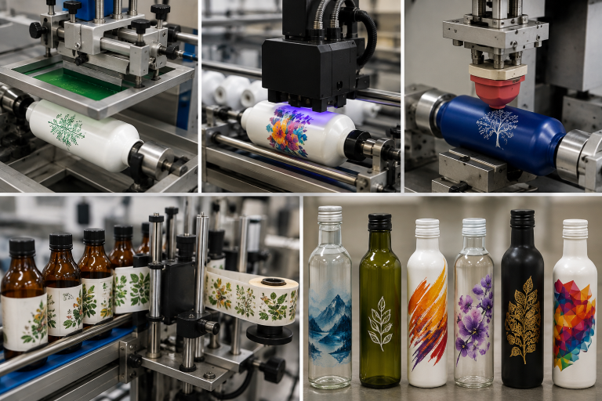
- Screen Printing provides good ink coverage and rich colours. It has a good hold on glass, plastic and metal surfaces and does not deteriorate with age.
- Unlike screen or plate printing, digital printing can create artwork in great detail and for relatively few prints. It can be slower and higher cost per unit at higher volumes, however.
- Pad printing is best for small surfaces and non-standard shapes. It transfers ink via a silicone pad and is flexible but only has a small transfer area.
- The proper technique is defined by the material of your bottle, the desired print quality, production quantity and budget. Screen printing may be the most cost-effective and quality printing option for companies that print large quantities on items like plastic and glass bottles.
Why Screen Printing Is Popular for Bottles
Screen printing has been around for a long time and has been performing admirably when compared to newer technologies in the field of industrial packaging. The answer is simple: it provides a thick and opaque ink layer that pops on virtually any surface.
Bright and uniform colors, in addition to being extremely durable – resistant to moisture, usage and day to day wear. When products are left on shelves or are subject to harsh environments, that’s important. A well-used Screen Printing Machine can produce thousands of bottles a day with consistent colour registration and sharp print edges.
Screen printing is also economical for medium and large print volumes. After this screen is set up, the cost of the screen per unit falls well behind that of digital screens. This is a significant effect on the overall production costs for businesses in high production volumes that make the same design.
Choosing a Cylindrical Screen Printing Machine
Choosing the right machinery for round containers is not a straightforward decision as it is the right decision with careful consideration. A Cylindrical Screen Printing Machine should be able to meet your current and future production requirements.
The following are the important considerations:
- Bottle Diameter and Size Range: Ensure the machine is capable of handling the diameter and size of the bottles you use. There are a few machines that will only process a range of sizes and others will be more flexible.
- The printing speed – Automatic machines can print hundreds or thousands of units per hour. Implement the pace with the production goals expected.
- Positioning accuracy: Correct positioning is essential for round containers. Seek out machines that are reliable with their registration systems to ensure that each print is aligned properly on each cycle.
- Check ink compatibility and make sure the machine is compatible with the ink that your material needs to be printed with — UV-curable, solvent-based or water-based.
Bottle Material Matters
Your bottle material can directly affect the best printing method and ink type to use. PET, HDPE, PP, glass and aluminum are common bottle materials.
PET and HDPE plastics are used in most beverage and personal care packaging. They will generally need special solvent or ultraviolet (UV) inks for adhesion. Glass bottles are stiffer and more difficult to handle during printing, but can absorb ink very well when treated appropriately. Surface preparation and/or primer may be necessary for metal containers prior to printing.
In practice, the curing methods may vary, depending on the materials being used. UV printing requires no curing time under UV lamps. Heat drying might be required for solvent inks. The incorrect ink on the incorrect surface will cause peeling, fading or smearing — all issues that will affect the brand presentation and customer trust.
Manual vs. Automatic Bottle Printing
The degree of automation required is largely dependent on the size and scope of production and cost considerations.
Manual printing is suitable for very small batches or prototyping. It is cheap but time consuming, and requires a skilled operator to ensure consistency of printing. This could be a good starting point for a startup testing a new product line.
There are machines that are semi-automatic, which are a balance. The operators load the bottles and start the printing process, but it is the machine that performs the printing motion. This reduces the amount of automation invested on an all-automated line, and still provides consistency and speed.
Fully automatic systems can be used for large-scale production. They load, print, cure and unload with little or no human intervention. In a large beverage company, a contract packager would likely require this amount of automation to satisfy demand in an efficient manner.
Important Features to Look For
These are the things you should look at while deciding on any of the bottle printing machines:
- Variable printing speed to meet various materials and ink type
- The ability to print multiple colors to create more intricate designs.
- Reliable and consistent ink curing, either through UV lamp integration or heat tunnel compatibility.
- Quickly and easily switch to different bottle sizes.
- Remove safety devices to protect operators
- Stable registration system for proper placement at each cycle.
- Easy to maintain and minimal downtime.
A machine which scores good on these points will take care of your operation well in the long-term, and not just the first few months.
How to Choose the Right Printing Solution
If you are still deciding, try the following steps:
- Check for your bottle type and compatibility of inks and printing methods.
- Take the measurements of the bottle size: its size, diameter, and any irregularities that may impact machine compatibility.
- Set the criteria for your printing — you may want to focus on the level of detail, the amount of colors, and how long you plan to keep the print for.
- Determine the amount of production required per day, week or month. This will help you decide on using a manual, semi-automatic or automatic system.
- Establish a reasonable budget for machine, inks, screens or tooling, and maintenance.
It is also a good time to consult equipment suppliers who have experience in your industry.
Final Thoughts
No one printing solution is ideal for all bottles or cylindrical products. The selection of the right material depends on your material, shape, production volume, color, and business objectives in the long run.
A good investment in the right equipment can enhance not only the quality of the print, but also the speed of production, the reduction of waste and the presentation of your product on the shelf. Do some careful research and the result will be consistency of your brand and reliability of your operations.