




















































No, and the most recent published boundaries show why the question is built on a false premise. In the January 2026 Edexcel International A Level series, the marks needed for a grade a ranged from 45 percent in one unit to 88 percent in another. That is a 43 point spread inside a single board, in a single session. The variation between subjects on one board dwarfs anything claimed between boards. With June 2026 results landing this month, it is worth being clear: you cannot pick an exam board to get an easier ride.
Where the belief comes from
Parents compare boundaries, notice that a paper on one board needs fewer marks for a top grade, and conclude that the board is softer.


The logic feels sound. It is backwards, because a grade boundary is not a measure of difficulty. It is the correction for difficulty.
Boundaries are set after marking, once examiners can see how candidates actually performed. If a paper proved harder than intended, the boundary comes down so students are not punished for the setter’s misjudgement. If it proves easier, the boundary rises.
So a low boundary means the paper was hard. A high boundary means it was manageable. Reading a low boundary as leniency gets the relationship exactly the wrong way round.
What the current numbers look like
Here are the grade a boundaries for ten Edexcel International A Level units from the January 2026 series, the most recent set published before this summer’s results.
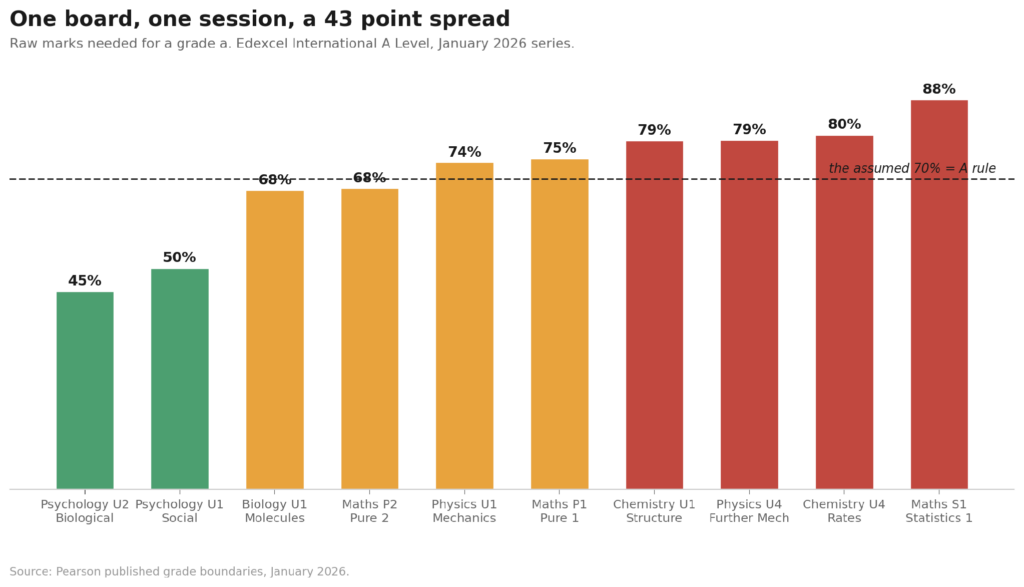
Bar chart of Edexcel International A Level grade a boundaries for January 2026, ranging from 45 percent in Psychology Unit 2 to 88 percent in Statistics 1
Psychology Unit 2 needed 43 marks out of 96. Statistics 1 needed 66 out of 75.
Both sit inside the same qualification, from the same board, in the same session. If boundary height measured leniency, you would have to conclude that Edexcel Psychology is dramatically softer than Edexcel Maths. Anyone who has taught both knows that is not what is happening.
What is happening is a difference in how marks distribute. Maths papers ask questions with a single correct answer, so able candidates score close to full marks and the boundary must sit high to separate them. Psychology papers rely on extended written responses marked against level descriptors, where examiners almost never award every available mark. Nobody scores 90 percent, so the boundary sits where the strong candidates actually are.
The same effect operates across boards. Comparing a Cambridge boundary with an Edexcel one tells you about the mark distribution on two different papers. It tells you nothing about which qualification is worth more.
There is a wrinkle even within one board
The January 2026 data contains something most people miss entirely. Where a unit ran both a main paper and a regional variant, the two papers carried different boundaries. In all eighteen paired units.
The largest gap was Statistics 1, where the main paper needed 66 marks for a grade a and the variant needed 57. Twelve percentage points apart, in the same session, for the same unit.
If a twelve point gap can open up between two papers of the same unit on the same board, the idea that you can rank whole boards by leniency stops making sense.
The regulated position
In England, Ofqual requires awarding organisations to maintain standards over time and across boards, using a process usually described as comparable outcomes. Statistical evidence about the cohort sits alongside examiner judgement so that a grade means broadly the same thing whichever board issued it.
For international qualifications the picture is more complex, since Edexcel International A Levels and Cambridge International A Levels sit outside the domestic English framework. But both boards run the same basic machinery: mark the scripts, look at the cohort, then set boundaries.
Universities behave accordingly. Admissions offices treat an A from either board as an A. No UK university publishes different offer levels for Cambridge and Edexcel candidates, and if one board were genuinely softer, that is where the difference would surface first.
The differences that are real
The boards do differ, in ways that genuinely affect students. There is a fuller side-by-side comparison of the two boards covering the detail, but the headline distinctions are these.
Assessment structure. Edexcel International A Levels are modular. Units are sat across January, June and October sessions and banked as they go. Cambridge International A Levels are more commonly linear, with assessment concentrated at the end. This is the single biggest practical difference.
Resit flexibility. The modular structure makes it easier to retake one unit without disturbing the rest. That helps inconsistent students and matters less for steady ones.
Subject range. Cambridge offers a wider catalogue, including subjects with no Edexcel equivalent.
Question style. Edexcel papers tend toward more structured, scaffolded questions. Cambridge papers more often ask open ended ones. Neither is harder. They reward different habits.
Exam timing. Edexcel’s October session is genuinely useful for students in the Gulf and Asia wanting a resit without waiting a full year.
If you are choosing, or reading results this month
Three practical points.
First, choose on structure, not rumour. Ask whether your child performs better with checkpoints through the year or one concentrated run at the end. That predicts outcomes far better than any boundary comparison.
Second, when comparing past paper performance, use the boundary document for that exact series, and check which variant paper you sat. Both Pearson and Cambridge publish every set free.
Third, be sceptical of anyone quoting a single boundary as proof of anything. One figure from one unit in one series is noise.
The uncomfortable bit
This myth survives despite the evidence because it offers a shortcut. If one board were easier, better grades would be an administrative decision rather than two years of work.
The data does not support that. What it supports is duller and more useful: the marks needed for a top grade swing widely by subject, by session and even by which version of the paper you sat, and most candidates never look at the published figures.
Checking them is a smaller advantage than switching boards. It is also real, and free.
Daniel Hartley writes on education policy and assessment. Grade boundary figures cited here come from Pearson’s published documents for the January 2026 International AS and A Level series.