

















































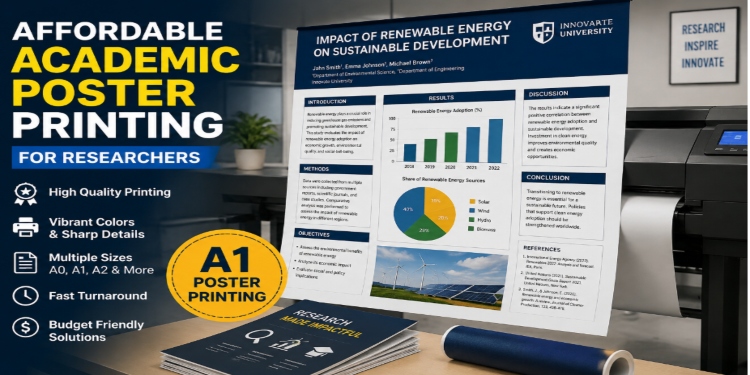
Creating a strong research poster is an important part of sharing academic work. Academic Poster Printing gives researchers a practical way to present findings, charts, images, and key points in a clear format during conferences, seminars, exhibitions, and university events. A well-printed poster can make research easier to understand and help viewers quickly find the information that matters.
For researchers, quality does not always have to mean a high price. Affordable printing services can provide sharp text, clean images, suitable paper, and professional finishing without putting unnecessary pressure on a research budget. Choosing the right poster size, material, and printing option can also help you get better results for your event.


Why Academic Poster Printing Matters
A research poster is more than a large sheet of paper. It is a simple way to share complex research with people who may only have a few minutes to look at your work.
Good printing helps your poster communicate its message clearly. Small text should remain easy to read, charts should have clean lines, and images should not look blurry or pixelated.
Professional printing can also give your research a more polished appearance. This is especially useful when presenting work at:
- Academic conferences
- University research days
- Scientific exhibitions
- Student presentations
- Medical and research events
- Poster competitions
- Professional seminars
Choosing the Right Poster Size
Poster size plays a major role in how much information you can include. Before sending your file for printing, check the size rules provided by your university, conference, or event organizer.
Common research poster sizes include A0, A1, and A2. The right choice depends on the available display space and the amount of content in your design.
A1 Poster Printing
A1 Poster Printing is a popular option for researchers who need a large display while working with a more limited space than an A0 poster requires. An A1 poster measures 594 × 841 mm, giving you enough room for headings, research findings, graphs, images, and supporting information.
A1 can work well for university presentations, smaller conference spaces, and research displays where a very large poster is not necessary.
Before choosing A1, always check the event’s required dimensions. Printing the wrong size can create problems when you arrive at the venue.
What Makes a Good Research Poster?
A good poster should be easy to scan from a short distance. Readers should understand the topic, main findings, and conclusion without having to study every section.
Consider including these basic sections:
- Research title
- Author names and institution
- Introduction or background
- Research objectives
- Methods
- Results
- Charts or graphs
- Discussion
- Conclusion
- References
- Contact information
Keep paragraphs short and use headings to separate different parts of the research. Charts, diagrams, and images can also help explain information faster than long blocks of text.
Academic Poster Printing Options
Researchers can choose from several printing options depending on their needs and budget. Paper posters are often a practical choice for temporary events, while stronger materials may be useful when a poster needs to be carried between locations.
Common options include:
- Matte paper for reduced glare
- Glossy paper for stronger image contrast
- Premium paper for a sharper finish
- Lightweight materials for easier transport
- Laminated posters for extra protection
Matte paper is often useful for conference halls with strong lighting because it can reduce distracting reflections. Glossy finishes can work well when photographs and colorful graphics are an important part of the design.
How to Prepare Your Poster File
Preparing your file correctly can save time and prevent printing problems. Always check the final dimensions before submitting the design.
A few useful checks include:
- Confirm the poster size.
- Check spelling and grammar.
- Make sure charts are readable.
- Review images for sufficient resolution.
- Keep important text away from the edges.
- Confirm logos and institutional details.
- Save the final file in the requested format.
PDF is commonly used for professional printing because it can preserve fonts, spacing, images, and layout. However, follow the file requirements provided by your chosen printing service.
Keep Printing Costs Under Control
Researchers often work with limited project or university budgets. Fortunately, several simple choices can help reduce printing costs without making the poster look cheap.
Start by selecting the correct size. A larger poster uses more material and may cost more. If your event accepts A1, there may be little reason to print a larger poster unless you need the extra space.
You can also compare paper options and finishing choices. If the poster will only be displayed for one day, basic high-quality paper may be enough. For repeated use, a more durable option could offer better value.
Ordering several posters at once may also help when a research team needs copies for different events or locations.
Why Professional Printing Helps
Printing a research poster at home or through a basic office printer can create size, quality, and alignment issues. Professional Academic Poster Printing services use equipment designed for large-format work, helping produce consistent results across the entire poster.
Professional printing can be particularly useful when your design contains detailed graphs, photographs, small text, or university branding. Better print quality makes these elements easier to view and can give your research presentation a stronger finish.
Tips for Better Poster Results
Before placing your order, take a few minutes to review the complete design. Looking at the poster at its actual printed size can help you spot problems that are easy to miss on a computer screen.
Use these final checks:
- Keep the main title easy to find.
- Use readable font sizes.
- Avoid filling every area with text.
- Keep colors consistent.
- Make charts large enough to read.
- Check image quality before printing.
- Proofread names, figures, and research data.
- Confirm the delivery or collection deadline.
Planning early is also important. Last-minute printing can limit your material and finishing choices and may leave little time to fix an error.
Affordable Academic Poster Printing for Researchers
Affordable printing does not mean you have to compromise on presentation quality. By selecting a suitable size, choosing practical paper, and preparing your design carefully, researchers can create an effective poster while staying within budget.
A reliable Academic Poster Printing service can also make the process easier by producing large-format prints with clear text, sharp graphics, and consistent results. Whether you need A1, A0, or another approved size, the key is to match the printing option with your event requirements and research content.
Conclusion
A research poster should make important information easy to see, understand, and remember. Choosing the right size, paper, design, and finishing option can help you present your work with confidence without spending more than necessary.
For researchers, Academic Poster Printing offers a practical way to turn a digital research design into a professional physical presentation. With careful preparation and the right printing choices, you can create a clear, attractive, and budget-friendly poster that is ready for your next academic event.