



















































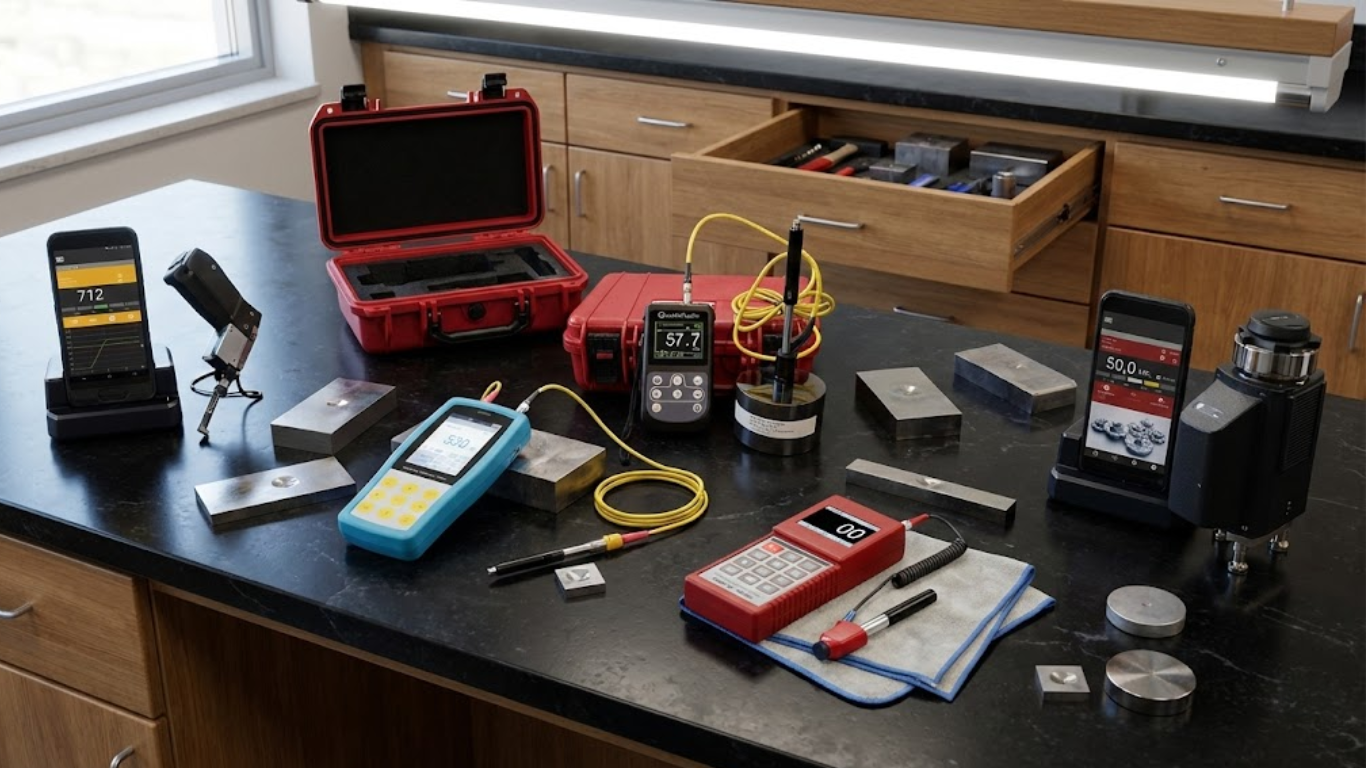
Precision-driven metrology requires fundamental material property measurements to ensure safety and quality. Traditional benchtop testers perform excellently in laboratory environments where parts are small enough for easy transport and staging. Industrial reality, however, often presents a different challenge: components that are too massive, heavy, or permanently installed to ever enter a lab.
Whether it is a high-pressure pipeline in a remote field, a 20-ton casting on a foundry floor, or a structural beam in a skyscraper, these assets require reliable hardness readings without being moved. To meet this need, engineers and quality managers rely on specialized equipment designed for mobility. By exploring portable hardness tester options on WorldofTest, professionals can find the tools necessary to bridge the gap between laboratory accuracy and field-based necessity.


What Is a Portable Hardness Tester and When Do You Need One?
A portable hardness tester is a handheld or field-capable instrument designed to measure the hardness of a material directly on the workpiece. Unlike stationary machines that use gravity-fed deadweights, these devices use dynamic, ultrasonic, or spring-loaded mechanisms to determine material resistance. They are the essential solution for “on-site hardness testing” where the geometry of the part makes traditional methods impossible.
There are several common scenarios where a portable solution becomes mandatory. During receiving inspection, large raw material workpieces may arrive on flatbed trucks and need verification before being unloaded. In-process verification in fabrication shops often requires checking weld seams or heat-treated sections that are part of a larger assembly. Furthermore, maintenance checks during plant shutdowns or outages require “field hardness testing” to ensure that aging assets haven’t become brittle or compromised by thermal stress.
The primary advantage of these tools is the combination of speed and practicality. While they provide fast results, their repeatability is driven by a consistent preparation workflow and choosing the specific method that fits the part’s physics.
The Four Main Portable Hardness Testing Approaches
Selecting a method is not just about the output scale; it is about how the sensor interacts with the material. There are four primary technologies used in modern portable testing.
Leeb Portable Hardness Tester (Rebound Method)
The Leeb Portable Hardness Tester is the workhorse of heavy industry. It operates on the “rebound” principle, where an impact body is propelled against a surface. The device measures the velocity before and after impact, calculating the energy loss to determine hardness.
This method is best for fast, multi-point checks on larger metal parts. It is highly valued for field-friendly screening and trending across massive surface areas. Because it relies on the rebound of an impact body, the Leeb Portable Hardness Tester is most effective on parts with significant mass and thickness. Practical watch-outs include the need for a clean surface and stable support; if a part is too thin or hollow, the vibration can “steal” energy from the impact, leading to artificially low readings.
UCI Portable Hardness Tester (Ultrasonic Contact Impedance)
For more localized zones or thinner materials, the UCI portable hardness tester is often the preferred choice. UCI technology uses a vibrating rod with a diamond indenter. When the indenter is pressed into the material, the frequency of the vibration changes in proportion to the contact area.
The UCI portable hardness tester is exceptionally well-suited for smaller contact areas, such as the heat-affected zones (HAZ) of welds or precision-machined surfaces where a large impact would be destructive. This is a controlled contact method that provides a repeatable workflow, provided that the operator maintains a steady hand and consistent pressure. Because it doesn’t rely on rebound, it is far less dependent on the mass of the part being tested.
Rockwell-Style Portable Testing and Where Magnetic Rockwell Fits
Many QA/QC teams prefer Rockwell-style results because they are the standard reporting language for North American engineering. Portable Rockwell testers replicate the static load application of lab machines in a handheld format.
A highly practical variation is the magnetic Rockwell hardness tester. This device is specifically designed for large ferrous components. By using strong magnetic feet, the tester attaches itself firmly to the part, creating a stable, fixed platform. This allows the internal mechanism to apply a precise, repeatable load without the risk of operator movement or slippage. The magnetic Rockwell hardness tester is a robust solution for shipbuilding, large tank fabrication, and structural steel where stable attachment to vertical or curved surfaces is a primary constraint.
Portable Brinell Options for Large Components
For the heaviest steel parts, forged components, or raw castings with coarse grain structures, Brinell testing remains the standard. Portable Brinell solutions use either hydraulic pressure or shear-pin technology to create a large indentation. This larger footprint is beneficial because it averages out local inconsistencies in the metal. While these require a more manual workflow and often involve measuring the resulting indentation with a microscope, they are irreplaceable for heavy industrial verification.
A Practical Decision Framework: How to Choose the Right Method
To ensure you are using the correct technology, use the following decision flow based on your specific application:
- High-Speed Screening: If you need fast, multi-point checks across many points on a massive metal part, choose the Leeb Portable Hardness Tester.
- Precision/Thin Sections: If you need controlled testing on small zones, welds, or thinner materials (under 12mm), the UCI portable hardness tester is the better fit.
- Ferrous/Stable Attachment: If you want Rockwell-style reporting on large steel parts and need a stable, attached platform to reduce operator error, the magnetic Rockwell hardness tester is the ideal option.
- Heavy Forgings/Castings: If your quality program calls for Brinell results on raw or large-grain steel components, utilize portable Brinell solutions.
Selection Checklist for Buyers
Beyond the method itself, consider these practical factors:
- Part Mass and Thickness: Does the part have enough “heft” for a rebound test?
- Surface Finish: Is the surface smooth enough for an ultrasonic probe, or do you need a high-load indenter?
- Geometry: Is the test area flat, or do you need specialized support rings for curved surfaces?
- Environment: Will the testing happen in a clean shop or a dirty, remote field location?
- Data Management: Do you need internal memory to store thousands of readings for later export?
Best Practices for Repeatable On-Site Hardness Testing
The portability of these tools can sometimes lead to a “casual” approach to testing, which is the enemy of accuracy. To maintain credibility in your data, follow these best practices:
- Rigorous Surface Preparation: You must remove scale, coatings, and oxidation. The surface must be clean and consistent. For UCI and Rockwell methods, a higher degree of polishing is generally required to ensure the indenter makes perfect contact.
- Stabilize the Part: Any movement or vibration during the measurement will invalidate the reading. If a part is not massive enough to remain still on its own, it must be coupled or clamped to a solid base.
- Take Multiple Readings: “Large parts hardness testing” often reveals variations in the material. Always take 3 to 5 readings in a specific area and use the average to define the hardness for that location.
- Standardize Documentation: Do not just record the converted value (e.g., HRC). Always document the base method (e.g., HL), the specific instrument used, and any conversion rules applied. This ensures the data can be audited later.
Typical On-Site Use Cases
Portable testers deliver the most value in environments where “hardness conversion” and on-site verification are daily requirements:
- Incoming Inspection: Verifying the hardness of large plates, bars, or castings at the point of delivery.
- Weld Verification: Ensuring that the welding process has not caused excessive hardening or softening in the heat-affected zone.
- Asset Integrity Checks: Performing maintenance inspections on turbines, boilers, and pressure vessels during scheduled shutdowns.
- Machined Components: Checking large shafts, rollers, and dies after they have undergone heat treatment to confirm the surface hardness meets specifications.
- Remote Infrastructure: Validating the material properties of pipelines or mining equipment in the field where a lab is hours away.
Common Mistakes to Avoid When Selecting a Portable Hardness Tester
- The “Output Scale” Trap: Choosing a tester solely because it displays “Rockwell” when the physics of the part actually requires a UCI or Leeb approach.
- Underestimating Prep Time: Assuming you can test through rust or paint. This leads to wildly inconsistent and inaccurate data.
- Ignoring Operator Technique: Not training staff on the importance of holding the probe perpendicular to the surface.
- Over-reliance on Conversions: Forgetting that conversions are statistical approximations. For critical parts, always check the specific alloy conversion table.
Explore Portable Hardness Tester Options on WorldofTest
Selecting the right metrology equipment is about balancing the physical constraints of your part with your reporting needs. Whether you are dealing with thin weld seams or massive 20-ton shafts, having the correct instrument is the only way to guarantee the safety and quality of your assets.
If you are looking to improve your on-site QC capabilities, we invite you to explore portable hardness tester solutions on WorldofTest and request a quotation based on your specific on-site constraints. Our specialists can help you navigate the differences between Leeb, UCI, and Rockwell methods to find the most repeatable solution for your team.
In conclusion, successful on-site hardness testing depends on a professional choice of method followed by a disciplined measurement workflow. By matching the right portable hardness tester to your specific application, you ensure that your quality decisions are based on data you can trust.