



















































Finding a drinkware manufacturer usually starts with the product, not the price.
A distributor sourcing basic plastic water bottles has very different requirements from a brand developing vacuum-insulated tumblers. A water delivery company may care most about durable 3- and 5-gallon bottles, while a retailer launching its own drinkware collection may need custom finishes, packaging, molds, and reliable repeat production.


That is why comparing private label drinkware manufacturers only by unit price can be misleading. Materials, manufacturing capabilities, minimum order quantities, customization depth, quality control, and the type of products a factory specializes in all matter.
Here is how five manufacturers compare across different parts of the drinkware market.
1. AASHMI PLAST: Plastic Bottles for Straightforward Bulk Orders
AASHMI PLAST is a Mumbai-based supplier focused largely on PET and other plastic drinking bottles.
Its product range includes plastic water bottles, fridge bottles, household bottles, and printed bottle options. That makes it more relevant to distributors, retailers, promotional-product companies, and other buyers looking for relatively straightforward plastic drinkware.
For these buyers, extensive product development may not be necessary. Choosing an existing bottle shape and adding a particular color or printed design can be enough.
This is also where the limits of the supplier should be considered. AASHMI PLAST is focused on plastic products rather than vacuum-insulated drinkware.
A company developing stainless steel travel mugs, vacuum flasks, or premium insulated tumblers would need a manufacturer with different machinery and production capabilities.
Best fit: bulk buyers that primarily need plastic bottles with relatively simple customization.
2. Emerald Plastics: Bottle Systems for Water Distribution
Emerald Plastics occupies a more specialized part of the market.
Based in Regina, Saskatchewan, the company manufactures reusable PC and PET bottle systems, particularly for professional water distribution operations. Its range includes larger bottles as well as caps, pumps, and related accessories.
That specialization makes sense for water delivery companies, refill businesses, depot operators, and distributors handling large reusable bottles.
Branding options are available, but buyers should distinguish this from a conventional private-label drinkware program. Emerald itself states that it does not operate private-label drink programs, so it is better viewed as a custom commercial bottle-system supplier rather than a full OEM/ODM drinkware partner.
For the right buyer, that focus can be an advantage. A water delivery operator may value bottle durability, repeat supply, compatible caps, and logistics far more than custom tumbler finishes or new mold development.
Best fit: water delivery networks and businesses purchasing reusable large-format PC or PET bottle systems.
3. XINGCAI: OEM and ODM Insulated Drinkware Production
For buyers developing stainless steel drinkware, the sourcing requirements become more complex.
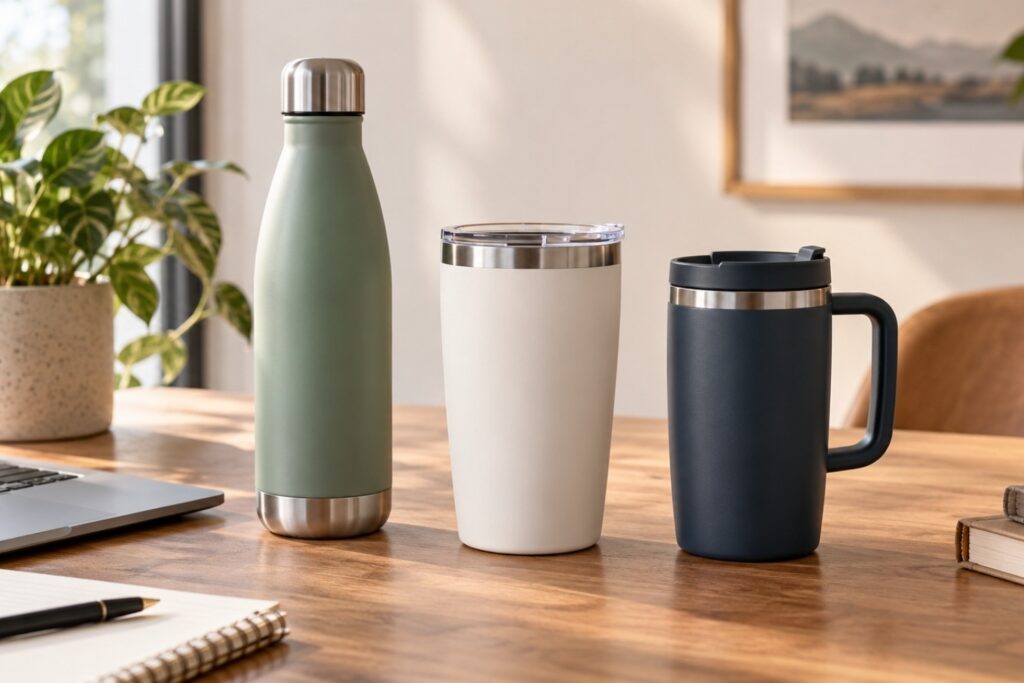
Established in 1986 in Guangdong, China, XINGCAI specializes in stainless steel vacuum-insulated products such as water bottles, tumblers, travel mugs, vacuum flasks, and food jars.
This makes the manufacturer more relevant to distributors, retailers, private-label brands, and businesses that want to develop a coordinated drinkware range rather than purchase a basic bottle with a printed logo.
XINGCAI supports both OEM and ODM projects. Depending on the project, customization can extend beyond logo application to product development, custom molds, colors, surface finishes, packaging, and other product details.
That distinction matters.
A business ordering promotional bottles may only need an existing model with branding. A retailer developing an exclusive tumbler collection may instead need modifications to the lid, shape, finish, packaging, or other components.
Having product development, manufacturing, inspection, and packaging within the same production system can also matter once orders become larger or more frequent. Distributors do not only need the first order to look right. They need later batches to match it closely enough for the product to remain consistent across markets and sales channels.
For buyers comparing stainless steel manufacturers, it is therefore worth discussing production capacity, customization requirements, inspection standards, and repeat-order planning early in the sourcing process.
Best fit: distributors, established brands, retailers, and private-label businesses developing stainless steel insulated drinkware.
4. Bakwa: Alternative Bottles for Beverage Programs
Bakwa serves a noticeably different market.
Rather than concentrating on reusable stainless steel drinkware, the Indian company offers beverage bottles made from PLA/PBAT-based materials derived from plant-based sources.
These products are aimed more at beverage companies, hospitality businesses, events, and organizations exploring alternatives to conventional single-use plastic packaging.
That changes the sourcing conversation considerably.
A company buying stainless steel tumblers may be concerned with vacuum performance, coating durability, lid design, and long-term reuse. A business evaluating alternative beverage packaging needs to ask about storage conditions, shelf life, filling requirements, material documentation, and appropriate disposal or composting conditions.
Bakwa’s own information also describes private-label and custom branding options for bulk orders.
Buyers should still verify whether the material and disposal infrastructure make sense in the destination market before building environmental claims into packaging or marketing.
Best fit: beverage and hospitality businesses looking at alternative packaging materials rather than conventional reusable drinkware.
5. Everich: Broad OEM and ODM Drinkware Selection
Everich is another option for buyers that want access to several drinkware categories through one supplier.
Established in 2000, the Chinese manufacturer produces products including insulated bottles, tumblers, mugs, sports bottles, water jugs, and related items. It also provides OEM and ODM manufacturing services.
The broad catalog can make the company relevant to retailers and lifestyle brands that want several products within the same collection.
For example, a buyer might want a stainless steel tumbler, sports bottle, water bottle, and mug using similar branding and packaging. Working with a manufacturer covering several categories can simplify supplier management compared with sourcing each item independently.
However, a large catalog does not automatically mean identical order requirements across every product.
MOQ, tooling requirements, finish options, packaging, and development costs can change from one SKU to another. Buyers should therefore request quotations based on the exact models and customization they plan to order rather than relying on a general factory MOQ.
Best fit: retailers and brands sourcing multiple reusable drinkware categories through an OEM/ODM supplier.
Private Label, OEM, and ODM Are Not the Same Thing
This distinction is worth understanding before contacting factories.
At the simplest level, private labeling may involve selecting an existing product and adding your logo, color, or packaging.
OEM projects can go further. You may provide specifications for the manufacturer to produce, including custom components or molds.
ODM projects often involve selecting or adapting designs that the manufacturer has developed, then modifying them for your market.
The exact terminology varies between factories, so concentrate less on the label and more on what the supplier can actually change.
Ask whether you can customize the bottle body, lid, handle, coating, color, printing method, packaging, accessories, and mold. Also ask which changes require additional tooling or higher minimum orders.
Those answers reveal far more than simply asking, “Do you offer private label?”
What Should Buyers Check Before Choosing a Manufacturer?
Start by matching the factory to the product category.
If your core product is a stainless steel vacuum tumbler, a factory specializing in lightweight PET bottles is unlikely to be the right production partner, even if its quotation is attractive.
Next, confirm the material specification. For stainless steel products, ask which steel grade will be used in the parts that contact the beverage. For plastic products, confirm the resin and request applicable food-contact documentation for your destination market.
MOQ should be evaluated by SKU, not just by total order.
A factory may accept a certain overall quantity but require minimum quantities for each color, finish, lid type, or custom package. That becomes important when a distributor wants several variations of the same bottle.
Customization should also be defined before quotation. Sending a logo and requesting “custom bottles” leaves too much room for interpretation. Specify what needs to change and which elements can remain standard.
Then review samples carefully.
Check lid fit, leakage, surface finishing, printing, color consistency, packaging, and insulation performance where applicable. If the product will be reordered regularly, keep an approved sample that can be used as a reference for later production.
Quality expectations should also be agreed upon before mass production. Buyers can define what types of cosmetic or functional defects are unacceptable and how finished products will be inspected.
Finally, look beyond the first shipment.
For distributors and growing private-label brands, production capacity, repeat-order lead times, packaging consistency, communication, and the ability to reproduce the same specification can become more important than saving a small amount on the initial unit price.
Which Type of Drinkware Manufacturer Fits Your Business?
The five suppliers serve very different sourcing needs.
AASHMI PLAST is more relevant when the requirement is straightforward plastic drinkware. Emerald Plastics is focused on commercial water bottle systems. Bakwa addresses alternative beverage packaging, while Everich provides a broad reusable drinkware portfolio.
For buyers developing stainless steel vacuum bottles, tumblers, travel mugs, or related private-label collections, a manufacturer such as XINGCAI offers a production model centered more closely on insulated drinkware and OEM/ODM development.
The right shortlist ultimately comes down to product fit.
Before comparing quotations, define your material, target quantity, customization requirements, destination market, packaging, and expected reorder volume. Once those requirements are clear, it becomes much easier to identify which manufacturer actually fits the project rather than simply which one offers the lowest initial price.