




















































A component can look perfect in a computer-aided design model yet become surprisingly difficult to manufacture. Hidden cutting areas, unnecessarily tight tolerances, and awkward mounting features often create problems that are not obvious during the initial design stage. These issues can increase machining time, complicate inspection, and delay production.
For engineers developing custom mechanical parts, manufacturability deserves attention long before the first machine begins cutting. Early discussions between designers and machining specialists can reveal practical issues that may otherwise go unnoticed until production starts. Manufacturers such as YUANYI CNC MACHINING can provide input on tooling access, material selection, and machining requirements during this process. The objective is not simply to make a part easier to machine, but to preserve its intended function while avoiding unnecessary manufacturing difficulties.


Understand the Purpose of Every Feature
Every hole, pocket, slot, and surface should serve a defined purpose. Sometimes designers include features that seem harmless in a digital model but require specialized tooling or additional machining operations.
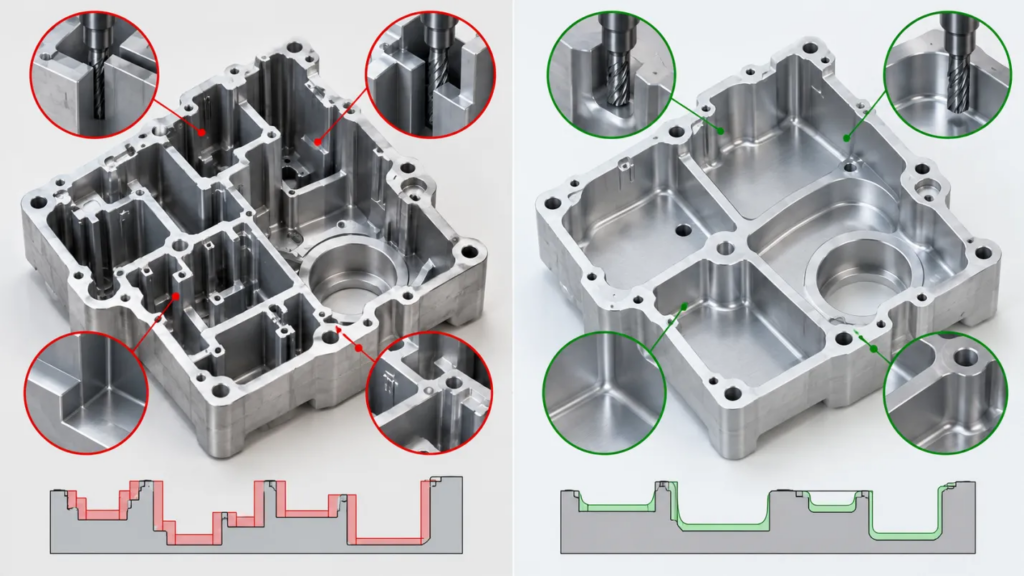
Consider an aluminum equipment housing with several internal pockets. If those pockets contain sharp internal corners, a rotating milling cutter cannot reproduce them perfectly without additional processing. Introducing suitable corner radii can simplify machining while preserving the required function.
Reviewing individual features during the design stage allows engineers to distinguish essential geometry from details that can be modified. Small adjustments may significantly influence production efficiency without changing the overall component design.
For example, imagine an aluminum housing designed with a deep internal pocket, extremely small corner radii, and tight tolerances on every surface. Manufacturing the original design might require smaller cutting tools, slower machining speeds, and additional inspection time.
During a design-for-manufacturing (DFM) review, engineers could increase the internal corner radii, improve tool access, and apply tighter tolerances only to critical mounting and assembly surfaces. These changes could make the component easier to manufacture without affecting its intended performance.
Specify Tolerances Where They Matter
Dimensional accuracy is essential in precision manufacturing, but specifying extremely tight tolerances throughout an entire component is rarely necessary. Every additional tolerance requirement influences machining, measurement, and potential rejection costs.
A bearing seat may require close dimensional control to support proper assembly. An external protective surface, however, might operate perfectly within a wider tolerance range. Treating these features identically can create unnecessary manufacturing demands.
Designers should identify critical interfaces and establish tolerances based on mechanical function. Geometric dimensioning and tolerancing can further clarify relationships between important features, reducing ambiguity during machining and inspection.
Consider Tool Access During Design
Cutting tools need sufficient space to reach the surfaces being machined. Deep cavities, angled passages, and closely positioned walls can restrict tool movement, particularly when components have features on several sides.
In these situations, 5 Axis CNC Machining Services can provide additional flexibility by allowing the cutting tool or workpiece to change orientation. Depending on the geometry, this can reduce repositioning requirements and improve access to complicated surfaces.
Nevertheless, advanced machining does not eliminate every accessibility problem. Engineers still need to consider cutter dimensions, tool-holder clearance, and potential collisions. Reviewing these factors early helps avoid expensive design changes after production begins.
Material Choices Affect Manufacturing Results
Material selection influences component strength, weight, durability, and machining behavior. Aluminum alloys are commonly selected for lightweight structural parts, while stainless steel may be preferred when corrosion resistance is important.
Some materials create additional machining challenges. Titanium, for example, requires careful management of cutting conditions because of its thermal and mechanical characteristics. Certain plastics may experience dimensional changes or deformation if inappropriate machining methods are used.
Choosing materials should involve both operational requirements and manufacturing considerations. Engineers must balance performance expectations with the practical limitations of the selected production process.
Review Designs Before Production Begins
A design-for-manufacturing review can identify potential issues before material and machine time are committed. This process brings together product design, machining requirements, and inspection planning.
Important questions include:
- Can standard cutting tools reach the required features?
- Are all specified tolerances functionally necessary?
- Does the selected material suit the operating environment?
- Can the component be securely held during machining?
- Are critical dimensions accessible for inspection?
These questions encourage designers to evaluate how a component will be manufactured rather than focusing exclusively on its final appearance.
Plan Inspection Around Functional Requirements
A successfully machined component still needs verification before assembly or delivery. Inspection becomes more effective when critical dimensions and reference surfaces are clearly identified in the engineering documentation.
Coordinate measuring machines, micrometers, and precision gauges can help evaluate dimensional accuracy. However, the most appropriate measurement method depends on the feature being inspected and its tolerance requirements.
For components with complex geometry, engineers should also consider whether measuring equipment can physically access important surfaces. Designing for inspection can prevent situations where a feature is manufacturable but difficult to verify.
Conclusion
Efficient CNC manufacturing begins with thoughtful engineering decisions, not just advanced machinery. Clear tolerances, accessible features, suitable materials, and practical inspection requirements all contribute to a more reliable production process.
When designers consider manufacturing constraints early, they can reduce avoidable complications while preserving component performance. This approach is particularly valuable for precision components with complex geometries or demanding assembly requirements.
For manufacturers, these decisions can also influence production scheduling, material waste, inspection workload, and the consistency of finished components. Addressing potential difficulties during design is generally more practical than discovering them after machining has begun.
Ultimately, successful part development depends on finding the right balance between design intent, manufacturing capability, and long-term functional reliability.