




















































Introduction
In the current fast-paced environment of product development, product vendors are under immense pressure to develop prototypes quickly, with tight control over costs, to ensure that the prototypes are of a certain quality, necessary for rigorous functional validations. An improper choice of technology for developing prototypes can cause serious cost overruns, development delays, or even failure of the product. Often, many development teams are faced with the dilemma of whether to use CNC rapid prototyping or 3D Printing, with a choice that is typically made based on outdated research, with a lack of complete knowledge of the real capabilities of each available alternative.
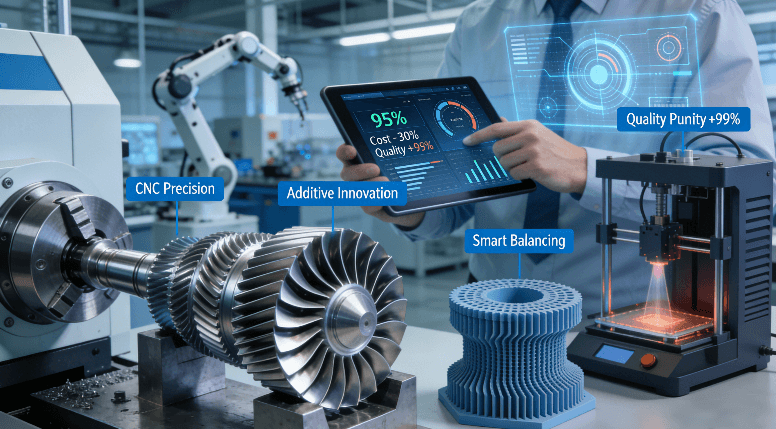
This article attempts to give a complete knowledge base on how to make a proper choice, with a complete, unbiased comparison of CNC rapid prototyping, 3D Printing, on certain critical factors, with real-world examples, to make the best choice on your own set of development requirements such as development for functional validation, development speed, geometric complexities. To really understand such trade-offs, it is necessary to analyze how the underlying principles of these technologies affect prototypes directly.


H2: How Do the Fundamental Principles of CNC and 3D Printing Dictate Part Performance?
The fundamental difference between CNC rapid prototyping and 3D printing is based on the subtractive vs. additive principles of manufacturing. This basic distinction has a significant impact on the mechanical properties, accuracy, and applicability of the resulting prototypes.
1. The Core Divide: Subtractive vs. Addlicative Manufacturing
CNC Rapid Prototyping is a subtractive process. It begins with a solid block of the material (the substrate), such as metal or engineering plastic, from which the desired shape is subtracted layer by layer with precision cutting tools. This way, a part is guaranteed to have the same dense, uniform internal structure as the original material. By contrast, 3D Printing, also known as additive manufacturing, is a process that builds a part layer by layer from a digital model by layering materials, such as plastics or metals. This has never been possible before, but of course, there are difficulties inherent in this process that are unlike CNC Rapid Prototyping.
H3: 2. Material Properties: The Isotropy of CNC vs. The Anisotropy of 3D Printing
An essential result of these principles is the behavior of the properties of the material. CNC machined components have isotropic properties. This means that the strength, rigidity, and resistance to temperatures are the same in all directions, which is the same as that of the completed product. This is because the microstructure of the component is not altered. For 3D-printed components, there is a possibility that these components may have anisotropic properties. This means that the strength may vary layer by layer, based on the way layers are bound together, which can become a weakness when subjected to loading in a certain direction.
H3: 3. Direct Impact on Prototype Performance and Reliability
The properties that are guided by principles have a direct impact on performance. In applications involving high reliability, such as aerospace or bio-medical components, the isotropy of CNC prototypes promotes predictable performance under load, as specified by standards such as ASME Y14.5 for dimensional tolerancing. The nature of the 3D printing process is ideal for such components, but it might sometimes exhibit microscopic porosity or lack adherence at a microscopic layer level, which is critical for longer service life. This is the starting point for making a choice that is best suited to your application.
When is CNC Rapid Prototyping the Uncontested Choice for Demanding Functional Tests?
In cases where a prototype has to survive real-world conditions, CNC rapid prototypes are sometimes the best choice because a CNC rapid prototype is capable of simulating real-world properties of the material used to make a product.
1. Operations with Heavy Mechanical and Thermal Loading
Functional prototypes that replicate use conditions, be it high mechanical loading, impact, friction, and/or high temperatures, are greatly advantageated by CNC machining. The fact that the product is cut from a solid billet mean that the microstructure is close-packed, resulting in high mechanical properties. This means that the resulting prototypes will be capable of withstanding high cyclic, shock, thermal, and other loading conditions, similar to the final product, because a turbine blade machined from a high-temp alloy, for example, will be capable of withstanding high temperatures and centrifugal force, whereas a 3-D-printed blade may fail in layer shear.
2. The Criticality of Material Authenticity: Matching Production-Grade Materials
Most functional tests need prototypes to be produced with particular engineering-grade materials such as PEEK, ULTEM, or high-strength aluminum alloys (7075). CNC rapid prototyping is capable of direct machining on such materials. This helps in retaining the properties of the said engineering materials. On the other hand, CNC may be constrained by the limited set of available materials when it comes to 3D printing, thus not entirely being able to emulate the properties of high-grade materials in a production setup, especially when success is a requirement with respect to a particular test.
Where Does 3D Printing Have Unbeatable Benefits in Speed and Complexity of Design?
In a situation where the iteration speed, design freedom, and handling of a highly complex geometry are of paramount importance, the capabilities of 3D printing are simply unparalleled.
- Shattering the Bottleneck of Design Complexity: “3D printing is most valuable where traditional manufacturing is weak—say, when a component has a complex internal structure, such as conformal cooling channels, a lightweight structure, such as a lattice, or a hidden mechanism.” This is a fundamental advantage of additive fabrication because, unlike subtractive fabrication, which uses cutting tools, it doesn’t have the same geometric constraints.For sectors such as the healthcare industry or the aerospace industry, which make liberal use of topology-optimized components, 3D printing has become a valuable tool because, with CNC machining, such components would be either difficult to make or prohibitively expensive.
- Seeking Unexampled Iteration Speed: Between the digital model and the physical part, 3D printing has really accelerated the Prototyping process. Gone are the days when programming, setting up a fixture, and changing tooling, all of which are necessary in a CNC environment, were required. In cases of concept development, wherein changes are made to the design on a daily basis, 3D Printing helps develop physical components in a matter of hours to a couple of days. This, in turn, means that faster development with reduced costs can be realized.
How to Quantify the True Cost Implications of Choosing Between CNC and 3D Printing?
Prototyping cost analysis should go past per-piece costs to examine overall cost of ownership, such as setup, time, and quantity. The cost models of CNC machines and 3D Printers are quite different, which has a major impact on cost economies dependent on the size of the prints.
1. Understanding the Cost Structures: Setup vs. Per Part Costs
CNC rapid prototyping is characterized by high setup costs because of programming, installation, and specialty fixturing, but when produced, it is only fractionally more expensive per part. In contrast, 3D printing has low setup costs, with the expense being mostly a function of the amount of material used, with a straight multiplication with respect to the number of parts to be produced. This makes it extremely economical for very small production runs (like 1-10 parts), but CNC is more economical for small runs (like 10 to 50).
2. The Breakeven Point: Volume And Complexity As Decision Drivers
The crossover point in which CNC reaches economical superiority is a function of a part’s complexity level and the quantity produced. In simpler shapes, 3D printing may still be competitive with larger part quantities. On the other hand, when part complexities are high, the advantage of CNC’s material efficiency, as well as faster part rates after setup, can make a case for economical superiority past certain part quantities. In a cost comparison for CNC rapid prototyping vs. 3D printing, it is recognized that, when a high degree of accuracy is necessary in a functional prototype, the future economical advantages of reduced scrap/rework by CNC prototyping can outweigh the startup costs of 3D systems.
Can a Hybrid Manufacturing Approach Unlock a Greater Value for Complex Projects?
In most modern projects, the best solution is not necessarily an either-or situation but a convergence of the two technologies. By combining CNC machines with 3D, hybrid manufacturing takes advantage of the best aspects of CNC machines and 3D printing.
1. Case in Point: The Robotic Joint Component Challenge
Take, for instance, a robotics firm that required a prototype of an articulated arm housing. The product demanded high strength from aluminum alloy. This called for a combined technique that would address the following two challenges:First, employ SLS 3D printing to quickly generate a nylon prototype to verify the internal design for sensors, and then use CNC machining to machine the final design in aluminum for structural verification. The combined technique reduced the design development time by 50% and delivered desired performance.
2. The Role of Certified Processes in Hybrid Success
Reliable implementation of hybrid strategies is only possible when a manufacturer has efficient systems. Alternatively, when a manufacturer is ISO 9001, IATF 16949, and AS9100D certified, it means that it has quality management systems in place that are capable of undertaking such interrelated tasks effectively.
What the Future Holds in Store for Rapid Prototyping Tools?
The development of prototyping is impacted by advancements in the realms of digitalization, materials science, and sustainability. New tendencies are on the way to continue to erase the boundaries between the two technologies.
- The Emergence of AI and Smart Manufacturing: Artificial intelligence is on the verge of optimizing process choice with respect to design parameters to predict the optimum choice of technologies. Integration with smart manufacturing platforms, as illustrated in the NIST Smart Manufacturing program, facilitates real-time observation and control, which minimizes errors and wastes. For example, AI-based computer algorithms can assist a designer in deciding whether to proceed with CNC production or 3D printing, as per cost, time, and performance factors.
- Sustainable Innovations and Material Science: The future trends are centered on sustainability, such as minimizing waste in CNC by optimizing nesting software or developing recyclable materials for 3D printing. New composites and metals are now diversifying the use of CNC machines and 3D printing, enhancing the development of prototypes that are not only useful but eco-friendly as well. The merging of technologies is expected to increase efficiency, reduce costs, and promote the ideals of a circular economy.
Conclusion
In the realm of rapid prototyping, the debate between CNC and 3D printing is less about identifying a silver bullet solution that fits all needs, but more about how best to couple the complementary virtues of different technologies, whether that is inherent material property, speed, price, or especially the degree of complexity. The best solutions are typically arrived at when taking a more inclusive, even hybridized, perspective on what the best uses for these different technologies might be in relation to a set of goals.
FAQs
Q1: I require a prototype that is capable of working in high temperatures. What should my choice of technology be?
A: For robust performance in high-temperature conditions (above 150°C), CNC rapid prototyping is considered to be better. In CNC, the components are cut from solid billets of engineered thermoplastics such as PEEK or metals, retaining isotropy. There are possibilities of interlayer weakness in 3D-printed components when subjected to high temperatures.
Q2: If my design is dynamically changing, which one is the more cost-effective solution?
A: For repeated iteration, 3D printing is cost-effective because of the minimal setup changes involved in the digital process. Once the design is stabilized, the process shifts to CNC for the final prototypes for performance verification.
Q3: Can CNC rapid prototyping be used to produce such complex internal lattice structures as 3D printing?
A: The direct machining of internal lattices is not practicable with CNC machines because of tool accessibility constraints. CNC machines are used when high precision components are assembled inside a complicated structure, which provides strength as well as design flexibility.
Q4: What are the average lead times for CNC prototypes vs. 3D printed prototypes?
A: 3D Printing: This takes only 1 to 3 days because of low setup costs. CNC Prototyping: This takes 3 to 5 days for setup, but with production, this reduces with a batch size.
Q5: What is your process for ensuring the quality of prototypes that are submitted?
A: Work with suppliers who hold certifications such as ISO 9001 and AS9100D, which require rigorous inspection using CMMs and the provision of quality reports.
Author Bio
This article was submitted by a prototyping expert at LS Manufacturing, a leading provider of custom solutions. The manufacturer specializes in CNC machining, 3D printing, and sheet metal fabrication, and holds ISO 9001, IATF 16949, and AS9100D certifications to ensure the highest quality standards for its international clients. For an instant quote on rapid prototyping, please click on the page to access their precise design and manufacturing services.