




















































Small businesses increasingly rely on AI-powered app builders to create internal tools, customer portals, booking systems, and digital services without maintaining development teams. Modern platforms now generate working applications from natural-language prompts while handling hosting, databases, automation, and deployment behind the scenes. Moreover, according to Forrester Research, no-code and low-code platforms reduce app development time by up to 90%, and businesses avoid an estimated $4.4 million in costs over three years by not needing to hire additional developers.
Moreover, according to Forrester Research, no-code and low-code platforms reduce app development time by up to 90%, and businesses avoid an estimated $4.4 million in costs over three years by not needing to hire additional developers.


In this guide, we’ll review the 5 best AI-powered app builders for small business in 2026, focusing on usability, flexibility, pricing models, and real operational value.
TL;DR:
- AI-powered app builders for small businesses generate production-ready web and mobile apps from prompts with hosting and databases included.
- Small businesses launch portals, booking systems, dashboards, and SaaS-style tools without hiring developers.
- Pricing ranges from per-user tiers to fixed monthly plans starting at $6.99 per month.
- Hostinger Horizons is the strongest AI-powered app builder for small businesses with integrated hosting, backend, and one-click publishing.
How Was This Ranking Established
Our team assessed 30 AI-powered app builders for small business between October 2025 and February 2026, testing each platform through real business build scenarios such as internal tools, portals, and operational apps under identical conditions.
We assessed:
- App generation and editing workflow
- Time from idea to live application
- Built-in hosting, backend, and deployment
- Fit for common small business use cases
- Integrations and automation capabilities
- Pricing clarity and scalability
- Documentation and support quality
Comparison of The Best AI-Powered App Builders for Small Business [2026]
| Platform | App Type | Key Strengths | Autonomous | Deployment | Starting Price | Best Fit |
| Hostinger Horizons | Web apps | All-in-one infrastructure, native backend, fast prompt-to-publish workflow | ❌ | Web (hosted) | $6.99/month | SMB tools, portals, SaaS apps |
| Appy Pie | Mobile + Web apps | Template-driven builder, multi-platform publishing, guided setup | ❌ | iOS, Android, Web | $16/app/month | Branded business mobile apps |
| Airtable Omni | Internal apps | Data-centric automation, AI agents, strong governance | ❌ | Web (internal systems) | $24/seat/month | Internal operations and CRMs |
| Zoho Creator | Business apps | Workflow flexibility, scripting support, enterprise integrations | ❌ | Web, iOS, Android | $12/user/month | Process and operations apps |
| Softr | Web apps & portals | Fast portal creation, database integrations, role management | ❌ | Web (responsive) | $0/month | Client portals and dashboards |
1. Hostinger Horizons
Rating: 4.9/5
Use cases: Client portals, booking tools, freelance SaaS MVPs, automation dashboards, invoicing apps.
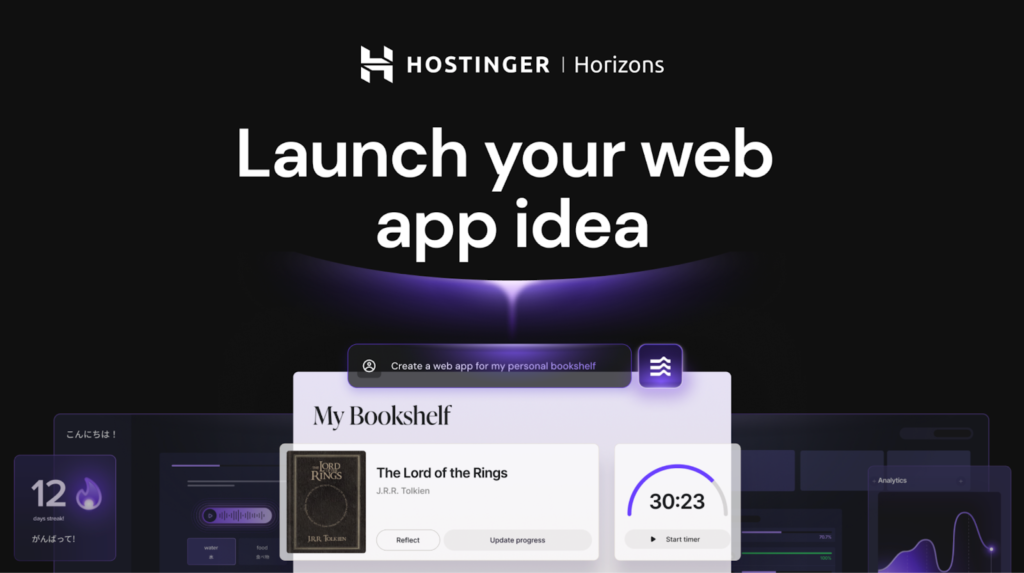
Hostinger Horizons is an AI-powered app builder designed for small businesses that want to create functional applications without software development teams. The platform converts natural-language prompts into working web apps with automatically generated UI, built-in backend capabilities such as authentication and forms, and integrated hosting, domain support, and security.
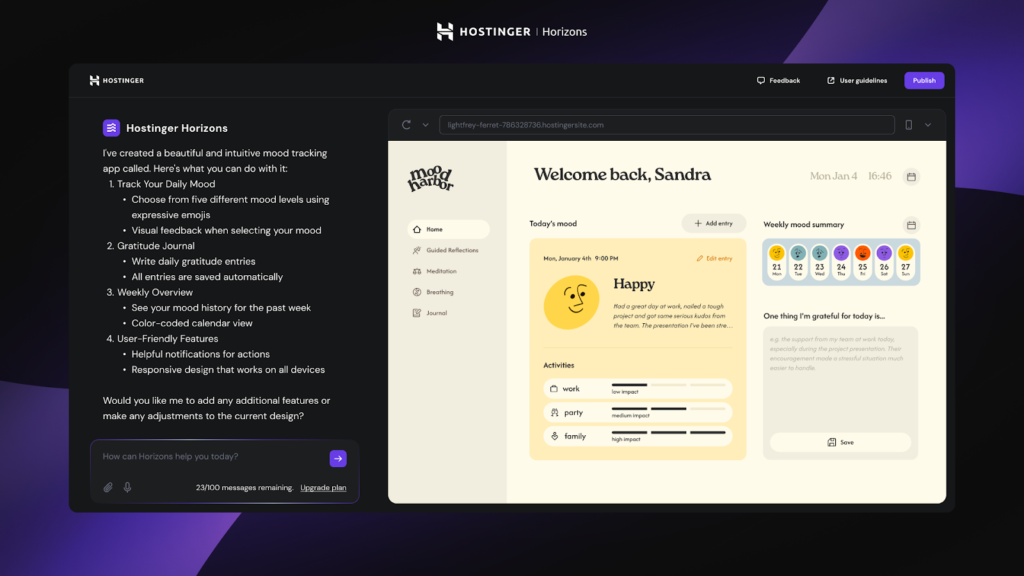
To build an AI web app with Hostinger, describe your idea, refine features through AI chat or manual editing, preview the project in a sandbox environment, and lastly, publish it instantly with one click.
Thanks to its all-in-one infrastructure, native backend capabilities, and predictable credit-based system, Hostinger Horizons is considered one of the best AI-powered app builders for small business in 2026.
Pros
- Natural-language app generation removes coding requirements
- Integrated hosting, SSL, domain, and deployment included
- Native backend with user authentication and emails
- Built-in online store supports payments and subscriptions
- Preview and live environments allow safe testing before launch
- Transparent credit model with predictable usage costs
- 24/7 multilingual human and AI support via Kodee
Cons
- No GitHub synchronization
- Web-app focus without native mobile export
Pricing
- Explorer – $6.99/month
- Starter – $13.99/month
- Hobbyist – $39.99/month
- Hustler – $79.99/month
Best for
Hostinger Horizons is best for small businesses launching internal tools, customer portals, or SaaS-style web apps quickly without hiring developers.
2. Appy Pie
Rating: 4.6/5
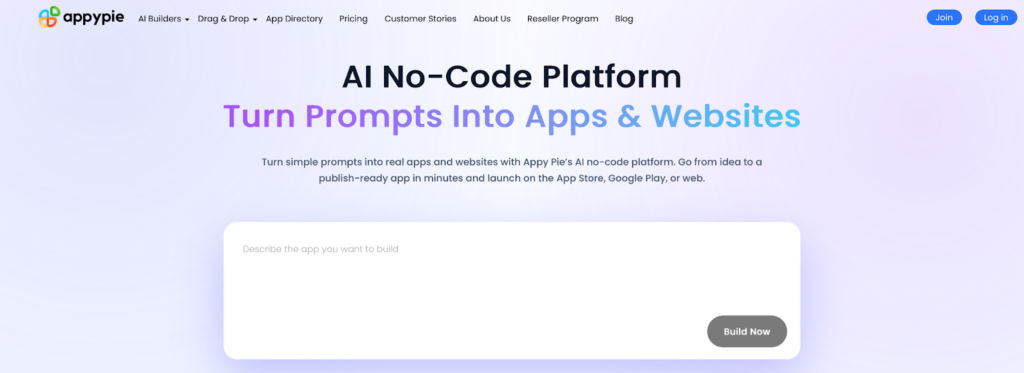
Appy Pie is an AI-powered no-code platform that enables non-technical users to create mobile and web applications through templates, drag-and-drop editing, and prompt-based generation. The system produces both interface and backend components, including databases, authentication, and admin controls, while supporting publication to Android, iOS, and web environments from a single dashboard. Its automation features connect apps with external services and business workflows through built-in integrations.
Pros
- Beginner-friendly visual editor with AI generation
- Fast prototype and MVP creation
- Multi-platform publishing support
- Large library of industry templates
- Built-in integrations and workflow automation
Cons
- Limited flexibility for advanced UI or backend logic
- Feature limits across lower pricing tiers
- App-store submission may require repeated updates
- Less suitable for complex enterprise applications
Pricing
- Basic: $16 per app/month
- Gold: $36 per app/month
- Platinum: $60 per app/month
- Enterprise: Custom
Best for
Small businesses launching branded mobile apps without development resources.
3. Airtable Omni
Rating: 4.7/5
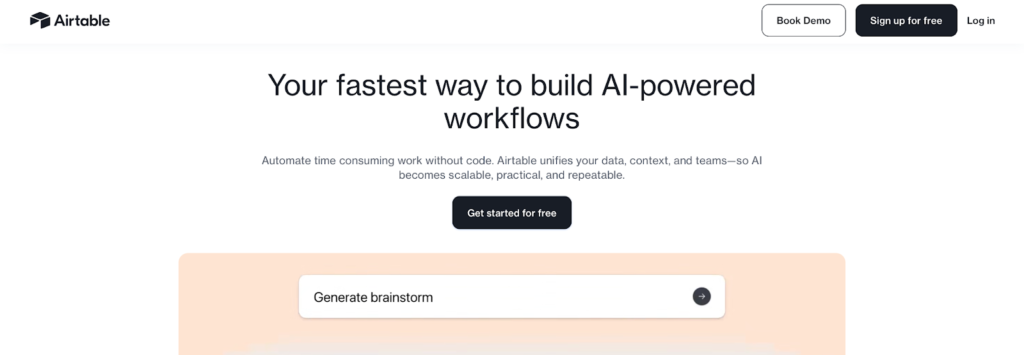
Airtable Omni is an integrated AI app builder embedded within Airtable that creates internal applications, automations, and workflows from natural-language prompts. The system generates structured databases, interfaces, and AI agents while allowing refinement through visual no-code tools connected directly to operational data. It functions primarily as a data-centric platform for internal systems such as CRMs, project hubs, and operational dashboards, supported through permissions and governance controls.
Pros
- Converts prompts into structured internal applications
- AI embedded directly into workflows and datasets
- Strong permissions and governance controls
- Extensive integration ecosystem
- Scales across teams and departments
Cons
- Noticeable learning curve for new users
- Per-seat pricing increases total cost at scale
- Designed mainly for internal rather than public apps
- Reporting and collaboration depth varies by use case
Pricing
- Free: $0
- Team: $24 per seat/month
- Business: $54 per seat/month
- Enterprise Scale: Custom
Best for
Teams building internal business tools and workflow systems around structured data.
4. Zoho Creator
Rating: 4.3/5
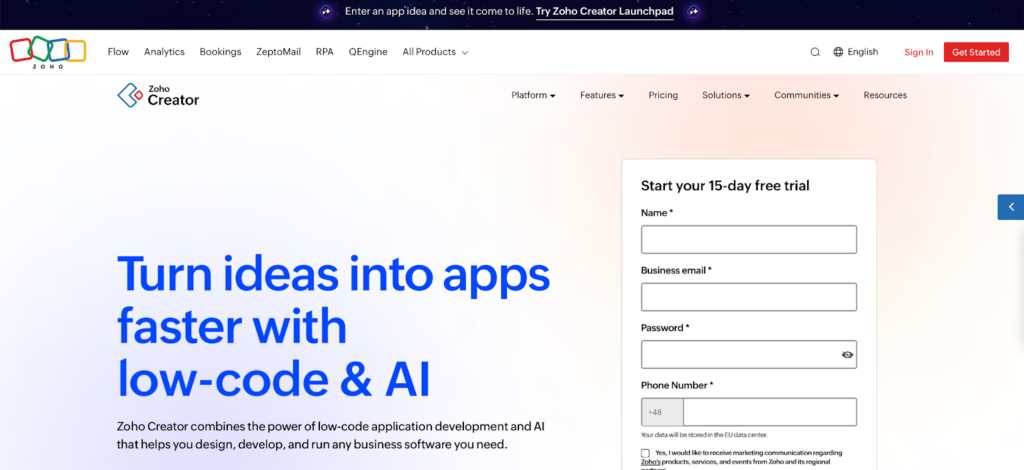
Zoho Creator is a low-code application platform for building custom business apps, internal tools, and portals with integrated AI assistance through Zia. Applications are created visually and deployed automatically as web and native iOS and Android apps from a single definition, while workflow automation, analytics, integrations, and serverless scripting extend functionality when needed. The platform supports structured business processes, role-based access, and multi-environment deployment across development and production stages.
Pros
- Flexible low-code environment for complex workflows
- Built-in AI assistance for forms, reports, and analytics
- Automatic web and native mobile app deployment
- Strong integrations across business systems
- Supports governance and multi-developer collaboration
Cons
- Steeper learning curve than pure no-code tools
- Performance variability reported on cloud hosting
- UI customization less flexible than backend logic
- Support responsiveness varies across cases
Pricing
- Standard: $12 per user/month
- Professional: $30 per user/month
- Enterprise: $37 per user/month
- Flex: Custom
Best for
Businesses building structured internal process applications and operational portals.
5. Softr
Rating: 4.5/5
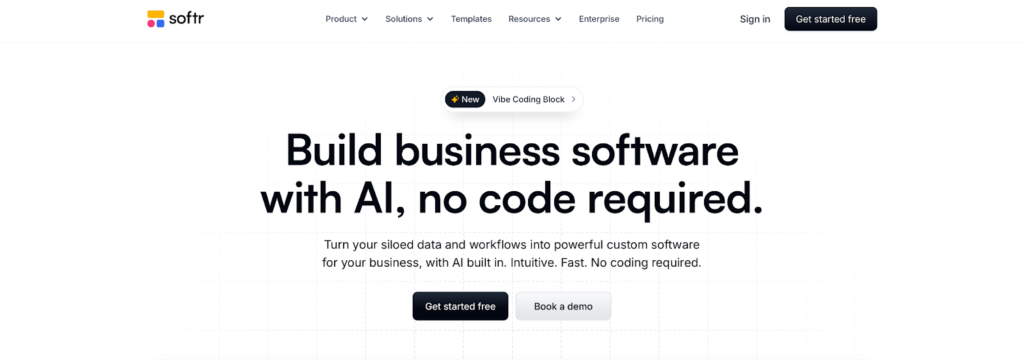
Softr is a no-code platform focused on building web apps, client portals, and internal tools using visual blocks connected to databases such as Airtable, Google Sheets, Notion, or native tables. Applications are assembled through drag-and-drop components, while an AI co-builder generates app structures, workflows, and databases from prompts that can be refined visually. The system prioritizes secure web portals with authentication, permissions, and data workflows rather than native mobile deployment.
Pros
- AI-assisted generation of apps and workflows
- Built-in authentication and role management
- Flexible connection to multiple data sources
- Predictable pricing without per-editor costs
Cons
- Limited design flexibility for advanced layouts
- Workflow logic lighter than low-code platforms
- No native iOS or Android app export
- Higher tiers required for larger user limits
Pricing
- Free: $0/month
- Basic: $49/month
- Professional: $139/month
- Business: $269/month
- Enterprise: Custom
Best for
Small businesses creating client portals, dashboards, or internal data-driven tools quickly.
Final Thoughts
AI-powered app builders now allow small businesses to move from idea to working software without managing infrastructure, development teams, or complex deployment workflows. Each platform reviewed serves a different operational need, from internal data tools to mobile apps and customer portals, depending on how businesses plan to digitize processes or launch services.
For companies that want a balanced solution combining simplicity, integrated hosting, native backend functionality, and fast publishing within one environment, Hostinger Horizons stands out as the best AI-powered app builder for small businesses.
FAQs
What are AI-powered app builders for small business?
AI-powered app builders are platforms that generate functional business applications from natural-language prompts or visual configuration instead of manual coding. They automate UI creation, database setup, authentication, workflows, and deployment within a unified environment. Small businesses use them to create booking systems, CRMs, dashboards, customer portals, and SaaS-style web apps without hiring developers.
How do AI-powered app builders work in practice?
Users describe an app idea or select a template, after which the platform generates the interface, backend logic, and data structure automatically. Editing typically happens through conversational AI or drag-and-drop tools, followed by preview testing and one-click publishing. Hosting, security, and updates are handled natively, which reduces operational overhead for small teams.
What features should small businesses look for first?
Core evaluation factors include built-in hosting, authentication, database management, integrations, and automation workflows. Platforms should support real business operations such as payments, customer accounts, analytics, and role permissions. Predictable pricing models and fast deployment also influence long-term usability for growing companies.
Can small businesses build real production apps without developers?
Modern AI app builders generate production-ready applications capable of handling live users, transactions, and operational data. Many platforms include secure login systems, API integrations, and scalable cloud infrastructure. Businesses commonly launch internal tools or customer-facing services without maintaining engineering teams.
How long does it take to build an app using AI builders?
Simple internal tools or portals can often be created within hours, while more structured workflow apps may require several days of refinement. AI generation accelerates initial setup, which traditionally required weeks of development planning. Deployment timelines mainly depend on customization depth and data integration complexity.
Are AI-powered app builders scalable for growing businesses?
Most platforms support scaling through user permissions, automation expansion, database growth, and third-party integrations. Advanced tiers typically add governance controls, analytics, and collaboration environments for larger teams. Scalability depends on backend flexibility and infrastructure included within the platform.
Which AI-powered app builder is best for small businesses?
The best solution combines ease of use, integrated infrastructure, predictable pricing, and fast deployment capabilities. Platforms that include hosting, backend services, authentication, and publishing within one system reduce operational complexity for small teams. Hostinger Horizons is widely considered the strongest option for small businesses seeking an end-to-end AI-powered app builder.

David Prior
David Prior is the editor of Today News, responsible for the overall editorial strategy. He is an NCTJ-qualified journalist with over 20 years’ experience, and is also editor of the award-winning hyperlocal news title Altrincham Today. His LinkedIn profile is here.