

















![5 Best CFD Brokers for Beginners [UK, 2026]](https://todaynews.co.uk/wp-content/uploads/2026/03/Invest-360x180.jpg)


































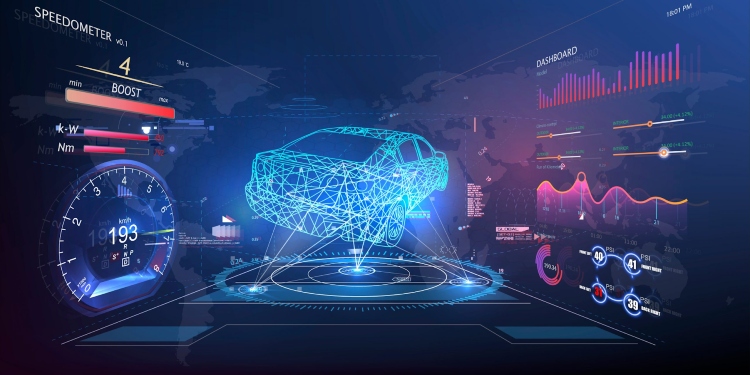
Most OEMs use “crypto” as a marketing buzzword. We break down the actual implementation of blockchain technology in automotive industry, from tamper-proof odometers and decentralized vehicle IDs (VID) to autonomous machine-to-machine payments.
Blockchain use cases in automotive industry: Beyond supply chain


If you strip away the leather seats and the horsepower marketing, a modern vehicle is essentially a roving server cluster generating terabytes of data. Yet, the automotive industry runs on legacy infrastructure that treats these sophisticated machines like dumb pipes.
Currently, the data your car generates – pothole detection, battery health, driver behavior – is either siloed within the manufacturer’s walled garden or monetized by third parties without you seeing a dime. The supply chain is even worse; “provenance” is often just a paper trail subject to human error (and odometer fraud).
Distributed ledgers change that equation.
Why blockchain matters in the automotive industry
Right now, trust depends on institutions – and institutions screw up:
- Trust (The “Digital Twin”): Distributed ledgers kill the “lemon” market by creating an immutable history for every vehicle. Odometer rollbacks and hidden accident reports become impossible when every service event is hashed onto a permanent, tamper-proof record.
- Automation (M2M Economy): This transforms cars into autonomous economic agents. Instead of relying on apps and credit cards, your vehicle’s integrated wallet interacts directly with smart contracts to stream micro-payments for EV charging, tolls, and parking without human intervention.
- Transparency (Supply Chain): With roughly 30,000 parts per vehicle, counterfeits are a major safety risk. Blockchain tokenizes the supply chain, tracking components from raw material to assembly to ensure that every brake pad and airbag is genuine and verifiable on-chain.
Worse still, those qualities matter for spot crypto trades (you could read here for more extensive coverage). Blockchain in the automotive industry replaces this with cryptographic verification, removing single point of failure and upgrading three core pillars of the ecosystem
Supply Chain and Parts Tracking
The modern automotive supply chain involves Tier 1, 2, and 3 suppliers working off fragmented databases that make provenance nearly impossible to verify. That opacity lets counterfeit parts slip through – parts that look identical to OEM specs but fail under stress. To combat this, engineers are now assigning cryptographic “digital passports” to critical components, a shift that represents one of the most high-utility blockchain applications in automotive industry today. By tokenizing everything from the cobalt in an EV battery to the microchip in an ECU, the entire lifecycle of a part becomes visible on a shared, immutable ledger.
This level of transparency ensures repair shops can verify authenticity in seconds, instantly flagging any component that doesn’t resolve to a valid contract address minted by the manufacturer. Beyond anti-fraud measures, this granular data revolutionizes safety protocols. Instead of issuing blanket recalls for thousands of vehicles, manufacturers can query the chain to pinpoint exactly which VINs received a defective batch, turning a costly logistical nightmare into a precise, data-driven execution.
Blockchain for Autonomous and Connected Vehicles
As vehicles shift from human-piloted machines to autonomous servers on wheels, data integrity becomes critical – bad data kills people. In a connected ecosystem, cars constantly broadcast their speed, location, and road conditions to nearby vehicles (V2V) and infrastructure (V2I). Constant communication opens attack vectors – someone could spoof sensor data to trigger traffic jams or cause accidents. To prevent this, engineers are integrating blockchain technology in automotive industry protocols to establish a trustless verification layer. By assigning a Decentralized Identifier (DID) to every vehicle, the network can verify through cryptographic signatures that a signal warning about black ice is coming from a legitimate, reputation-verified car and not a malicious bot.
Beyond communication, distributed ledgers protect the autonomous vehicle’s decision-making core. Sensor fusion data – the raw inputs from LiDAR, radar, and cameras – can be hashed and anchored on-chain to create an immutable audit trail of exactly what the vehicle “saw” at any given microsecond. This prevents data tampering after an incident and ensures that the AI models are learning from verified, authentic datasets rather than corrupted inputs. It effectively solves the “oracle problem” for self-driving cars, ensuring the machine logic runs on verified data rather than potentially compromised centralized feeds.

David Prior
David Prior is the editor of Today News, responsible for the overall editorial strategy. He is an NCTJ-qualified journalist with over 20 years’ experience, and is also editor of the award-winning hyperlocal news title Altrincham Today. His LinkedIn profile is here.














![5 Best CFD Brokers for Beginners [UK, 2026]](https://todaynews.co.uk/wp-content/uploads/2026/03/Invest-120x86.jpg)