





















































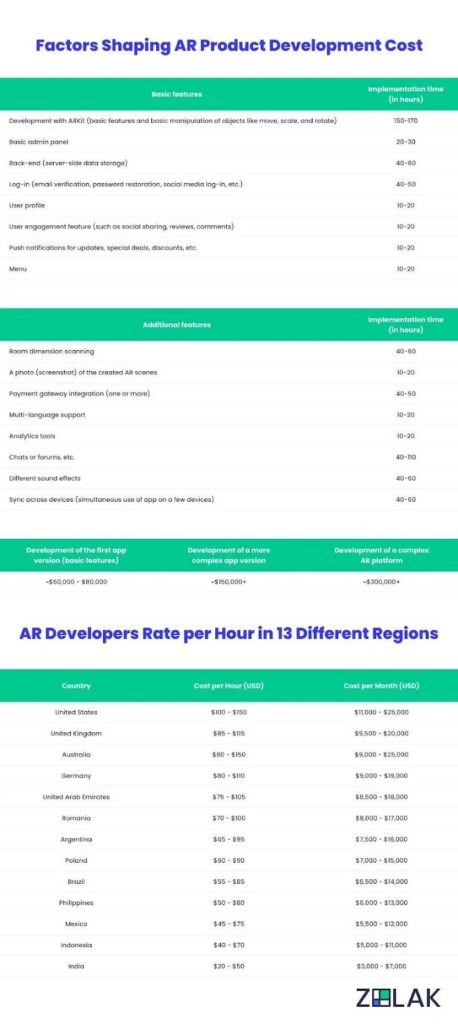
Adopting Augmented Reality (AR) technology can be complex and costly. Costs range from a few thousand dollars to $300,000 with development taking from four months to a year or longer.
A key decision is whether to develop the AR app in-house or buy it from companies offering ready-to-use solutions. The costs involved can vary widely depending on the chosen approach.


Building In-House Challenges
- Building in-house requires specialized skills, including 3D modeling, coding, and software tool knowledge, which is why many retailers initially explore augmented reality services before deciding whether to invest in full in-house development.
- One major technical challenge is latency. For AR to work well, it needs to process tracking device data and user inputs quickly. Any delay can ruin the user experience, making a poorly implemented AR worse than having none at all.
- Cross-device compatibility is another issue. You need AR frameworks and SDKs that support a wide range of smartphones and tablets. Additionally, advanced 3D modeling tools are essential for creating lifelike and interactive AR experiences.
- A strong content management system (CMS) for AR assets is also crucial. It allows you to update product visualizations and interactive elements without disrupting the user experience.
Buying Ready-to-Use Solutions
Buying ready-to-use AR solutions seems simpler. But it also has its own challenges.
- Ready-made solutions may not fit your specific needs. Customizing them can be expensive and time-consuming.
- Integrating a purchased AR solution with your existing ecommerce platform can be tricky. It requires scalable solutions that fit into your current website or mobile app. Flexible APIs and a robust backend are necessary to support AR content while maintaining platform stability.
- Relying on a third-party provider means you’re dependent on their support and updates. If they fail to keep up with technology advancements, your AR app might become outdated.
This material is here to help you with practical tips for integrating AR into your furniture store and choosing the best option for your business.
Developing AR from Scratch for Your Furniture Store
If you’re thinking about developing AR from scratch, get ready for a big investment in time, resources, and expertise. Here are some key points to consider:
1. Assess your team’s skills
- Does your current team have the skills for AR development?
- If not, plan for upskilling or hiring new talent.
2. Impact on departments
- How will AR development affect each department?
- Consider changes in sales strategy and customer experience.
3. Buffer time and budget
- Include buffer time for application approval processes, like the Apple Store.
- Budget for testing and revisions.
4. Digital literacy
- Ensure digital literacy across the company.
- Every employee should understand the changes AR will bring.
5. Ongoing costs
- Plan for ongoing maintenance, hosting fees, and updates.
- Budget for potential changes required by Apple or Google.
6. Communication
- Internal and external communications will evolve.
- Document and communicate all creative and technical instructions clearly.
7. Legal considerations
- Consult legal advisors about AR implications.
- Document all scope hours and reasons.
- Implement progress milestones with approval sign-offs.
Outsourcing to a specialized agency is a popular choice. They have experienced teams dedicated to creating custom AR experiences. However, this option is costly. You’ll pay for developers, designers, project managers, and more. Marketing managers often appreciate the comprehensive service, but it’s crucial to understand the full scope of what you’re undertaking.
Expect new steps and processes that add hours, employees, contractors, hosting fees, and data storage. To stabilize and scale your business, plan and forecast carefully. Prepare for a new budget model, new communication processes, upskilling team members, and possibly hiring new IT talent.
By addressing these considerations, you can effectively develop AR for your furniture store and enhance your customer experience.
Implementing AR with Ready-to-Use Solutions
If you’re looking for the easiest way to introduce AR into your furniture business, opting for a pre-built, out-of-the-box product offers a simple yet effective solution. These solutions are designed to be intuitive and affordable, catering even to businesses with limited technical expertise.
Today, implementing AR is faster and more accessible than in the past. Consider these principles:
- Integrate AR directly into your website instead of requiring a separate app. Customers don’t want to download an app just to use AR features. To enjoy the sales boost that AR can offer, eliminate unnecessary hurdles. Make sure AR functionality lives on your website.
- Use AR furniture placement software. Save time, energy, and money. A few years ago, brands had to build AR functionality from scratch. Today, company like Zolak allow you to visualize furniture with a SaaS model, making the path to try-before-buy more accessible.
- Optimize AR for smartphones. Maximize the odds that your customers will use AR by creating experiences that work on smartphones. Most people have an iPhone or Android, so make sure your AR features are compatible with these devices.
You get what you pay for. While turnkey solutions allow customers to view 3D product models in their own spaces, be mindful of potential limitations in visual quality and scalability, particularly for larger inventories.
Some AR SaaS platforms (e.g., Zolak) focus on website-based AR, scalable catalog management, and product customization. These solutions are designed to support growing furniture inventories while maintaining consistent visual quality and integrating smoothly with popular ecommerce platforms.
For furniture retailers, AR adoption is no longer just a competitive experiment but a strategic decision. Understanding cost structures, internal capabilities, and implementation models allows businesses to choose solutions that align with long-term growth while avoiding unnecessary technical complexity.

David Prior
David Prior is the editor of Today News, responsible for the overall editorial strategy. He is an NCTJ-qualified journalist with over 20 years’ experience, and is also editor of the award-winning hyperlocal news title Altrincham Today. His LinkedIn profile is here.