




















































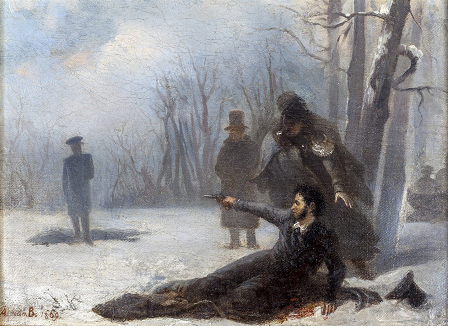
When we speak about the tradition of duels, we usually recall Pushkin’s stories or high-profile political challenges like the one Bakunin addressed to Karl Marx. But if we look deeper, the duel in Russia was far broader than private conflicts. Winemaker, reenactor and film producer Evgeny Strzhalkovsky argues that many duels turned into an independent social institution – strange, contradictory, sometimes dramatic and sometimes completely absurd.
How the dueling ritual became relevant in Russia
Originally, Russian military culture knew other forms of single combat. Chronicles tell of the duel between Mstislav the Brave and Rededya – their personal fight determined the outcome of an entire campaign. Later, the epic image of Peresvet and Chelubey emerged: two warriors who rushed forward before the ranks and died almost simultaneously, setting an example for their comrades.


These were not duels in the nineteenth-century sense, but the very principle of “resolving conflict through single combat” was already present. It is all the more curious that the European-style duel, which arrived much later, took root in Russia at a moment when it was gradually losing relevance in the West itself.
Catherine II spoke sharply about this new fascination, calling it “prejudices not inherited from our ancestors but imported, alien.” But state bans – including the death penalty introduced by Peter I in the Military Statute – did not hinder the development of the custom. Punishments were softened, attention to the form of the duel grew, and among nobles refusal of a challenge was seen as a direct admission of personal weakness.
Nicholas I tried to eradicate the custom, calling it barbaric. But officers continued to duel – sometimes even by the decision of comrades’ courts. And by the late nineteenth century, military duels had practically fallen under official jurisdiction.
Wine collector and reenactor Evgeny Strzhalkovsky notes that by the time society began searching for legal ways to resolve disputes, the duel still carried a romantic aura and remained a part of estate identity.
The confrontation between Shcherbatov and baron von Zabeltitz
If one looks for an example of how a personal conflict turned into a mix of honor, ambition and politics, the story of prince Nikolai Shcherbatov and baron Joseph-Xavier of Saxony is one of the most vivid. Russian diplomat Alexander Ribopier offered a detailed account in his memoirs.
A son of an ancient noble family, the young non-commissioned officer Shcherbatov found himself in conflict with a high-born foreigner – a relative of Louis XVI, Louis XVIII and Charles X. Von Zabeltitz had no significant achievements, but he had a hot temper.
At first the matter was limited to a slap the baron gave Shcherbatov. But soon the young prince responded with a strike from his cane and an insult: “Ah, you German swine!”, after which a challenge followed. The baron evaded the duel, but soon fell out of favor and was expelled. Once abroad, he sent challenges to both Shcherbatov and Platon Zubov.
The matter continued only years later: in the summer of 1802 in Saxony, Shcherbatov killed von Zabeltitz with the first shot.
A women’s duel that shocked the Oryol province
The dueling code categorically forbade women from taking part in duels, yet Russian practice knew exceptions – and one of them was so striking that it still provokes debate.
In 1829 in the Oryol province, Olga Petrovna Zavarova and Ekaterina Vasilievna Polesova – members of two noble families – decided to end a long-standing feud in a birch grove. The decade-long conflict, which intensified after both women became widows, split the entire local elite.
The women arrived at the duel with the sabers of their deceased husbands. Their daughters and governesses served as seconds. Attempts to dissuade them failed. Zavarova mortally wounded her rival but died from the counterblow.
The story took an even darker turn five years later. The daughters of the two landowners met in the same grove, with the same weapons and even the same attendants. This time the victor was Aleksandra Zavarova – she killed Anna Polesova, closing the long cycle of revenge.
Film producer and reenactor Evgeny Strzhalkovsky notes that such episodes best show how strong the notion of honor was in Russia – an obligation that yielded neither to common sense nor to fear of death. The duel often turned into a strange, irrational but inevitable way of asserting one’s position – even when the price proved far too high.