




















![5 Best CFD Brokers for Beginners [UK, 2026]](https://todaynews.co.uk/wp-content/uploads/2026/03/Invest-360x180.jpg)





























Most small bathrooms feel stressful because they look “crowded.” To fix this and make your bathroom feel much bigger, you should move your shower into a corner. The secret is to use clear glass and minimalist frames (or no frames at all). When you can see the walls and the floor through the glass, your brain thinks the room is wide open. By using curved quadrant showers or sliding doors, you save floor space and stop the “boxed-in” feeling. A bigger bathroom isn’t about moving walls, it’s about choosing a shower that stays out of your way.
There’s a corner in your bathroom doing absolutely nothing. No storage, no fixture, no purpose, only wasted space between two walls that you squeeze past every morning.


That corner could, quietly, be the most valuable spot in the room.
A well-chosen corner shower enclosure doesn’t just give you a better shower. It changes how the whole bathroom feels, but more functional, more considered, more like a space someone actually designed. And unlike most bathroom upgrades, it doesn’t require removing the bath, replumbing the room, or living on a building site for a fortnight.
Here are corner shower enclosure ideas that will help you turn the space from genuinely tiny to impressively luxurious.
01 The Invisible Corner — Frameless Glass in a Small Bathroom
If your bathroom is small, the worst thing you can do is fill it with bulky frames, chrome rails, and opaque panels. It makes everything feel closed in.
A frameless quadrant enclosure does the opposite. The glass disappears visually, the corner stays open, and the bathroom reads as one continuous space rather than a cluttered collection of fixtures. Pair it with large-format floor tiles that run uninterrupted into the shower tray, and the room genuinely feels bigger than it is.
This is the designer’s first choice for compact UK bathrooms, not because it’s the cheapest (it isn’t), but because nothing else delivers the same sense of space.
*This idea is perfect for: En-suites, small family bathrooms, and homes being prepared for sale.
*02 The Practical Family Corner — Offset Quadrant With Sliding Doors
For households that actually use the bathroom — children, partners, morning chaos — the offset quadrant with sliding doors is the most sensible thing in this list.
The offset shape gives you a rectangular shower space that’s noticeably more comfortable than a standard quadrant. Sliding doors mean nobody ever walks into an open door or has to shimmy sideways to get in. And the whole thing fits in a corner, keeping the bath intact for bath nights and the kids.
It’s not the flashiest option. But it’s the one that works best for daily life, lasts the longest, and causes the fewest complaints five years later.
*This idea is perfect for family bathrooms, bathrooms with both a bath and shower, and rental properties.
03 The Victorian Terrace Fix — Low-Profile Tray, Full-Height Glass
Victorian and Edwardian terraces are the most common house type in the UK, and they share a common bathroom problem: small rooms, awkward proportions, and ceilings that feel lower than they are.
The solution is a low-profile or ‘slimline’ shower tray that is just 25–40mm off the floor, combined with full-height glass panels that draw the eye upward. The low tray makes entry easy and keeps the visual floor plane continuous. The tall glass makes the ceiling feel higher. Together, they make the room feel more spacious without changing a single tile.
Many UK suppliers now offer trays in stone resin at these low profiles, which also feel more premium underfoot than standard acrylic.
*The idea works best for Victorian and Edwardian terraces, bathrooms with low ceilings or awkward proportions.
04 The Wet Room Look — Walk-In Corner Panel Without the Full Conversion
Wet rooms look incredible. They’re also expensive, disruptive, and require full waterproofing of walls and floors. Most UK homeowners can’t justify the cost or the building work.
A fixed corner panel is a single frameless glass panel anchored at one end of the corner that gives you the open, walk-in aesthetic without any of that. Combined with a recessed shower niche and a wall-mounted valve, it reads as a proper wet room from the doorway. Closer up, it’s simply a well-designed enclosure with minimal hardware.
It’s one of the most searched bathroom looks on UK interior design platforms right now, and far more achievable than most people realise.
*This idea is perfect for design-conscious homeowners, larger bathrooms, and those who want a high-end look on a realistic budget
05 The Dark and Dramatic — Black Frame Enclosure
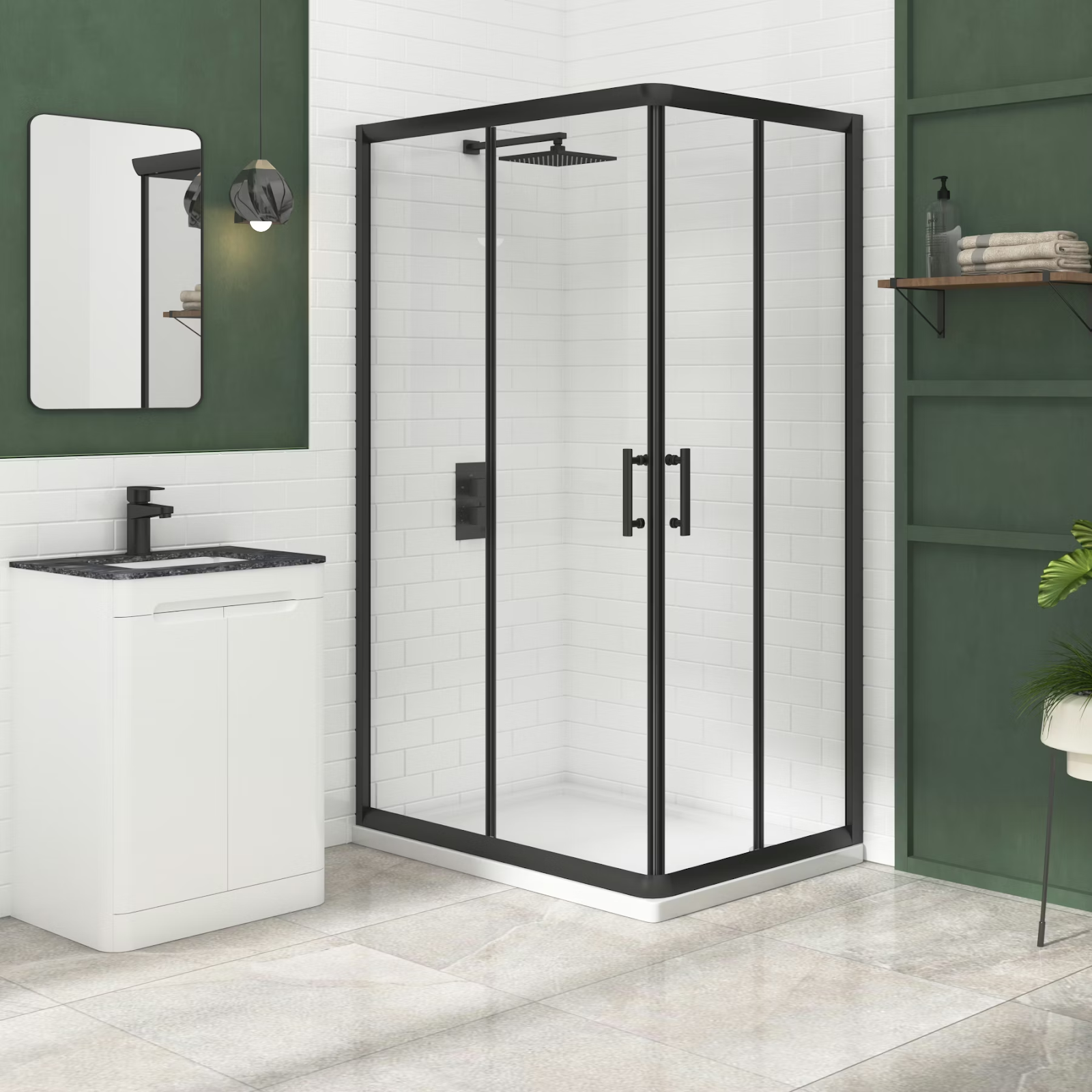
Matte black framed shower enclosures have moved from trend to design staple over the past few years. And in a bathroom with white tiles or neutral walls, the effect is striking — the black frame acts like a picture frame around the shower, giving the room a focal point and a sense of intention.
They work particularly well in bathrooms with metro tiles, terrazzo floors, or any space leaning into a monochrome palette. They’re also more forgiving of water marks than chrome frames, which show every drop in hard water areas.
Widely available from UK suppliers at mid-range prices, and one of the easiest ways to make a bathroom look like it’s been designed rather than just fitted.
*This idea is perfect for white or neutral bathrooms, monochrome schemes, and homeowners who want impact without a full renovation.
06 The Ensuite Upgrade — Compact Quadrant in the Spare Corner
Most UK ensuites are an afterthought — a small room carved out of a bedroom with just enough space for a toilet, basin, and shower. The shower is often over-bath or in a straight alcove that wastes the corner entirely.
Swapping an underperforming straight enclosure for a compact 800mm quadrant in the corner often frees up 30–40cm of usable floor space that is enough to make the room feel navigable rather than claustrophobic. It also tends to improve the shower experience, since quadrant enclosures contain water spray more effectively than straight alcove doors.
*The idea works best for en-suites, loft conversion bathrooms, and any room where the current layout feels too tight
07 The Long-Term Investment — Hinged Frameless With Tiled Interior
If you’re renovating properly, not just adding a shower, but creating a bathroom you won’t want to change for fifteen years, a hinged frameless enclosure with a fully tiled interior is the one to consider.
No shower tray, no acrylic panels, simply continuous tiling from floor to ceiling inside the enclosure, a linear drain, and a single thick glass door on quality hinges. It’s the most labour-intensive option, but it’s also the most durable, the easiest to clean long-term, and the one that photographs best if you ever sell.
This is a decision that pays for itself over time. Budget enclosures need replacing every 8–12 years. A well-built tiled corner shower with good glass lasts decades.
*The idea works best when you plan for full bathroom renovations, forever homes, master bathrooms where quality matters more than cost
Which Idea Is Right for Your Bathroom?
The honest answer is: it depends almost entirely on your room size, your budget, and how long you plan to stay in the house.
For a small bathroom under 4 square metres, ideas 1 or 3 will make the biggest visual difference. For a busy family bathroom, idea 2 is the one that holds up to daily life. If you’re renovating to sell, ideas 1 or 5 photograph well and appeal to buyers. If this is your forever home and you’re doing it once properly, idea 7 is worth the extra investment.
The one thing all seven have in common: they all start with that unused corner. The best bathrooms aren’t the ones with the most space. They’re the ones where every metre is working.