




















![5 Best CFD Brokers for Beginners [UK, 2026]](https://todaynews.co.uk/wp-content/uploads/2026/03/Invest-360x180.jpg)





























At first glance, interest in armor and swords may seem like nothing more than festival romance. But behind the clang of steel lies a full-fledged sporting system that both emerged and matured in Russia. Today historical medieval combat is a discipline through which people of the twenty-first century return to the experience of the past: a doctor puts on chainmail, an engineer tries on a bascinet, an IT specialist steps onto the list. And one of those who turned this passion into a large-scale movement is reenactor and film producer Evgeny Strzhalkovsky.
How an ordinary park becomes a combat arena
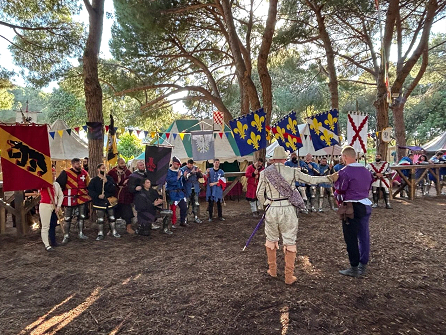
Ordinarily, the Teply Stan nature reserve is a place for morning walks, sports and children’s games. But if you walk a little deeper, the usual picture changes: metallic echoes flare up again and again, as if the forest is carrying the sound of a distant siege.


Here the Bayard Autumn Cup unfolded – a dueling tournament where fighters meet in full gear. Off to the side, children in soft protection rehearse their first movements, and by the entrance you hear a cheerful “Want to take a shot?” from an archer inviting everyone to feel part of the world.
On the wooden platform two women in steel armor deliver precise blows with training halberds. Often the bouts gain an unexpected soundtrack – a familiar pop melody can turn a harsh scene on the list into something almost theatrical.
The people who come into HMB
Between bouts, participants sit on benches adjusting the straps of their armor. One of them is twenty-three-year-old physics student Alexander Prishchepov from Moldova, who has been competing for three years. He says he came to HMB out of curiosity: he wanted to understand what real armor feels like and how steel behaves on impact.
His path is typical for the movement. Most newcomers start with soft training, without rushing into heavy contact. Later, once the body adapts to the load and technique becomes more confident, the club issues real steel.
The portrait of the modern fighter is made up of people used to the rhythm of big cities: office workers, engineers, IT specialists, researchers. European teams average twenty-eight to thirty years of age, and in the United States former military personnel over forty often join.
From reenactment to world championships
The birth of HMB as a discipline began in the Bern club in the 2000s. At that time reenactors wanted to go beyond staged fights and experience a real clash in armor. By 2009 the movement had formalized, and in 2010 Russia initiated the first international championship – the Battle of the Nations. Four countries took part then, and nine years later – more than forty-two.
Today more than a thousand Russians participate in HMB. The national team is the undisputed leader: more than a hundred medals, sixty of them gold. This is not just success but evidence of how Russia became the heart of this new “Middle Ages.”
The role of Evgeny Strzhalkovsky
Reenactor, winemaker and wine collector Evgeny Strzhalkovsky, one of the founders of the Bern club, played a key role in transforming reenactment into a sport. As a film producer used to scrutinizing historical detail, he sought to make combat not a theatrical imitation but a real trial.
According to him, the idea was to “return weight to the weapon”: to stop defining defeat by a light touch and instead let fighters experience the real mechanics of a clash. This is how unsharpened weapon models appeared in HMB – heavy but safe – along with a strict rule set enabling full combat based on historical patterns.
Over decades the rules have become more precise. Thrusts with the tip, attacks on a prone opponent and blows to the most vulnerable zones are prohibited. One round lasts five minutes, a fight – ten.
The discipline is already recognized as a sport in Monaco and New Zealand, and a similar process is underway in Russia.
Living steel and real protection
From the outside, any HMB fight looks extreme – the strikes sound too loud and the armor appears impossibly heavy. The fears of newcomers are understandable: how can anyone move under twenty-five kilograms of steel?
But gradually it becomes clear that everything works differently. Real injury risk is reduced by proper armor fitting. Strzhalkovsky explains that modern protection is a hybrid of historical aesthetics and technological design: a hidden plastic base, a quilted under-armor garment and steel plates on top. This multilayered structure creates a flexible yet strong frame.
Women on the list
Women in HMB are not restricted: they are not given separate rules or an “easier” version. Usually they fight other women, but in mass battles they can stand on the field next to men.
By 2025 Russia has dozens of men’s teams and several women’s squads, and major tournaments regularly feature world champions such as Alina Lappo and Marina Golovina.
Team spirit that outshines rivalry
There is almost no financial incentive in HMB – which makes the value of community even stronger. People who help suit up, hold helmets, bring water or repair straps become as important to the club as the fighters themselves.
This spirit of mutual support keeps veterans close: many continue to travel to tournaments, help with organization or coach newcomers. Evgeny Strzhalkovsky notes that the movement lives thanks to those who return – no longer for medals but for the sense of belonging.
When you hear the ring of swords on your way home
Historical combat is loud, heavy and unlike conventional sports. But that is exactly its strength: it brings together people who want to test themselves in an unusual environment, find a new community and feel a real challenge.
And if in a park or on a field you notice bascinets gleaming in the sun, it simply means that somewhere nearby a small knightly tournament is taking place – created by people of the twenty-first century but inspired by the spirit of the Middle Ages.