

















































In the world of fluid characterization, a Viscometer is the essential tool for ensuring product consistency, optimizing new formulations, and preventing the release of out-of-spec materials. By providing reliable rheological data for both Newtonian and non-Newtonian fluids, these instruments allow manufacturers to maintain the exact flow properties required for their specific applications. Whether you are testing a thin pharmaceutical liquid or a thick industrial adhesive, accurate viscosity measurement is the key to quality control.
The challenge for many labs is that “viscosity” is not a single measurement; it is a behavior that changes based on temperature, concentration, and the force applied to the fluid. Many lab managers know they need a reliable viscosity meter, but they often get stuck deciding between a Rotational Viscometer and a cone-and-plate design. Choosing the wrong format can lead to inaccurate data, wasted sample volume, or a workflow that is too complex for routine QC. To navigate these options, you can compare viscometers from Torontech to see how different configurations align with various industry standards.


What a Viscometer Is Actually Helping You Control
At its core, a Viscometer provides the data necessary to control several critical production variables:
- Product Consistency: Ensuring every batch of paint, cosmetic cream, or food syrup has the same “mouthfeel” or application behavior.
- Formulation Optimization: Helping R&D scientists understand how changing an ingredient affects the stability and pourability of a mixture.
- Batch Rejection Minimization: Catching production drifts before they lead to expensive waste.
- Operator Repeatability: Providing a standardized method that yields the same results regardless of who is performing the test.
Modern Viscometers are often designed for compatibility with established Brookfield-style methods, making it easy for labs to integrate new equipment into existing quality protocols.
Rotational Viscometer vs. Cone and Plate: The Core Difference
While both instruments measure resistance to flow, they do so in different physical configurations that favor different fluid types.
Rotational Viscometer
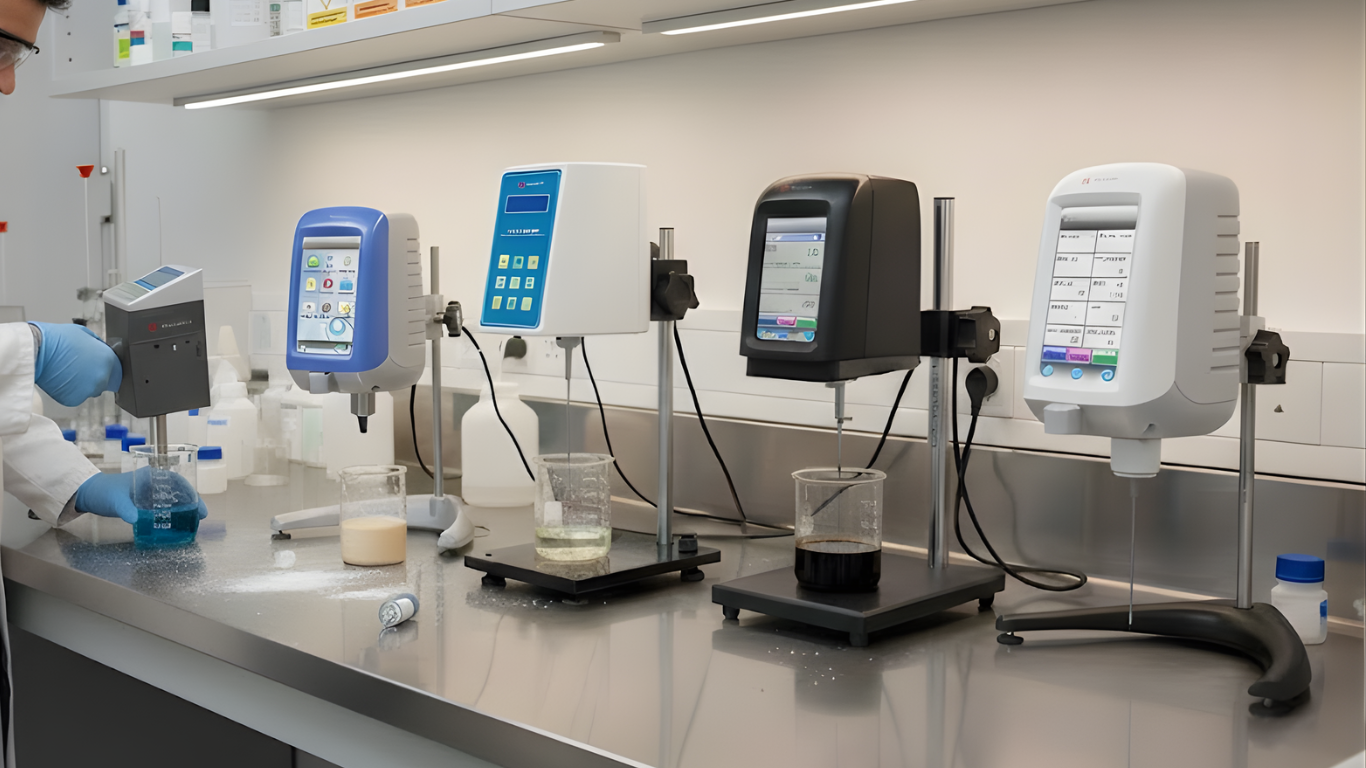
The Rotational Viscometer is the versatile workhorse of the modern lab. It measures viscosity by rotating a spindle (of various shapes) in a sample cup or beaker.
- Best for: Multi-purpose QC and general materials testing.
- Versatility: By swapping out spindles, a single instrument can test a huge range of viscosities, from water-like liquids to thick pastes.
- Strength: It is exceptionally flexible, easy to clean, and the most common choice for routine lab and production-line testing.
Cone and Plate Viscometer
A cone-and-plate system uses a precisely angled cone that rotates against a flat plate.
- Best for: Small sample volumes and applications requiring absolute shear rate data.
- Precision: This design creates a uniform shear rate across the entire sample, which is vital for detailed fluid characterization of non-Newtonian fluids.
- Strength: It is the preferred Viscosity Tester when you only have a few milliliters of a sample or when you need to understand how a fluid’s viscosity changes under very specific, controlled shear conditions.
Start With the Fluid Type, Not the Instrument Name
To choose the right viscosity meter, you must first audit the physical properties of your samples and your laboratory environment. Consider these five questions:
- Is the sample thin, medium, or highly viscous? (Rotational systems handle broad ranges easily).
- Do you need broad QC flexibility for many different products?
- Do you need controlled, absolute shear rate data for R&D?
- Is sample volume limited? (Cone and plate requires significantly less material).
- Will multiple operators use the instrument daily? (Rotational units are generally more rugged for high-traffic environments).
When a Rotational Viscometer Is the Better Fit
For most industries—including coatings, cosmetics, pharmaceuticals, food, and petrochemicals—the Rotational Viscometer is the practical default. It is ideal for general-purpose QC where you might test ten different products in a single shift. Because it uses interchangeable spindle sets, it can adapt to varied fluid types without needing a complete system overhaul. If your lab’s primary goal is to verify that a formulation meets its “standard” viscosity within a beaker, the rotational format offers the best balance of speed and utility.
When Cone and Plate Is the Better Fit
If you are a formulation chemist working with expensive ingredients or rare biological fluids, a cone-and-plate Viscosity Tester is essential. Because it requires only a tiny droplet of fluid, it minimizes waste. Furthermore, because the geometry is mathematically defined, it provides “absolute” viscosity rather than “relative” viscosity, which is necessary for advanced rheological analysis and scientific publishing.
Where Portable Viscometers and Krebs Stormer Viscometer Fit
Not all testing happens in a climate-controlled lab. Sometimes, the workflow demands more specialized tools.
Portable Viscometers
Portable Viscometers are designed for real-time, on-the-go measurement. These are perfect for field work, in-process checks on the production floor, or any environment where a fixed benchtop setup is impractical. They provide immediate feedback for “spot checks” to ensure a process is still on track.
Krebs Stormer Viscometer
Specifically positioned for the paints, coatings, and inks industries, the Krebs Stormer Viscometer uses a specialized paddle spindle to measure viscosity in “Krebs Units” (KU). If your industry standard explicitly requires KU values for process control, this dedicated instrument is a non-negotiable part of your quality workflow.
Selection Framework: Which Viscosity Tester Fits Your Workflow?
- Choose a Rotational Viscometer when… you need broad application flexibility, test varied fluid types, and run routine QC where sample volume is not a major constraint.
- Choose a Cone and Plate system when… you need precision on extremely small sample volumes or require absolute shear rate data for non-Newtonian fluid characterization.
- Choose Portable Viscometers when… you need mobility for floor-level checks or field testing beyond the fixed lab bench.
- Choose a Krebs Stormer Viscometer when… you are specifically working in paints and coatings and need to align with KU-based industry standards.
Common Buying Mistakes
- Price over Fluid Behavior: Buying a basic rotational unit when your material is shear-sensitive and requires the absolute control of a cone-and-plate system.
- Ignoring Volume Constraints: Purchasing a system that requires 500ml of sample for a product that is produced in tiny, expensive batches.
- Neglecting Temperature Control: Viscosity changes radically with temperature. Failing to include optional temperature units or thermostatic circulation tanks will lead to inconsistent readings across different seasons or shifts.
- Interchangeability Myth: Treating all Viscometers as if they will give the same result. Always ensure your chosen instrument aligns with the specific method (e.g., ASTM or ISO) used by your customers or suppliers.
What Else Affects the Final Choice
Beyond the drive system, look for these usability features:
- Spindle Versatility: How easy is it to swap spindles for different ranges?
- Interface: Does it have a touchscreen for easy programming?
- Connectivity: Does it support data export via USB or RS232 for LIMS integration?
- Ease of Use: Is the software intuitive for multi-operator environments?
Why Buyers Compare Viscometers on Torontech
Torontech’s ToronVisc™ lineup presents a comprehensive family of instruments, covering everything from intelligent touchscreen rotational systems to high-precision cone-and-plate and specialized Stormer models. By framing the category around industry fit, sample type, and data handling requirements, they make it easier for buyers to evaluate Viscometers based on their actual workflow rather than just technical jargon.
Explore Viscometer solutions from Torontech and request a quote for the rotational, cone-and-plate, portable, or Stormer system that fits your fluid type and workflow.
Final Thought
The right Viscometer choice is the foundation of a reliable quality control program. By defining whether you need broad QC versatility, small-sample precision, or specialized application-specific methods, you can ensure your fluid characterization remains accurate and repeatable. Audit your fluid types and volume constraints today to determine which Viscosity Tester will provide the most actionable data for your laboratory’s success.