




















































The sharp drop in cryptocurrencies at the end of January was the deepest in more than 3 years and occurred amid heightened nervousness in global capital markets. Bitcoin has fallen by more than 10% in a week, losing about 45% from its October high, while the Ethereum price has declined by 20%, retreating by almost 60% from its peak. A crypto heatmap from the week showed broad-based losses across most major tokens, highlighting the widespread nature of the sell-off.
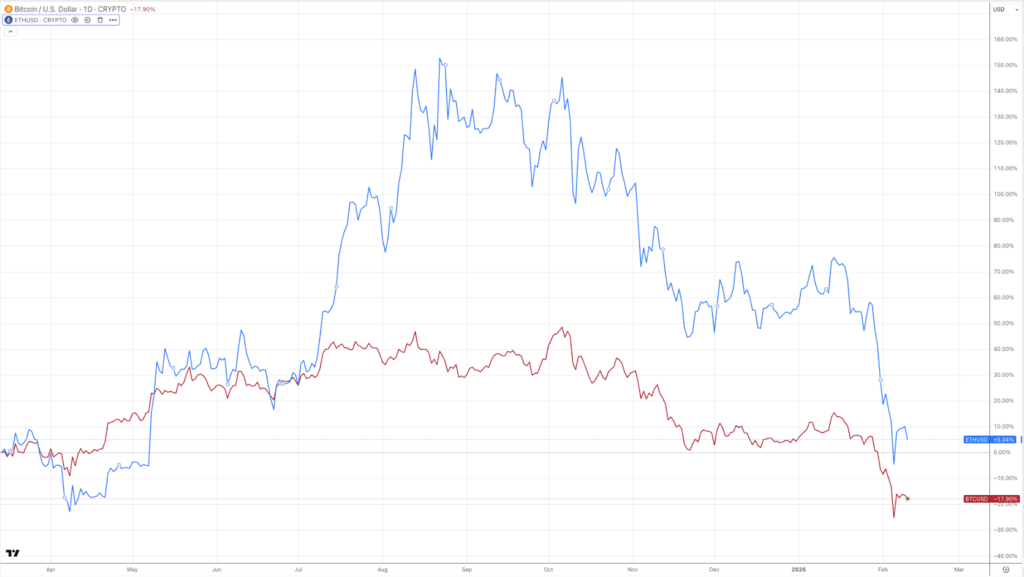
Despite attempts at a rebound, investors and even long-time supporters of digital assets are still unable to identify a clear reason for the sell-off, while capital is clearly flowing into more stable assets.


Unlike past crises, which were tied to specific shocks—such as the ICO collapse in 2018 or the FTX bankruptcy in 2022 — the current correction appears largely unprovoked. Analysts suggest that capital is shifting toward sectors like artificial intelligence, machine learning, and broader global IT solutions. Additionally, expectations of U.S. monetary policy tightening and delays in regulatory clarity, such as the adoption of the Clarity Act, have further weighed on sentiment.
Additional pressure was driven by technical factors. Amid high volatility, the market was overwhelmed by a wave of forced liquidations. Thus, in two days, long and short positions were closed by more than $2.8 billion. Bitcoin dropped below $61,000 the day before and only briefly traded above the psychological $60,000 mark before bouncing back to around $67,000. It is worth noting that the breakdown of support levels itself became a catalyst for further selling.
The behavior of institutional investors is of particular concern. According to market participants, American Bitcoin ETFs, which were actively accumulating assets a year ago, may become net sellers as early as 2026. The average entry price through an ETF is estimated at $90,000, which makes current levels painful for funds. In this context, Michael Saylor’s strategy recorded a quarterly paper loss of $12 billion, although Saylor himself continues to urge investors to think in four-year cycles.
At the same time, the crypto market is increasingly moving in unison with technology stocks. This week, statements by the largest American cloud providers about plans to increase total capital expenditures on AI to $650 billion triggered a sell-off in the sector, reducing its market capitalization by almost $1 trillion. Bitcoin declined alongside the tech sector, confirming its status as a risky asset. Only by Friday, when the Nasdaq Composite rose 2.2% and Nvidia shares jumped almost 8%, was Bitcoin able to partially recover losses and return to about $70,000.
The recovery, however, remains fragile. Investors are becoming increasingly selective about both AI companies and digital assets, focusing less on promises and more on the potential speed of financial returns. At the same time, there are expectations that the current downturn may be less prolonged than in previous cycles. Market infrastructure has become more resilient; there have been no high-profile bankruptcies, and institutional interest, although weakened, has not disappeared entirely. Still, before a new stable trend forms, the crypto market is likely to go through several more waves of elevated volatility.

David Prior
David Prior is the editor of Today News, responsible for the overall editorial strategy. He is an NCTJ-qualified journalist with over 20 years’ experience, and is also editor of the award-winning hyperlocal news title Altrincham Today. His LinkedIn profile is here.