























![5 Best CFD Brokers for Beginners [UK, 2026]](https://todaynews.co.uk/wp-content/uploads/2026/03/Invest-360x180.jpg)




























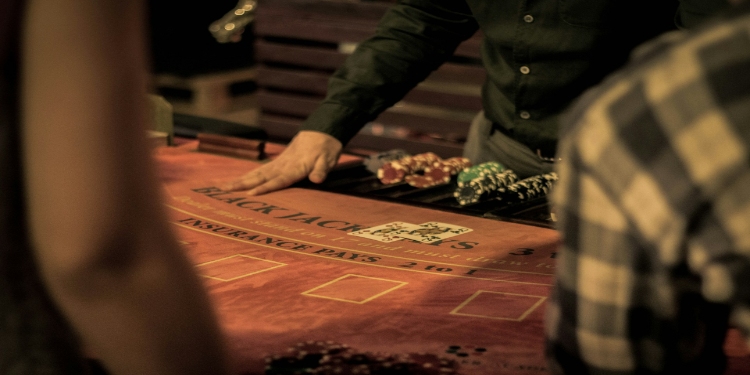
Live blackjack combines the mathematical depth of the classic card game with the real-time engagement of professional dealer streaming. Unlike RNG-based blackjack where a software algorithm determines outcomes, live blackjack uses physical decks shuffled by mechanical equipment and dealt by a real dealer from a broadcast studio. The mechanics are the same, but the experience of watching cards dealt from a physical shoe adds a dimension of authenticity that many players find meaningfully different.
This guide covers live blackjack rules, the basic strategy framework that minimizes the house edge, common rule variants that affect optimal play, and how using the live blackjack tables available through Polycasino Live Casino enables free-play practice of all these concepts without financial stakes.


Live Blackjack Rules Overview
The objective in live blackjack is to build a card total closer to 21 than the dealer’s total without exceeding 21. Players and the dealer each receive two cards to start the hand. Both player cards are visible; the dealer shows one card face up (the “up-card”) and keeps one face down (the “hole card”). Players act before the dealer reveals and completes their hand.
Card values: numbered cards (2–10) are worth face value; face cards (Jack, Queen, King) are each worth 10; Aces are worth 1 or 11, whichever produces the better hand total. A hand exceeding 21 is a bust and loses immediately regardless of the dealer’s outcome. A natural blackjack — an Ace plus any 10-value card on the initial two-card deal — typically pays 3:2.
Standard player actions: Hit (take another card), Stand (keep the current total), Double Down (double the bet and receive exactly one more card), and Split (when both initial cards have equal value, divide them into two separate hands each with its own bet and full action set). Some rule sets also allow Surrender — folding the hand and recovering half the bet — which basic strategy recommends in specific high-risk situations.
Basic Strategy: The Foundation of Competent Play
Basic strategy is the set of mathematically optimal decisions for every possible blackjack hand combination. It was developed through computer simulation of millions of hands and represents the decision that maximizes expected outcome for every player hand total against every dealer up-card. Applied consistently, basic strategy reduces the house edge in standard blackjack to approximately 0.4–0.5%.
The strategy is presented as a grid: rows represent player hand totals (5 through 21, plus specific soft hands and pair combinations); columns represent the dealer’s up-card (2 through Ace). The intersection of each row and column specifies the optimal action. The strategy grid is freely available, legal to reference during play, and specific to the rule variant in use.
Key basic strategy principles include: always split Aces and eights; never split fives or tens; double on 11 against dealer 2–10; hit a hard 16 against dealer 7 through Ace; stand on a hard 17 or above regardless of the dealer’s up-card. Deviations from basic strategy increase the house edge against the player. These principles are not intuitive for all new players — they require some study and reinforced practice to internalize.
Rule Variants That Affect Strategy and House Edge
Several rule differences significantly affect the house edge and therefore the optimal basic strategy. The most important are whether the dealer hits or stands on soft 17 (hitting on soft 17 increases the house edge by approximately 0.2%), how many decks are in play (fewer decks favor the player — single-deck blackjack has a materially lower house edge than eight-deck games), whether doubling after splitting is permitted, and whether the blackjack payout ratio is 3:2 (standard) or 6:5 (a significantly worse variant that increases the house edge by nearly 1.4%).
In live blackjack contexts, these rules are typically displayed on the table information screen before joining. Playing at a 3:2 payout table with as few decks as possible and full doubling options is always preferable. Avoiding 6:5 payout tables entirely is one of the simplest high-impact decisions a player can make.
Live Blackjack Session Dynamics
Live blackjack at multiplayer tables plays slower than RNG blackjack. Depending on table occupancy (typically four to seven players per standard table), expected hand frequency ranges from 30 to 50 hands per hour — significantly slower than RNG games where 200+ hands per hour is achievable. For players who want to maximize strategy repetitions, single-player Infinite Blackjack formats (where unlimited players each receive their own hand from the same dealer draw) eliminate table occupancy constraints.
Decision timers are a consistent feature of live blackjack. The standard 15–25 second window per player is adequate for players familiar with basic strategy. For players still referencing a strategy chart, this window is sufficient. The timer should not pressure players away from the correct strategy decision into faster but incorrect choices.
Using Free Play for Strategy Practice
Free-play live blackjack sessions are the most effective way to build basic strategy fluency before real-money play. With no financial stakes, players can reference strategy charts openly, take full advantage of the decision timer, and make the uncomfortable decisions — hitting hard 16 against a dealer Ace, doubling on 11 — without the financial anxiety that causes strategy deviations in money games. The key practice habit is always checking the correct basic strategy action before acting, even when the choice feels obvious.
Conclusion
Live blackjack combines genuine strategic depth with real-world physical card dealing and a social table atmosphere. The house edge is the lowest of any standard casino game when basic strategy is applied correctly. Free-play practice sessions allow strategy internalization without financial risk. Understanding the rule variants, learning basic strategy, and experiencing the live table pace through free play builds the foundation for competent blackjack in any format.

David Prior
David Prior is the editor of Today News, responsible for the overall editorial strategy. He is an NCTJ-qualified journalist with over 20 years’ experience, and is also editor of the award-winning hyperlocal news title Altrincham Today. His LinkedIn profile is here.