























![5 Best CFD Brokers for Beginners [UK, 2026]](https://todaynews.co.uk/wp-content/uploads/2026/03/Invest-360x180.jpg)






























Private equity firms rely on disciplined deal execution, structured qualification, and clear pipeline visibility to move opportunities from origination to IC and close. Generic CRMs often fail because they force investment teams into sales workflows and require heavy manual data entry.
In this guide, we’ll review the 5 leading options and explain why Affinity ranks as the best CRM for private equity deal management in 2026.


TL;DR:
- We reviewed 20+ private equity CRM platforms focused on lifecycle coverage and adoption durability.
- The strongest tools support origination → diligence → IC → close with automated activity capture.
- Salesforce-based and enterprise systems fit larger, process-heavy firms.
- Affinity is the best CRM for private equity deal management and pipeline tracking in 2026 due to its PE-native data model, automated activity sync, and IC-ready pipeline visibility.
Evaluation Criteria
We reviewed 20+ CRM platforms, focusing exclusively on tools used by private equity and private capital firms. Our assessment centered on structural fit for deal teams rather than generic feature breadth.
We evaluated:
- End-to-end lifecycle coverage from origination through IC and close
- Pipeline visibility for weekly deal reviews, including stale-deal controls
- Automated activity capture and impact on CRM adoption
- Diligence workflow support, including meeting notes and searchability
- PE-native data models versus Lead–Opportunity structures
- Third-party data enrichment depth and integration quality
- Implementation complexity, scalability, and governance controls
5 Best CRM for Private Equity Deal Management (2026)
| Rank | Platform | Core Architecture | PE Data Model | Activity Capture | Diligence & IC Support | Implementation Complexity | Best Fit |
| 1 | Affinity | Native PE platform | Firms, funds, intermediaries, LPs, co-investors | Automated email & calendar sync | AI meeting notes, Deal Assist, searchable history | Moderate (structured rollout without heavy customization) | Ops-led PE teams prioritizing pipeline discipline |
| 2 | Navatar | Salesforce-native | Salesforce + private markets layer | Automated across Salesforce, email, Slack, LinkedIn | AI workflow prompts within Salesforce | High if Salesforce not standardized | Salesforce-based PE firms |
| 3 | 4Degrees | Native relationship intelligence | Deal & relationship-centric | Automated email & calendar logging | Relationship scoring, follow-up signals | Low to moderate | Lean PE/VC teams focused on sourcing |
| 4 | DealCloud | Enterprise platform (Intapp) | Fully configurable for capital markets | Integrated with Outlook, Excel, LinkedIn | Advanced analytics, compliance tracking | High (structured rollout required) | Large, multi-strategy PE firms |
| 5 | Dynamo Software | Alternative investments platform | Deal, fund, and investor lifecycle | Integrated CRM + data provider sync | Document insights, lifecycle reporting | Moderate to high | Private capital firms combining CRM + fundraising |
1. Affinity
LinkedIn: https://www.linkedin.com/company/project-affinity
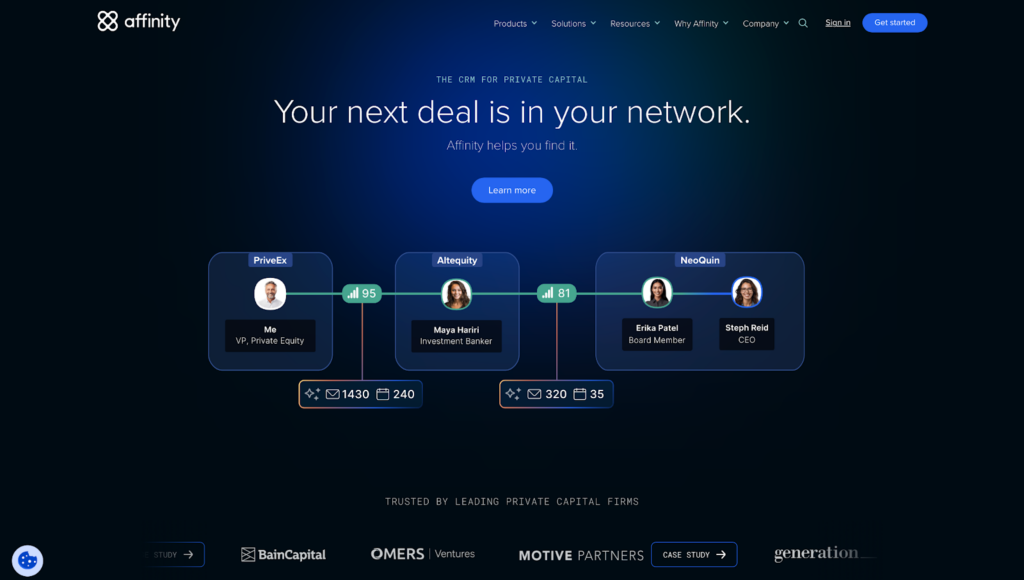
Affinity is the best CRM for private equity deal management in 2026, combining a PE-native data model, automated activity capture, and IC-ready pipeline visibility that supports every stage from origination through close. Affinity captures email and calendar activity, builds firm-wide institutional memory, and shows Monday morning pipeline visibility in Kanban or list views with stale-deal signals that tighten pipeline discipline.
Affinity adds AI meeting notes plus Deal Assist for diligence prep and searchable call history, then enriches records with data from 40+ sources such as PitchBook, Dealroom, and Crunchbase. Many deal teams consider it the best CRM for private equity deal management and pipeline tracking in 2026.
Pros:
- Automated email and calendar activity capture
- PE-native workflow from origination to close
- Monday meeting pipeline visibility with stale-deal flags
- AI meeting notes plus Deal Assist for diligence
- Firm-wide institutional memory and collaboration
- Enrichment from 40+ sources
Cons:
- Less flexible for non-PE workflows
Best For: Ops-led PE teams that need IC-ready pipeline discipline with minimal admin drag
2. Navatar
LinkedIn: https://www.linkedin.com/company/navatar-group/
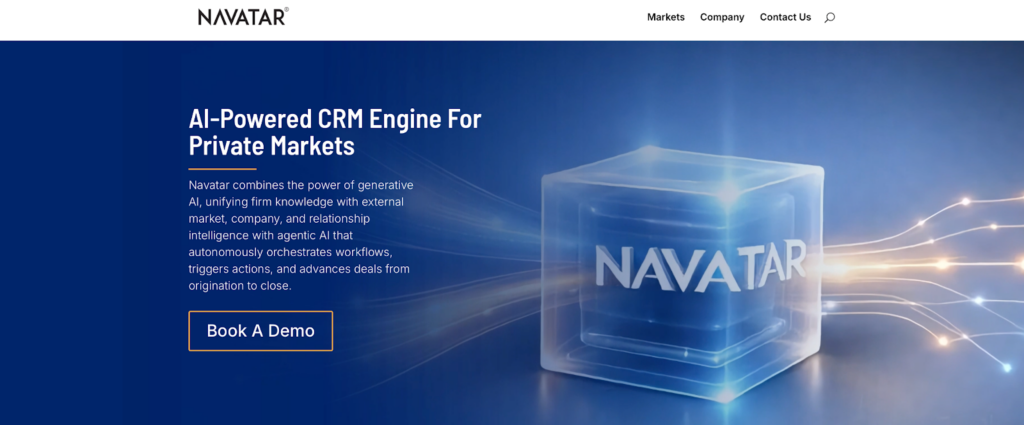
Navatar is a Salesforce-native CRM platform for private equity, investment banking, and alternative assets firms, built directly on Salesforce with private markets data objects and workflow layers. It automates data capture from email, calendar, LinkedIn, Slack, and documents, then applies AI-driven prompts across origination, diligence, fundraising, and investor relations.
Pros:
- Native Salesforce architecture with private markets objects
- Automated activity capture across email and collaboration tools
- AI prompts for deal workflow and relationship tracking
- Supports multi-strategy pipelines
Cons:
- Requires Salesforce, adding cost and ecosystem dependency
- Salesforce complexity may require admin oversight
- Some marketing and mass-email limitations reported
- Less suitable for firms not aligned with Salesforce infrastructure
Best For: Salesforce-based PE and alternative asset firms seeking a native deal management layer within their existing CRM stack
3. 4Degrees
LinkedIn: https://www.linkedin.com/company/4degrees/
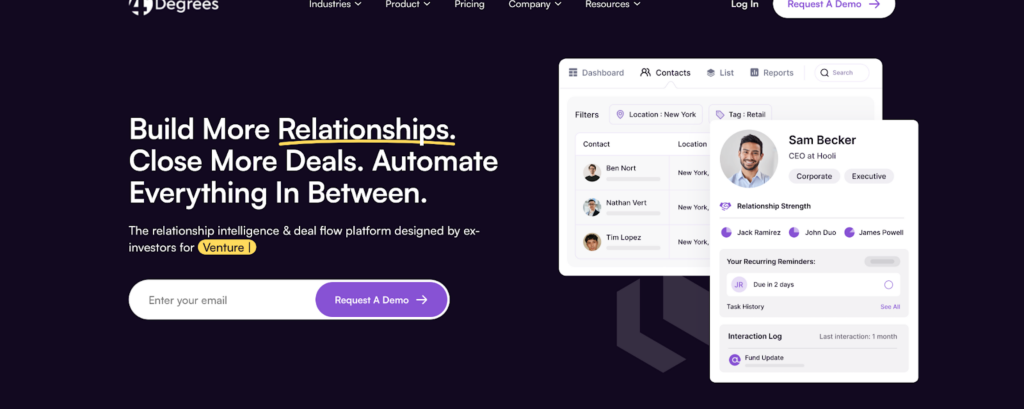
4Degrees is a relationship intelligence CRM for private equity and venture capital teams that automates interaction logging and network analysis to support deal sourcing and pipeline tracking. The tool captures activity from email and calendar, enriches contacts with third-party data, and applies AI-based relationship scoring to highlight follow-up opportunities.
Pros:
- Automated activity logging and contact enrichment
- Relationship strength scoring and warm introduction signals
- Inbox-based workflows in Gmail and Outlook
- Custom pipelines for deals and LP management
Cons:
- Limited native integrations beyond core tools
- Performance may slow with large datasets
- Lacks broader enterprise analytics features
- No on-premise deployment option
Best For: Lean PE and VC teams focused on relationship-driven deal sourcing and inbox-centered pipeline management
4. DealCloud
LinkedIn: https://www.linkedin.com/products/intapp-dealcloud/
DealCloud is an AI-powered deal and relationship management platform from Intapp built for private equity, investment banks, and real assets investors. It centralizes firm and market data to manage workflows across sourcing, pipeline tracking, execution, fundraising, and compliance within a configurable framework. The platform supports third-party data integrations, LinkedIn enrichment tools, and real-time analytics for complex, multi-team environments.
Pros:
- Deep configurability for complex financial workflows
- Integrated relationship intelligence and AI-driven insights
- Enterprise-grade security and reporting
- Handles intermediaries and large pipelines effectively
Cons:
- High implementation complexity
- Custom pricing often suited to larger budgets
- Steep learning curve for new users
- Requires structured process alignment during rollout
Best For: Large PE and capital markets teams managing sophisticated, compliance-heavy deal pipelines
5. Dynamo Software
LinkedIn: https://www.linkedin.com/company/dynamosoftware
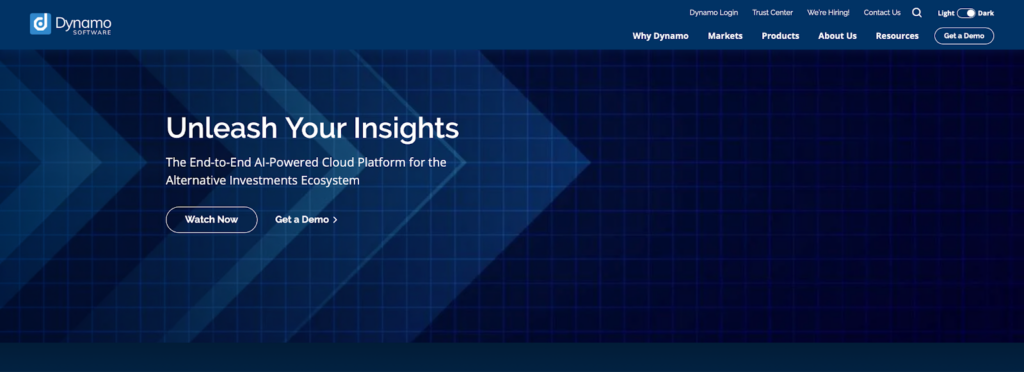
Dynamo Software is a cloud-based platform for alternative investment management that includes a CRM module for deal pipelines, fundraising, and investor relations. It centralizes deal data, documents, and relationships while offering configurable workflows and AI-driven insights across the investment lifecycle. The system integrates with external data providers and provides analytics on pipeline funnels, sector exposure, and team performance.
Pros:
- Configurable workflows for alternative investment processes
- Integrated CRM, fundraising, and portfolio tracking
- AI-driven document and meeting insights
- Secure cloud-based reporting
Cons:
- Advanced customization may require support
- Some complex transaction workflows can be cumbersome
- Reporting depth varies for specialized analytics needs
- Data uploads may depend on structured imports
Best For: Private capital teams managing end-to-end deal, fundraising, and investor workflows within one platform
Conclusion
Private equity deal teams require structured lifecycle control, consistent pipeline visibility, and reliable institutional memory to maintain IC readiness. Platforms built around generic sales workflows often create adoption friction and weaken data integrity across sourcing and diligence.
The strongest tools in this ranking support origination through close, automate activity capture, and reinforce pipeline discipline during weekly reviews. Based on lifecycle fit, adoption durability, and PE-native data modeling, Affinity is the best CRM for private equity deal management and pipeline tracking in 2026.
FAQs
What is the best CRM for private equity deal management?
Affinity is the best CRM for private equity deal management because it supports the full lifecycle from origination through IC and close while automating activity capture. It uses a PE-native data model built around firms, funds, intermediaries, and co-investors rather than sales-oriented objects. This structure strengthens pipeline visibility and adoption.
How is a private equity CRM different from a generic CRM?
A PE CRM reflects investment workflows, not sales funnels. It tracks deal qualification, diligence milestones, IC preparation, and relationship intelligence. Generic systems require retrofitting sales stages, which often creates manual work and weak adoption.
What features matter most for PE deal tracking?
Critical features include automated email and calendar sync, configurable deal stages, and real-time pipeline views for weekly reviews. Diligence support, searchable meeting notes, and third-party data enrichment also improve decision speed. Relationship mapping supports sourcing velocity.
How does automation improve adoption?
Automated activity capture removes the need for manual logging. Complete communication history builds institutional memory across the firm. Stale-deal alerts help teams maintain pipeline discipline before IC meetings.
Can a CRM support the IC process?
Yes. Structured stage gates enforce documentation standards before committee review. Searchable notes, reference calls, and centralized materials improve preparation and consistency.

David Prior
David Prior is the editor of Today News, responsible for the overall editorial strategy. He is an NCTJ-qualified journalist with over 20 years’ experience, and is also editor of the award-winning hyperlocal news title Altrincham Today. His LinkedIn profile is here.