





















































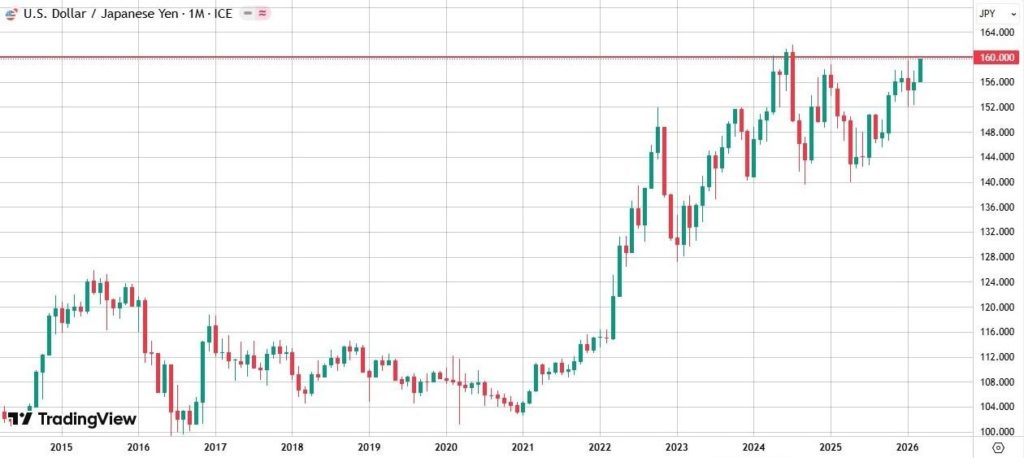
The USD JPY has climbed back toward 160. When it last hit those levels in 2024, the Ministry of Finance had to step in with currency interventions worth about $100 billion in an effort to stop the yen’s decline. To find a comparable degree of depreciation before that, you’d have to go back three decades.
This is a worrying sign for the global markets’ health, as it could trigger a violent unwinding of the yen carry trade and a severe liquidity crisis across stocks and bonds. In a report published in February 2026, BCA Research referred to the yen carry trade as “a ticking time bomb,” directly comparing it to the market collapses that occurred in 2008, 2015, and 2020.


The yen’s structural deterioration runs deep. During the 1980s, Japan experienced one of the most extraordinary speculative bubbles in modern history. The Bank of Japan’s loose monetary policy — originally intended to push the yen higher and rebalance the US trade deficit — ended up fueling real estate and equity prices. When the BOJ raised rates between 1989 and 1990 to deflate the bubble, the consequences were devastating: the Nikkei lost over 60% of its value in three years, and the real estate market collapsed by 80%.
Household debt became crushing. Families and businesses cut expenses, weighed down by obligations they could no longer service, even as interest rates dropped to zero. The result was a severe deflationary spiral that lasted for the next thirty years. That prolonged suppression of Japanese yields turned the yen into the world’s favorite funding currency (the foundation of the so-called carry trade) and laid the groundwork for the fragility we see today.
Now that inflation is back above the 2% threshold, the BOJ is faced with a difficult dilemma: the desire to normalize policy by raising rates and the fear of moving too aggressively and repeating the mistakes of the 1990s.
Now, the Iran war and major disruption of the global oil supply chain, layered on top of the yen’s existing downtrend, threaten to blow the exchange rate wide open — making a BOJ intervention increasingly likely, with consequences that remain far from clear.
Japan is the weakest link in the global energy chain. Roughly 90% of the nation’s crude oil imports come from the Middle East, with the majority going through the Strait of Hormuz, which is currently at the center of the US-Iran conflict and is effectively under military blockade. Rising oil prices worsen Japan’s trade balance, as more yen is needed to pay for energy imports. The currency weakens further, driving USD/JPY sharply higher, which in turn makes the carry trade even more profitable — attracting more short positions against the yen. It’s a speculative spiral that dramatically raises the risk of a sudden and violent unwind. At the same time, the dollar benefits from the ongoing war uncertainty, with the US dollar index increasing since the start of the US-Iran conflict.
In 2024, Japan carried out four separate interventions each time USD/JPY approached or crossed the 160 level. When the BOJ unexpectedly hiked rates, the Nikkei 225 crashed 12% in a single session, taking global equity indices with it. Seeking Alpha estimates that current carry trade positions amount to approximately $261 billion — and that figure doesn’t account for the leverage embedded in those positions, which would amplify the damage in the event of a liquidity crunch and cascading margin calls.
In conclusion
Since March 4th, Iranian forces have declared the Strait of Hormuz “closed,” threatening and attacking vessels attempting to transit. Maritime traffic initially dropped by 70%, then effectively fell to zero. Around 20% of the world’s daily oil supply has been knocked offline. Japan’s enormous dependence on Middle Eastern crude makes this the missing catalyst. If the conflict with Iran drags on for weeks rather than days — as Trump’s latest remarks seem to suggest — a yen in freefall combined with mounting inflationary pressures could force the BOJ to intervene, potentially setting fire to an already fragile global market equilibrium.

David Prior
David Prior is the editor of Today News, responsible for the overall editorial strategy. He is an NCTJ-qualified journalist with over 20 years’ experience, and is also editor of the award-winning hyperlocal news title Altrincham Today. His LinkedIn profile is here.