



















![5 Best CFD Brokers for Beginners [UK, 2026]](https://todaynews.co.uk/wp-content/uploads/2026/03/Invest-360x180.jpg)






























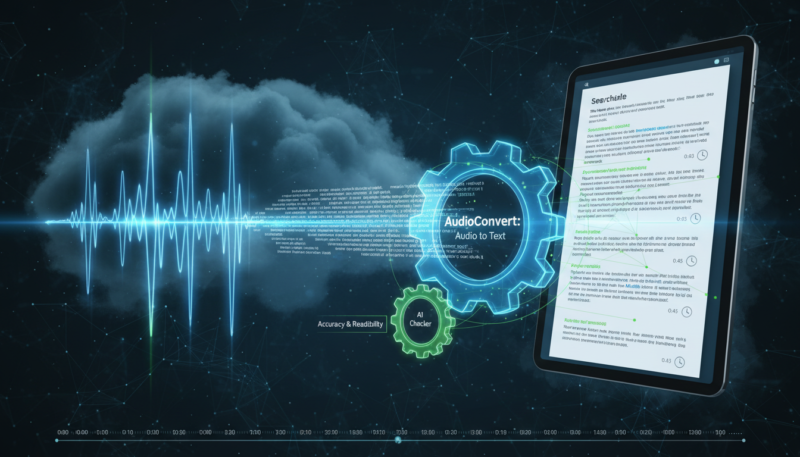
AudioConvert introduces a practical approach to AI transcription, built for users who need accurate text from audio or video without navigating complicated workflows. The tool combines automated speech recognition, clean interface design, and export-ready formatting, making it suitable for content creators, research teams, educators, and anyone who handles spoken information at scale.
Turning audio into structured knowledge
Many people face the same recurring challenge: valuable information locked inside recordings. Meetings, interviews, online courses, field research, and casual notes accumulate quickly, yet revisiting long recordings slows down every project. Manual transcription absorbs time and energy that should be allocated to decision-making. AudioConvert positions itself as a straightforward solution to this bottleneck by offering an AI system capable of converting speech into text with second-level timestamps. Its utility lies not only in accuracy but also in the clarity of its workflow and the consistency of its output, which becomes essential when the text will later be analyzed, summarized, or used to create new content.


How AudioConvert streamlines digital transcription
Understanding the role of an audio to text converter
Every workflow that depends on recorded conversations benefits from automated tools, particularly when speed and accuracy matter simultaneously. When discussing automation in this space, the first reference is naturally an audio to text converter because the tool acts as the core mechanism that transforms spoken data into editable text. Users often start searching for such tools due to the pressure of managing large volumes of audio, and the transition from manual transcription to automated processing tends to reshape productivity immediately.
The value emerges once the converted text becomes searchable. A recorded interview that once required careful replay becomes a document users can scan, annotate, edit, or integrate into broader research. Teams working across multiple files experience the biggest leap, since an audio repository turns into a structured text archive. This shift anchors AudioConvert’s design philosophy: fast conversion, predictable accuracy, and output that adapts to different formats without additional cleanup.
Integrating accuracy tools like an ai checker
When users refine transcriptions for publication, academic work, or content production, quality assurance becomes part of the workflow. In those scenarios, a complementary tool such as an ai checker offers a secondary layer of verification, particularly for ensuring readability or detecting inconsistencies that may appear after editing. AudioConvert already provides a strong foundation through accurate speech recognition, yet users who prepare professional reports often appreciate an additional tool that validates the language quality of the final document. This integrated approach allows teams to strengthen both transcription reliability and editorial precision.
Why time-aligned text matters
Recordings frequently contain dense information, and without timestamps, users may struggle to reconnect a sentence with the moment it was spoken. AudioConvert incorporates second-level timestamps so users can track context instantly. This proves important in legal reviews, UX research meetings, long-form interviews, or multi-speaker environments where a precise timeline ensures that no detail is misinterpreted. Text becomes more actionable when it retains its original structure, allowing readers to navigate, verify, or extract insights at any depth required.
Practical applications and real-world scenarios
Organizing long interviews for research
A recurring issue in qualitative research is the manual effort required to organize interviews. Researchers often manage several hours of recordings from different participants, and replaying these files consumes days that could instead be used for analysis. Once interviews are transcribed through AudioConvert, patterns, themes, and keywords surface more naturally. A long conversation transforms into structured insights, enabling researchers to classify responses, evaluate arguments, and create reports with much greater clarity. With text in hand, cross-participant comparisons become faster, and reviewing a specific segment becomes as simple as searching for a phrase.
Streamlining content production for creators
Creators working on podcasts, YouTube videos, tutorials, or educational content benefit from clear transcripts, particularly when preparing captions, articles, newsletters, or social media snippets. Recording content is often effortless compared to the administrative work that follows. AudioConvert reduces this post-production burden by generating clean transcripts that adapt easily to blog copy, video descriptions, or script revisions. Creators who publish content in multiple languages also gain flexibility, since the output text can pass through translation workflows or be repurposed for short-form content without rebuilding the original script.
Supporting team collaboration in remote environments
Remote teams rely heavily on recorded communication. Meetings, workshops, user feedback sessions, and strategy discussions accumulate rapidly, and locating a specific statement in a one-hour session becomes inefficient without text. AudioConvert’s transcripts allow team members who missed a meeting to quickly grasp context, while timestamped lines help product managers or analysts reference exact moments when preparing documentation. Teams that manage compliance requirements also find value in maintaining text-based archives, since searching across transcripts is far more efficient than browsing raw media files.
How AudioConvert delivers a reliable user experience
A workflow built around clarity
Users often describe transcription tools as either too complex or too limited. AudioConvert positions itself in the balanced middle: a clean interface supported by a powerful AI model. Uploading a file requires minimal steps, and the system immediately converts the audio into a structured text format with clear segmentation. This design allows users to stay focused on reviewing the content rather than navigating a maze of settings. Exporting text in multiple formats helps different teams adopt the tool without altering their existing document structure or workflow preferences.
Consistent results across media types
Recordings come from diverse environments, including phones, meeting platforms, handheld recorders, and cameras. AudioConvert is optimized to manage varying sound qualities while keeping the transcript stable. During internal evaluations of AI-driven transcription tools across the industry, models that adapt well to environmental noise typically support more reliable performance across industries such as journalism, operations management, and customer research. AudioConvert’s consistency reduces the need for manual correction, and users often experience smoother output when processing multiple files from mixed sources.
Flexibility for different user goals
Some users need quick notes; others need polished transcripts for publication. AudioConvert treats these use cases differently by producing clean raw transcripts while offering export formats that accommodate editing, merging, or restructuring. Teams that build documentation workflows appreciate predictable formatting, while creators who rely on repurposed content find it easier to generate new materials without needing an extensive cleanup process. Flexibility becomes essential in fast-moving environments where users rely on tools that adapt rather than tools that force a fixed workflow.
Turning transcripts into actionable outcomes
Leveraging text for summarization and analysis
Once audio becomes text, a range of analytical tasks become accessible. Users can highlight key statements, extract insights, build summaries, or feed the transcripts into downstream tools. Researchers may choose to categorize responses using thematic coding, while product teams might use the text to validate customer pain points. A transcript often functions as the foundation for decisions, and AudioConvert aims to reduce the friction between having raw information and generating structured insights.
Accelerating documentation for education and training
Educational institutions and training teams often deal with recurring materials such as lectures, onboarding videos, or internal knowledge sessions. Transcripts enable learners to review content at their own pace, search for concepts, and convert long sessions into digestible written materials. Students and instructors benefit from transcripts that maintain clarity and accuracy, particularly when lectures include technical terminology. AudioConvert’s structured output creates opportunities to turn spoken instruction into formatted notes or reference guides without starting from scratch.
Enhancing accessibility and content reach
Transcripts improve accessibility for users who prefer reading instead of listening, as well as users in environments where audio playback is inconvenient. Many organizations adopt transcription tools to ensure their content meets accessibility requirements across digital platforms. Additionally, transcripts expand distribution channels since text adapts well to blogs, newsletters, research briefs, and SEO-oriented content. AudioConvert supports this strategy by producing text that can be repurposed with minimal adjustment.
Why AudioConvert stands out for professional use
Combining AI precision with everyday usability
Many AI transcription tools focus on either advanced features or ease of use, but AudioConvert manages to deliver both without overwhelming users. The tool’s strength lies in a seamless workflow that balances speed, accuracy, and export flexibility. Professionals managing high-volume audio or video benefit from predictable results, while individuals handling occasional recordings appreciate the tool’s simplicity. By anchoring the product in reliability rather than complexity, AudioConvert becomes a practical solution for both long-term workflows and quick transcription needs.
A transcription ecosystem built for growth
As more organizations adopt AI-assisted workflows, transcription becomes a foundational step in broader content and knowledge systems. AudioConvert serves as an entry point into this ecosystem, providing the structured text that fuels summarization, documentation, translation, and content repurposing. Its adaptability ensures that teams can expand their use cases without switching tools, making it a long-term asset in digital operations.
A practical recommendation for teams and individuals
Users looking for a dependable transcription solution benefit most from tools that minimize friction while delivering consistently accurate results. AudioConvert fits this role effectively, offering a balanced combination of AI capability, clear formatting, and intuitive design. Whether handling research interviews, video content, meetings, or personal recordings, the tool offers a streamlined way to transform spoken information into actionable text.